More or less the defining film of a generation, The Breakfast Club is also the only John Hughes film I’ve yet seen that can maybe pass as decent and inoffensive. The latter characteristic, though, is probably only true because the film doesn’t have any minorities in it.
The Breakfast Club defines a generation because the ‘80s was the last time in which someone could make a film like this and only have white people in it. If it were made today there would be a black hip-hip loving b-boy, a skater / druggie, a smart Asian kid, a misunderstood Hispanic girl and an average Joe white guy. I’ll leave the question of whether the ethnic sameness of the film is a good or bad thing to people who care to write more than a couple hundred words about what I consider to be only a decent film. I only mention it because it’s fascinating to watch a film from the not too distant past that plays so much like a relic from a bygone time. My generation and probably all the ones following it, couldn’t accept such a whitewashed cast in a film that is so clearly meant to speak for a generation. I guess it really shows how much difference there is between generations despite the relative proximity in age.
Saturday, July 14, 2007
Wednesday, July 11, 2007
TRANSFORMERS – michael bay – 2.9 / 10
Whatever derogatory or negative things I or likeminded critics might have said about past Michael Bay films, it was undeniable that the man could direct an action sequence. No matter how racist or misogynist the larger movie was, when things started blowing up and racing around the screen, all critical faculties were momentarily short-circuited and the film became fun and exciting, if only for a fleeting moment.
But a curious thing has happened since the days of Bad Boys and The Rock, Michael Bay became a “better” director. The goal of most good directors is to incorporate the themes and aesthetic concerns of the film as a whole into every scene, thus creating a cohesive work that speaks to something specific about the human condition. (That’s a little overblown but you get the idea.) Good directors do this in every scene. Hack directors do it only once in a while. Michael Bay used to be a hack director, content to fling his racist, anti-feminist, borderline fascist beliefs only in a few keys moments. Thus, while The Rock is mostly garbage, the occasionally decent, subtext-free scene sneaks into the film and provides a respite from the rampant conservative agenda in evidence throughout the rest of the film.
Not so anymore. From Bad Boys II to The Island and now with Transformers, Michael Bay has managed to push his horrific social agenda into every corner of the film, leaving no sequence safe from his barbaric worldview. Take, for instance, the sequence in Transformers in which a Decepticon springs from the desert and attacks the heroic band of US soldiers that survived an earlier attack and are now trying to alert the officers back home to the danger coming their way. A younger Michael Bay might have been content to film a “bitchin’” battle sequence full of slow motion low-angle shots and lights streaming into the camera and call it a day. But the new Michael Bay finds time to insert a horrible, unfunny, racist aside about the foreign workers who, having stolen jobs from Americans, are now too lazy to do those jobs properly.
Leaving aside that this scene sucks all the air out of the larger sequence (thus destroying most of its tension) and is terrible filmmaking besides, the issue of outsourcing is so multi-faceted and difficult that a much better filmmaker than Bay could make a whole film about it and never quite get a handle on it. To think that he could say something meaningful and humorous in a few seconds is the height of Bay’s arrogance. And though he never quite reaches those lofty heights again, each of the action sequences in Transformers is saddled with an equally unfunny and racist or misogynist “joke.”
Though I can’t speak to Bay’s intentions in making this film, it seems likely that the more science fiction aspects of the Transformers were never a big draw for him. And maybe that explains the terribly convoluted and not convincing in the least plot machinations of the film. Maybe it even explains what the hell an Australian analyst character is even doing in the film (since she does nothing more than re-explain to an already overwhelmed audience something they have either already grasped or don’t care about anyway). Either way, Bay clearly has no idea what to do in the scenes where things aren’t blowing up or whizzing around. And that’s bad because this film, more than any other Bay film before it, spends an awful lot of time listening to people and machines yammer away at each other.
And yeah, the giant robots from space talk. And they don’t use speakers; they actually have mouths. And lips. And horribly cliché voices they’ve picked up from TV and the internet.
I understand, of course, that these robots have to do a little explaining to the humans but the extended planning sequence when the Autobots first reveal themselves to the humans is just laughable. They all have cutesy names like Bumblebee and Ratchet and Jazz. And they bicker and tease like a bunch of fourteen year-olds. It’s pathetic really.
To make matters worse, this scene is followed almost immediately by a scene in which the five thirty foot tall robots try to hide from the hero’s parents while they question him about masturbation and peek out the windows to check on the geraniums. The sight of the mighty Autobots crouching under a porch awning while a middle-aged woman takes to her son about his “happy time” is more than my childhood memories can take. Even if the sequence didn’t betray everything that Bay was trying to say about the awesome power of these robots, it would still have betrayed a fond childhood memory. That level of awfulness is a feat to be sure, just one I’d rather not pay money to be subjected to.
From that point on the film completely collapses in on itself. There is no logic (internal or external) to anything that happens. Plotlines are abandoned with no resolution (what happened to the Mountain Dew machine that was turned into a crazy killing robot by the All Spark (ugh) and why did it turn into a killing machine in the first place?). Things happen that make no sense (why can’t Bumblebee, after he loses his legs, transform into a smaller version of himself with legs?). A lot more stuff blows up. Lights shine into the camera lens. People walk towards the camera in slow motion. The end.
But a curious thing has happened since the days of Bad Boys and The Rock, Michael Bay became a “better” director. The goal of most good directors is to incorporate the themes and aesthetic concerns of the film as a whole into every scene, thus creating a cohesive work that speaks to something specific about the human condition. (That’s a little overblown but you get the idea.) Good directors do this in every scene. Hack directors do it only once in a while. Michael Bay used to be a hack director, content to fling his racist, anti-feminist, borderline fascist beliefs only in a few keys moments. Thus, while The Rock is mostly garbage, the occasionally decent, subtext-free scene sneaks into the film and provides a respite from the rampant conservative agenda in evidence throughout the rest of the film.Not so anymore. From Bad Boys II to The Island and now with Transformers, Michael Bay has managed to push his horrific social agenda into every corner of the film, leaving no sequence safe from his barbaric worldview. Take, for instance, the sequence in Transformers in which a Decepticon springs from the desert and attacks the heroic band of US soldiers that survived an earlier attack and are now trying to alert the officers back home to the danger coming their way. A younger Michael Bay might have been content to film a “bitchin’” battle sequence full of slow motion low-angle shots and lights streaming into the camera and call it a day. But the new Michael Bay finds time to insert a horrible, unfunny, racist aside about the foreign workers who, having stolen jobs from Americans, are now too lazy to do those jobs properly.
Leaving aside that this scene sucks all the air out of the larger sequence (thus destroying most of its tension) and is terrible filmmaking besides, the issue of outsourcing is so multi-faceted and difficult that a much better filmmaker than Bay could make a whole film about it and never quite get a handle on it. To think that he could say something meaningful and humorous in a few seconds is the height of Bay’s arrogance. And though he never quite reaches those lofty heights again, each of the action sequences in Transformers is saddled with an equally unfunny and racist or misogynist “joke.”
Though I can’t speak to Bay’s intentions in making this film, it seems likely that the more science fiction aspects of the Transformers were never a big draw for him. And maybe that explains the terribly convoluted and not convincing in the least plot machinations of the film. Maybe it even explains what the hell an Australian analyst character is even doing in the film (since she does nothing more than re-explain to an already overwhelmed audience something they have either already grasped or don’t care about anyway). Either way, Bay clearly has no idea what to do in the scenes where things aren’t blowing up or whizzing around. And that’s bad because this film, more than any other Bay film before it, spends an awful lot of time listening to people and machines yammer away at each other.
And yeah, the giant robots from space talk. And they don’t use speakers; they actually have mouths. And lips. And horribly cliché voices they’ve picked up from TV and the internet.
I understand, of course, that these robots have to do a little explaining to the humans but the extended planning sequence when the Autobots first reveal themselves to the humans is just laughable. They all have cutesy names like Bumblebee and Ratchet and Jazz. And they bicker and tease like a bunch of fourteen year-olds. It’s pathetic really.
To make matters worse, this scene is followed almost immediately by a scene in which the five thirty foot tall robots try to hide from the hero’s parents while they question him about masturbation and peek out the windows to check on the geraniums. The sight of the mighty Autobots crouching under a porch awning while a middle-aged woman takes to her son about his “happy time” is more than my childhood memories can take. Even if the sequence didn’t betray everything that Bay was trying to say about the awesome power of these robots, it would still have betrayed a fond childhood memory. That level of awfulness is a feat to be sure, just one I’d rather not pay money to be subjected to.
From that point on the film completely collapses in on itself. There is no logic (internal or external) to anything that happens. Plotlines are abandoned with no resolution (what happened to the Mountain Dew machine that was turned into a crazy killing robot by the All Spark (ugh) and why did it turn into a killing machine in the first place?). Things happen that make no sense (why can’t Bumblebee, after he loses his legs, transform into a smaller version of himself with legs?). A lot more stuff blows up. Lights shine into the camera lens. People walk towards the camera in slow motion. The end.
Sunday, June 10, 2007
TUCKER: THE MAN AND HIS DREAM – francis ford coppola – 4.8 / 10
It’s somewhat pointless and borderline foolhardy to pyschoanalyze a director through his work. That being said, there have to be some conclusions about Francis Ford Coppola’s state of mind that can be drawn from his work in the 1980s. Tucker: The Man and His Dream is the last in a line of films that sees Coppola retreating into the golden hued remembered (rather than realistic) past to tell a story about families (actual or surrogate) realizing how good they have it and pulling together when the chips are down.
From The Outsiders (and Rumble Fish) to Peggy Sue Got Married, Gardens of Stone and Tucker, every single one of Coppola’s films in the eighties is set in the past. And as you watch each of these films you can’t help feeling that Coppola is retreating into some idealized version of his early life. Added to that, his greatest successes (The Godfather films) were set in the past so it’s likely that he felt comfortable there (and that he didn’t have to try very hard to convince studio executives to back these films).
Making period films exclusively is not in and of itself cause for concern, of course. It’s just that the dark and dangerous undercurrent that runs through his earlier films has been entirely scrubbed clean leaving only the burnished amber glow of a time that only ever existed in people’s memories. Whereas The Godfather was a stylized and somewhat theatrical version of a period in history that, through its stylization, achieves timelessness, Tucker is theatrical and stylized in an artificial way that all but defeats the audience’s attempts at identification with this man and his dream.
More troubling than that, however, is the indication, gleaned from bonus materials and commentary tracks, that Coppola, in his post-70's output, cared as much or more about the atmosphere on set than about the film that he was exposing. All of the DVDs of those 1980s films mentioned above are full of actors talking rapturously about the nurturing atmosphere of a Coppola set. They talk about how wonderful a time they had and how much they learned. It’s as if, after the disaster that was the making of Apocalypse Now, Coppola decided that filmmaking wasn’t worth it if the people involved were going to hate every minute of it.
Thus the film that was actually being made ceased to be the sole purpose of a Coppola shoot. The enjoyment of the process by the cast and crew became almost as important as the finished film itself. And thus the finished film became hopelessly compromised.
It’s not necessary that a film set be a tyrannical environment in which all manner of hardship has to be endured for the sake of the finished product. But it is required that, when called for, individual sacrifices in comfort and pleasure be made for the good of the film. Without occasional hardship (overwork, multiple takes in the rain, etc.) the film becomes irretrievably compromised. And that’s what Coppola’s 1980s output is, compromised.
From The Outsiders (and Rumble Fish) to Peggy Sue Got Married, Gardens of Stone and Tucker, every single one of Coppola’s films in the eighties is set in the past. And as you watch each of these films you can’t help feeling that Coppola is retreating into some idealized version of his early life. Added to that, his greatest successes (The Godfather films) were set in the past so it’s likely that he felt comfortable there (and that he didn’t have to try very hard to convince studio executives to back these films).
Making period films exclusively is not in and of itself cause for concern, of course. It’s just that the dark and dangerous undercurrent that runs through his earlier films has been entirely scrubbed clean leaving only the burnished amber glow of a time that only ever existed in people’s memories. Whereas The Godfather was a stylized and somewhat theatrical version of a period in history that, through its stylization, achieves timelessness, Tucker is theatrical and stylized in an artificial way that all but defeats the audience’s attempts at identification with this man and his dream.
More troubling than that, however, is the indication, gleaned from bonus materials and commentary tracks, that Coppola, in his post-70's output, cared as much or more about the atmosphere on set than about the film that he was exposing. All of the DVDs of those 1980s films mentioned above are full of actors talking rapturously about the nurturing atmosphere of a Coppola set. They talk about how wonderful a time they had and how much they learned. It’s as if, after the disaster that was the making of Apocalypse Now, Coppola decided that filmmaking wasn’t worth it if the people involved were going to hate every minute of it.
Thus the film that was actually being made ceased to be the sole purpose of a Coppola shoot. The enjoyment of the process by the cast and crew became almost as important as the finished film itself. And thus the finished film became hopelessly compromised.
It’s not necessary that a film set be a tyrannical environment in which all manner of hardship has to be endured for the sake of the finished product. But it is required that, when called for, individual sacrifices in comfort and pleasure be made for the good of the film. Without occasional hardship (overwork, multiple takes in the rain, etc.) the film becomes irretrievably compromised. And that’s what Coppola’s 1980s output is, compromised.
Wednesday, June 6, 2007
ROAD HOUSE – rowdy herrington – 3.5 / 10
The only enjoyment to be found in the film is derived solely from seeing Patrick Swayze at his Swayze-est. As the best bouncer in the state who also holds a degree in philosophy, Swayze’s character in Road House is the idealized 80's man. And he could only have been played by Patrick Swayze in a rolled up t-shirt and the tightest pair of Jordaches he could find. Unfortunately, once you get past the initial they-can’t-really-be-serious reaction, there’s not much else to hold your attention. It’s amusing for a while but eventually, even Swayze in a pompadour with a shaved chest and oiled up torso, just stops being amusing and starts being sad. And when that happens, there’s just nothing left of to hold your interest. Certainly not the plot or the onscreen action, which is utterly ludicrous. So, if you must watch this film, watch half an hour, have a few laughs then put on Rumble Fish.
Tuesday, June 5, 2007
THE COTTON CLUB – francis ford coppola – 4.5 / 10
The plot of this film must have sounded really good on paper, concerning as it does the events surrounding some legendary gangsters in Harlem in the 1930s. There’s lots of fights and shoot-outs and sex and yelling. But, for some unknown reason, there’s also lots and lots of tap dancing. Though the tap dancing does eventually relate to the violence, the two separate tones of the film never align to form a coherent story.
Further, many of the scenes in the gangster world are undercut by the terrible performance of Nicholas Cage (his first of many in Coppola’s films). I don’t understand why, when the acting in the Godfather films and in Apocalypse Now and The Conversation is pitch perfect, that the acting in Coppola’s 80's output should be so screechingly awful. I can understand getting lazy in terms of storytelling and direction, choosing easy plot devices and boring camera angles. But how do you suddenly lose your eye for good acting? How can you see what makes a good performance one decade and not be able to see it in the next? That just blows my mind. And unfortunately the chief offender in these films tend to be members of Coppola’s own family. His daughter, so legendarily bad in the third Godfather also torpedoes every scene she is in Peggy Sue Got Married. And Nicholas Cage (Coppola’s nephew) takes three films to figure out that you don’t have to bounce off the walls to get noticed.
But I could forgive all that, really, if the direction of these films wasn’t so very lazy. Whenever possible, Coppola will shoot a scene in one angle (and not in a particularly compelling angle). And if it’s a dialogue scene, it looks as if he just parks a couple cameras on sticks and has the actors do their things. From what little I know about the man, it would seem that the atmosphere on the set and the cast and crew’s experience making the film became more important to him than the finished film itself. Sacrifices must be made to make a good film. People have to work longer hours than they might like, have to perform a difficult scene more than a few times, have to do elaborate technical set-ups to make a good film. But all of those things make the experience less fun for the people involved. So a director has to weigh his choices, make a good film and hurt a few feelings or make a mediocre film and have everyone love you. I guess after Coppola almost killed himself, his crew and his cast making Apocalypse Now, he decided he’d rather everyone have fun and let the film take care of itself. And that’s a damn shame because that’s the easy way out and it robbed cinema of one of its most talented artists.
Further, many of the scenes in the gangster world are undercut by the terrible performance of Nicholas Cage (his first of many in Coppola’s films). I don’t understand why, when the acting in the Godfather films and in Apocalypse Now and The Conversation is pitch perfect, that the acting in Coppola’s 80's output should be so screechingly awful. I can understand getting lazy in terms of storytelling and direction, choosing easy plot devices and boring camera angles. But how do you suddenly lose your eye for good acting? How can you see what makes a good performance one decade and not be able to see it in the next? That just blows my mind. And unfortunately the chief offender in these films tend to be members of Coppola’s own family. His daughter, so legendarily bad in the third Godfather also torpedoes every scene she is in Peggy Sue Got Married. And Nicholas Cage (Coppola’s nephew) takes three films to figure out that you don’t have to bounce off the walls to get noticed.
But I could forgive all that, really, if the direction of these films wasn’t so very lazy. Whenever possible, Coppola will shoot a scene in one angle (and not in a particularly compelling angle). And if it’s a dialogue scene, it looks as if he just parks a couple cameras on sticks and has the actors do their things. From what little I know about the man, it would seem that the atmosphere on the set and the cast and crew’s experience making the film became more important to him than the finished film itself. Sacrifices must be made to make a good film. People have to work longer hours than they might like, have to perform a difficult scene more than a few times, have to do elaborate technical set-ups to make a good film. But all of those things make the experience less fun for the people involved. So a director has to weigh his choices, make a good film and hurt a few feelings or make a mediocre film and have everyone love you. I guess after Coppola almost killed himself, his crew and his cast making Apocalypse Now, he decided he’d rather everyone have fun and let the film take care of itself. And that’s a damn shame because that’s the easy way out and it robbed cinema of one of its most talented artists.
Wednesday, May 9, 2007
ONE FROM THE HEART – francis coppola – 3.9 / 10
This is by no means a good film. However, having seen it I wouldn’t hesitate to offer Francis Coppola (as he’s billed here) just about anything else to direct. It’s clear from the first frames of the film that there is someone with real talent behind this film. Almost every scene’s master shot is a winding, circuitous tour de force. And once the couple at the heart of the film splits up, there are glorious transitions between their now separate lives that simultaneously show how close they still are and how distant they've become.
Additionally, the way the sets and tone of the film are constructed create a comprehensive magical realist world unlike anything I’ve seen before. Lights change color and fade away during shots. People burst into song in the middle of the street and everyone joins in. Everything is just magical.
But that bit about bursting into song hints at the film’s major problem, namely that it’s a more or less a musical and I mostly hate musicals. That’s especially true if most of the songs are sung by Tom Waits, a musician I simply cannot stand. Some people find some sort of magic in his gravelly voice but all I hear are nails on a chalkboard.
The music stuff isn’t the only problem with the film, however. The events of the film (a break up and subsequent (completely predictable) reconciliation) are not believable in the least. True, the whole world of the film is unbelievable but the idea that a woman would break up with her boyfriend then, on the same day, meet a guy (who lies to her with the very first words he utters) and go to bed with him and then agree to go to Bora Bora with him the following morning is ludicrous. There’s also the moment where the girl tries to make her boyfriend jealous by saying she wanted to sleep with his ridiculously ugly best friend. And then the guy meets a girl who sees that he’s still in love with his girlfriend but decides to sleep with him anyway.
The reason this stuff ruins the film is because magical realism needs to be grounded in character reality in order to be effective. Take something like Punch-Drunk Love as an example. The only way the more ridiculous elements can work is if they're offset by the realistic interactions between the people involved. This film doesn’t do that and suffers because of it. Overall, though, the film is a showcase for Coppola’s nascent talent. And I guess some other people noticed too because he got to direct The Godfather not too long after this.
Additionally, the way the sets and tone of the film are constructed create a comprehensive magical realist world unlike anything I’ve seen before. Lights change color and fade away during shots. People burst into song in the middle of the street and everyone joins in. Everything is just magical.
But that bit about bursting into song hints at the film’s major problem, namely that it’s a more or less a musical and I mostly hate musicals. That’s especially true if most of the songs are sung by Tom Waits, a musician I simply cannot stand. Some people find some sort of magic in his gravelly voice but all I hear are nails on a chalkboard.
The music stuff isn’t the only problem with the film, however. The events of the film (a break up and subsequent (completely predictable) reconciliation) are not believable in the least. True, the whole world of the film is unbelievable but the idea that a woman would break up with her boyfriend then, on the same day, meet a guy (who lies to her with the very first words he utters) and go to bed with him and then agree to go to Bora Bora with him the following morning is ludicrous. There’s also the moment where the girl tries to make her boyfriend jealous by saying she wanted to sleep with his ridiculously ugly best friend. And then the guy meets a girl who sees that he’s still in love with his girlfriend but decides to sleep with him anyway.
The reason this stuff ruins the film is because magical realism needs to be grounded in character reality in order to be effective. Take something like Punch-Drunk Love as an example. The only way the more ridiculous elements can work is if they're offset by the realistic interactions between the people involved. This film doesn’t do that and suffers because of it. Overall, though, the film is a showcase for Coppola’s nascent talent. And I guess some other people noticed too because he got to direct The Godfather not too long after this.
Friday, May 4, 2007
THE OUTSIDERS – francis ford coppola – 6.9 / 10
Quite possibly the gayest film ever made, Francis Ford Coppola’s The Outsiders concerns the extraordinarily close relationship between a bunch of kids known as greasers who have no parents to speak of. They sleep in the same beds (even spooning!) talking about their hopes for the future and how pretty the sunsets are. They care deeply about each other and do so openly in a way that would never fly these days.
In the documentaries that accompany the film on the DVD release (which is entitled “The Complete Novel” for some reason), everyone talks about how much time and effort the actors put into the process and how great Coppola was in facilitating their performances. From the auditions where all the kids hung out in one room and swapped parts with each other to the weeks they spent taping the scenes from the movie on video before they started filming, everyone is in agreement that this was the most fun, safe and nurturing environment. The thing is, though, that everyone’s performance is laughable. I guess twenty-five years ago people bought the idea that badass kids from the wrong side of the tracks would run around doing cartwheels and back flips and crying at the drop of a hat but that shit don’t fly these days. It’s ridiculous, homoerotic and plain silly.
But I was also thinking as I watched it about the mythologization of juvenile delinquent behavior. How would we feel about this film and book if it were about a bunch of black gangsters?
In the documentaries that accompany the film on the DVD release (which is entitled “The Complete Novel” for some reason), everyone talks about how much time and effort the actors put into the process and how great Coppola was in facilitating their performances. From the auditions where all the kids hung out in one room and swapped parts with each other to the weeks they spent taping the scenes from the movie on video before they started filming, everyone is in agreement that this was the most fun, safe and nurturing environment. The thing is, though, that everyone’s performance is laughable. I guess twenty-five years ago people bought the idea that badass kids from the wrong side of the tracks would run around doing cartwheels and back flips and crying at the drop of a hat but that shit don’t fly these days. It’s ridiculous, homoerotic and plain silly.
But I was also thinking as I watched it about the mythologization of juvenile delinquent behavior. How would we feel about this film and book if it were about a bunch of black gangsters?
Thursday, April 19, 2007
BUFFALO ’66 – vincent gallo – 4.9 / 10
Vincent Gallo is one charismatic dude. At least, I think he is. I’m not really sure. Everyone seems to treat him as if he is (in his own films anyway) so maybe it’s true. Myself, I don’t see it. I just think he’s a dick. He’s more compelling than your average dick but a dick nonetheless.
Let me briefly recap the film for you: Gallo’s character gets out of prison, kidnaps a girl, forces her to come with him to his parents’ house and pretend she’s his fiancé then abandons her at a hotel while he goes off to kill the place kicker for the Buffalo Bills that cost him a bunch of money ten years ago. Even though he doesn’t end up killing the guy, is there anything in that synopsis that would make you think this was a good and decent person?
And that’s not even taking into account his behavior during all this. He is at best recalcitrant and at worst outright belligerent to his parents and to the girl he kidnapped who, for some reason unbeknownst to me, likes this guy. She likes him even though he kidnapped her and treats her like dirt. To me that doesn’t say something about her character, it says something about how Gallo sees himself. Namely that everyone loves him no matter how he behaves towards them.
This film, while it has some interesting camera angles and compelling asides (not to mention a downright thrilling climax), ends up being little more than one man’s extended love letter to himself. It takes a bold, brave artist to put himself in his own film. It takes a fearless artist to make the character he plays in the film unsympathetic and unlikable. And it takes a borderline delusional one to have everyone therein love him. And that, my friends, is Vincent Gallo of Bufflao '66, brave, fearless and delusional.
Let me briefly recap the film for you: Gallo’s character gets out of prison, kidnaps a girl, forces her to come with him to his parents’ house and pretend she’s his fiancé then abandons her at a hotel while he goes off to kill the place kicker for the Buffalo Bills that cost him a bunch of money ten years ago. Even though he doesn’t end up killing the guy, is there anything in that synopsis that would make you think this was a good and decent person?
And that’s not even taking into account his behavior during all this. He is at best recalcitrant and at worst outright belligerent to his parents and to the girl he kidnapped who, for some reason unbeknownst to me, likes this guy. She likes him even though he kidnapped her and treats her like dirt. To me that doesn’t say something about her character, it says something about how Gallo sees himself. Namely that everyone loves him no matter how he behaves towards them.
This film, while it has some interesting camera angles and compelling asides (not to mention a downright thrilling climax), ends up being little more than one man’s extended love letter to himself. It takes a bold, brave artist to put himself in his own film. It takes a fearless artist to make the character he plays in the film unsympathetic and unlikable. And it takes a borderline delusional one to have everyone therein love him. And that, my friends, is Vincent Gallo of Bufflao '66, brave, fearless and delusional.
Tuesday, April 17, 2007
CLICK – frank coraci – 1.0 / 10
Leave it to Adam Sandler and his band of merry men to take what could have been an interesting concept and turn it into an excuse to make dick and fart jokes (literally dick and fart jokes and more than a few sex jokes as well). By making this into as broad a comedy as possible, they turn Click into nothing more than another high concept comedy in which the world contorts itself around in increasing unbelievable ways at the inconvenience of countless other people just so some privileged white guy (usually an architect) can learn to appreciate his life (that is already far better than 99 percent of the rest of the people on the planet). Huzzah.
It’s the same plot that we’ve seen in Sandler’s own Spanglish as well as Bruce Almighty and the recent Breaking and Entering. I guess it’s easier to just make a film like countless others (especially if it’s a proven money maker) but it sucks when they take what could have been a good concept for a serious minded movie and run it straight into the ground.
The most egregious error the filmmakers indulge in here is in making the universal remote ruin Michael’s life in a completely nonsensical and ridiculous way. They have to have things go wrong, of course, since this is that sort of film, but the way they do it is just silly. It involves the remote learning Michael’s “preferences” and then fast forwarding through every future occurrence of something he’s fast forwarded through once (fights with his wife and showers, for instance). Eventually he’s skipping so much of his life that he’s very near the end of it.
The problem with all that, besides the obvious fact that remotes don’t learn preferences and that, even if they did, there would have to be some sort of override control, is that it makes the device the scapegoat. Sure it’s reflecting Michael’s initial choices but after that he’s fighting the remote the whole time. Thus, when Michael is given a second chance at the end of the film (in that tired cop out to end all cop outs: it was all a dream), he really hadn’t changed all that much. Rather than learning to appreciate the little things in life, it’s far more believable that he would just have learned to distrust creepy men with strange haircuts who talk like Christopher Walken.
Add to this nonsense the fact that Michael is, for some reason, a huge dick to a neighbor’s kid (named O’Doyle in a reference to Sandler’s earlier and much funnier though no less puerile Billy Madison) and you get a very disturbing portrait of the man Sandler is playing here. This despite the fact that he’s certainly become aware of his critics’ descriptions of his man-child characters as monsters (witness his attempt to rehab his image in Spanglish and Reign Over Me). He and his band of cohorts are just not smart enough to realize that making Michael a “family man” does not absolve him of his sins. That’s far too subtle a concept to grasp for these Neanderthals. And as long as the filmgoing public at large doesn’t catch on anytime soon, I guess we’ll be stuck with an endless parade of these grinning assholes like Michael. Once again, huzzah.
It’s the same plot that we’ve seen in Sandler’s own Spanglish as well as Bruce Almighty and the recent Breaking and Entering. I guess it’s easier to just make a film like countless others (especially if it’s a proven money maker) but it sucks when they take what could have been a good concept for a serious minded movie and run it straight into the ground.
The most egregious error the filmmakers indulge in here is in making the universal remote ruin Michael’s life in a completely nonsensical and ridiculous way. They have to have things go wrong, of course, since this is that sort of film, but the way they do it is just silly. It involves the remote learning Michael’s “preferences” and then fast forwarding through every future occurrence of something he’s fast forwarded through once (fights with his wife and showers, for instance). Eventually he’s skipping so much of his life that he’s very near the end of it.
The problem with all that, besides the obvious fact that remotes don’t learn preferences and that, even if they did, there would have to be some sort of override control, is that it makes the device the scapegoat. Sure it’s reflecting Michael’s initial choices but after that he’s fighting the remote the whole time. Thus, when Michael is given a second chance at the end of the film (in that tired cop out to end all cop outs: it was all a dream), he really hadn’t changed all that much. Rather than learning to appreciate the little things in life, it’s far more believable that he would just have learned to distrust creepy men with strange haircuts who talk like Christopher Walken.
Add to this nonsense the fact that Michael is, for some reason, a huge dick to a neighbor’s kid (named O’Doyle in a reference to Sandler’s earlier and much funnier though no less puerile Billy Madison) and you get a very disturbing portrait of the man Sandler is playing here. This despite the fact that he’s certainly become aware of his critics’ descriptions of his man-child characters as monsters (witness his attempt to rehab his image in Spanglish and Reign Over Me). He and his band of cohorts are just not smart enough to realize that making Michael a “family man” does not absolve him of his sins. That’s far too subtle a concept to grasp for these Neanderthals. And as long as the filmgoing public at large doesn’t catch on anytime soon, I guess we’ll be stuck with an endless parade of these grinning assholes like Michael. Once again, huzzah.
Friday, April 13, 2007
DIRTY DANCING – emile ardolino – 4.3 / 10
I was halfway into this movie before I figured out that it was set in the 1950s (and really, I’m still not entirely sure). So poorly is the past recreated in the film that I just thought Patrick Swayze’s dance instructor was driving an old car because he wanted to be like James Dean. Though how a guy in tights with a penchant for twirling could think himself James Dean, I don’t know.
Anyway, the plot of the film revolves around the two-- possibly three-- week vacation a rich Jewish family from New York takes in the Catskills. It’s interesting to watch from the modern perspective where the idea of a rich successful doctor taking the better part of a month off to hang out and learn to dance and golf in the mountains is laughable. It’s like summer camp for grown-ups. Indeed, the resort in which the film is set and the archetypal characters that populate the film remind me so much of the same era’s slasher flicks that I half expected someone to get violently assaulted. The aesthetics are so similar, in fact, that I wouldn’t have been surprised to discover that the film was directed by a slasher film veteran. (Alas, it wasn’t.)
Don’t get me wrong, the film is bad. It’s just bad in a more interesting way than most other bad films. For instance, although it’s central love plot is never in much doubt, the obstacles that are thrown up between Swayze’s character and Jennifer Grey’s are a lot more interesting and serious than the contrived nonsense of something like How to Lose a Guy in 10 Days or The Wedding Planner.
I also find it curious that this sort of straightforward romantic movie is hardly ever seen anymore. Considering the runaway success of this film and the minor classic status it's attained over the years (and that women still make up fifty percent of the filmgoing public), it seems strange that the only place you can find romance these days is in a romantic comedy or absolute dreck like The Holiday or Something’s Gotta Give. Or it could just be that I’m watching this film from a far enough remove that I can’t quite poke as many holes in it as I might otherwise.
Anyway, the plot of the film revolves around the two-- possibly three-- week vacation a rich Jewish family from New York takes in the Catskills. It’s interesting to watch from the modern perspective where the idea of a rich successful doctor taking the better part of a month off to hang out and learn to dance and golf in the mountains is laughable. It’s like summer camp for grown-ups. Indeed, the resort in which the film is set and the archetypal characters that populate the film remind me so much of the same era’s slasher flicks that I half expected someone to get violently assaulted. The aesthetics are so similar, in fact, that I wouldn’t have been surprised to discover that the film was directed by a slasher film veteran. (Alas, it wasn’t.)
Don’t get me wrong, the film is bad. It’s just bad in a more interesting way than most other bad films. For instance, although it’s central love plot is never in much doubt, the obstacles that are thrown up between Swayze’s character and Jennifer Grey’s are a lot more interesting and serious than the contrived nonsense of something like How to Lose a Guy in 10 Days or The Wedding Planner.
I also find it curious that this sort of straightforward romantic movie is hardly ever seen anymore. Considering the runaway success of this film and the minor classic status it's attained over the years (and that women still make up fifty percent of the filmgoing public), it seems strange that the only place you can find romance these days is in a romantic comedy or absolute dreck like The Holiday or Something’s Gotta Give. Or it could just be that I’m watching this film from a far enough remove that I can’t quite poke as many holes in it as I might otherwise.
Thursday, April 12, 2007
SIXTEEN CANDLES – john hughes – 3.3 / 10
I was reading an article in Time the other day that was talking about the aging Baby Boomer population. It mentioned in passing that Generations X and Y are, if anything, prematurely nostalgic which, in my experience, is absolutely true. I guess there’s nothing wrong with that in and of itself except for the fact that they (or is it we?) are nostalgic for racist, misogynist crap like Sixteen Candles.
It’s bad enough that the whole plot of the film revolves around a young girl’s desire to be wanted by a man but the Long Duck Dong subplot is so abhorrent as to be unforgivable. The only thing the film has going for it is that it’s one of those so bad it’s good movies. Even the most blockheaded lunk notices the rampant racism that finds Dong’s every appearance accompanied by a gong on the soundtrack. And with the racism so obvious, you can’t help but be tickled by it, though, it should be said that you’re laughing not at the film but at the idea that someone would think this was funny. I mean, how did they ever get away with that? I guess you laugh because there’s just no other response to something this ridiculous.
Wednesday, April 11, 2007
DOMINO – tony scott – 2.4 / 10
What must it be like on the set of Tony Scott film? The behind the scenes documentary on the DVD release of this film indicates that Scott routinely has five or six cameras shooting at any given time. But the logistics of that must be a total nightmare. How do the actors know where to look? How does the DP light for six cameras? Are all the operators told to just shake the shit out of their cameras and zoom in and out at random intervals? And the editor, christ, he must want to shoot himself in the head.
The thing is, even if the film turned out to be good (which Domino really really isn’t), could Scott realistically take credit for its artistic success? I mean, there’s no way he’s sitting on set watching six monitors so there’s no way he’s even seeing all the footage he’s getting. (Dailies must be a fun little surprise for him.) Of course, he guides the overall artistic vision for the film but it seems overly generous to think of him as an auteur despite the fact that his films have a very unique and distinctive look.
I guess what I’m saying is that with so much chaos swirling around and so many cameras shooting on so many different film stocks with so much crazy movement and quick cutting, what could possibly be the artistic thought behind the film? The only thing effectively conveyed by all this nonsense is a feeling of sensory overload and that things are moving very quickly. But that’s really all.
The thing is, even if the film turned out to be good (which Domino really really isn’t), could Scott realistically take credit for its artistic success? I mean, there’s no way he’s sitting on set watching six monitors so there’s no way he’s even seeing all the footage he’s getting. (Dailies must be a fun little surprise for him.) Of course, he guides the overall artistic vision for the film but it seems overly generous to think of him as an auteur despite the fact that his films have a very unique and distinctive look.I guess what I’m saying is that with so much chaos swirling around and so many cameras shooting on so many different film stocks with so much crazy movement and quick cutting, what could possibly be the artistic thought behind the film? The only thing effectively conveyed by all this nonsense is a feeling of sensory overload and that things are moving very quickly. But that’s really all.
Friday, April 6, 2007
GRINDHOUSE: PLANET TERROR – robert rodriguez – 3 / 10 DEATH PROOF – quentin tarantino – 7.0 / 10
The first thing I want to talk about, to get that out of the way, is the fake trailers that play before and between the two films that comprise Grindhouse. I guess the idea for the trailers makes sense on a superficial level. And without thinking about it very much, I was excited to see them. But as they unspooled in front of me, I began to realize just how terrible an idea they were. The problem is that they serve no purpose. A trailer is supposed to get the viewer excited to see the film advertised (since they are, after all, advertisements) but since everyone watching this film knows that these trailers advertise nonexistent films, no one is going to want to see the film. Obviously the directors making these trailers were aware of that, so instead of making a trailer that would get people excited about a nonexistent film, they went for humor instead. But if the fake trailers are funny they are not fulfilling the role of trailers and thus become a new thing altogether. In other words, the fake trailers are pretty much a failure as trailers and are thus just short films that comment archly on trailers which, to me, is not very interesting.
A similar problem afflicts Robert Rodriguez’s half of the double feature, Planet Terror. Though he does a much better job of mimicking the experience of seeing a cheap movie in a cheap theater in the 1970s than Tarantino does, there’s a disconnect here between the aesthetic of the film and the substance. Sure it looks like it was shot on 16mm film and had been through the wringer a thousand times (there are hairs and burns and all manner of scratches flickering across the screen) but at the same time there’s so much that is clearly computer generated in the film that the whole thing shakes out as the very definition of disingenuous. To have the film look like it was a legitimate grindhouse picture but then to have clearly spent millions to make it that way makes the film almost impossible to like.
The very first scene, for instance, is of Rose McGowan’s Cherry Darling stripping (or go-go dancing which is, apparently, different). This scene infuriates for a number of reasons. First, McGowan remains clothed throughout. Now I’m not looking to be prurient or to see McGowan naked (really, I’m not that interested) but to make all this hay about the fact that this is a throwback to the boobs and blood splatter pictures of the 70's and then not show any boobs just makes no sense. (Couple this scene with a moment later in the film in which a sex scene “burns up” and the film jumps ahead ten minutes and you get a pretty clear picture of just how Puritanical and un-grindhouse Rodriguez is when it comes to sex). Second, anyone who has seen any commercials or trailers for the film has seen the moment wherein McGowan receives a prosthetic leg machine gun. But in that first go-go dancing scene, she clearly has both her legs intact. So, right from the get go it’s clear that there’s going to be an awful lot of CG work in the film to make it look like she only has one leg. (If this had been a real grindhouse picture, Cherry would have been played by a woman with one leg who would have had a pretty bad prosthesis the whole first half of the movie.) Thus it’s clear from pretty much the first minute of the film that Rodriguez is going to be faithful only to the superficial aspects of a grindhouse picture and not at all to the spirit of the thing. It’s no surprise then that he completely fails to absorb the audience into his nonsensical, meandering zombie picture.
Tarantino on the other hand, clearly set out to be more loyal to the spirit of the grindhouse than to the aesthetics of it (though he does a pretty decent job in that regard as well). Rather than try to make a film that looked like it was being shown in a cheap theater in the 1970s, Tarantino made a film to which the modern audience would respond the same way he did as a kid in that 1970s theater. Basically he chose the much harder path and got a lot closer to success than Rodriguez.
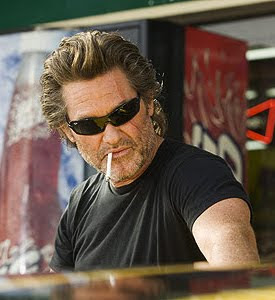
His half of the double feature, Death Proof, concerns a serial killer named Stuntman Mike (played wonderfully by Kurt Russell) who uses his invincible car to kill helpless women. The film is basically two terrific action set pieces separated by two extended conversations between groups of female friends. Though the lack of action for the first forty minutes of the film strikes me as not quite representative of the grindhouse aesthetic, when the action does come, it is fantastic and brutal and damn entertaining. It is also noticeably free of CG work and uses only techniques that would have been available to a filmmaker in the 1970s. Thus, even though from all appearances Tarantino approached his half of the film with a completely different goal than Rodriguez (to be inspired by rather than just imitate the exploitation films of the 1970s), he actually gets a lot closer to making a believable grindhouse flick.
Still, the lengthy dialogue scenes in the film continue the worrying trend Tarantino’s been on since he and Roger Avary parted ways after Pulp Fiction. Whereas he used to be content to have only a scene or two be entirely about his free associative pop culture ramblings (with the other scenes having this mixed in, of course, but not being the exclusive purpose of the scenes), he’s now making films that, anytime anyone opens their mouth, all that’s coming out is ephemera. Take away every last bit of dialogue from Death Proof, for instance, and you don’t lose much of the pleasure of watching the film. Indeed, it's probably increased since you don’t have to wait forty minutes in between action scenes.
I’m not saying that these long rambling conversations are boring because they aren’t. They just aren’t about anything. They exist outside of and apart from the rest of the film and are completely unconnected to the violence that surrounds them. Maybe that’s the point, but the whole enterprise has the same sort of feeling as when, in the end of the second volume of Kill Bill, the whole picture grinds to halt so Bill can talk about Superman for a while. What I’m saying, I guess, is that Tarantino’s banal insights into pop culture and relationships, etc. are just not interesting enough for their own sake. They need to be tied into a larger narrative or it becomes just Tarantino showing off his encyclopedic knowledge of the ephemera of modern life. And while that might have been interesting enough to sustain my interest in his work for a while, I’m starting to grow weary of it. And judging by other reviews of this film, I might not be the only one.
That’s the thing, really. Tarantino makes Tarantino films. He is not capable of doing anything else. Even when he assigns himself the task of mimicking another style of filmmaking, he can’t help but pour his own sensibility into the film and turn it into something uniquely his own. Indeed, he is of that rare breed of filmmakers who present a sui generis aesthetic to the world. The problem is that even though his aesthetic and worldview are completely unique and unlike anything anyone else is doing, there’s no escaping the fact that it is still more of the same in film after film. And I, for one, find the bloom to be off this particular rose. What was lively and intoxicating five films ago is now becoming commonplace and predictable. It’s almost as if Tarantino’s become a genre unto himself. There are worse things, I guess, than being completely unique in the same way film after film. But I had expected more from the video store wunderkind and patron saint of film geeks.
A similar problem afflicts Robert Rodriguez’s half of the double feature, Planet Terror. Though he does a much better job of mimicking the experience of seeing a cheap movie in a cheap theater in the 1970s than Tarantino does, there’s a disconnect here between the aesthetic of the film and the substance. Sure it looks like it was shot on 16mm film and had been through the wringer a thousand times (there are hairs and burns and all manner of scratches flickering across the screen) but at the same time there’s so much that is clearly computer generated in the film that the whole thing shakes out as the very definition of disingenuous. To have the film look like it was a legitimate grindhouse picture but then to have clearly spent millions to make it that way makes the film almost impossible to like.
The very first scene, for instance, is of Rose McGowan’s Cherry Darling stripping (or go-go dancing which is, apparently, different). This scene infuriates for a number of reasons. First, McGowan remains clothed throughout. Now I’m not looking to be prurient or to see McGowan naked (really, I’m not that interested) but to make all this hay about the fact that this is a throwback to the boobs and blood splatter pictures of the 70's and then not show any boobs just makes no sense. (Couple this scene with a moment later in the film in which a sex scene “burns up” and the film jumps ahead ten minutes and you get a pretty clear picture of just how Puritanical and un-grindhouse Rodriguez is when it comes to sex). Second, anyone who has seen any commercials or trailers for the film has seen the moment wherein McGowan receives a prosthetic leg machine gun. But in that first go-go dancing scene, she clearly has both her legs intact. So, right from the get go it’s clear that there’s going to be an awful lot of CG work in the film to make it look like she only has one leg. (If this had been a real grindhouse picture, Cherry would have been played by a woman with one leg who would have had a pretty bad prosthesis the whole first half of the movie.) Thus it’s clear from pretty much the first minute of the film that Rodriguez is going to be faithful only to the superficial aspects of a grindhouse picture and not at all to the spirit of the thing. It’s no surprise then that he completely fails to absorb the audience into his nonsensical, meandering zombie picture.
Tarantino on the other hand, clearly set out to be more loyal to the spirit of the grindhouse than to the aesthetics of it (though he does a pretty decent job in that regard as well). Rather than try to make a film that looked like it was being shown in a cheap theater in the 1970s, Tarantino made a film to which the modern audience would respond the same way he did as a kid in that 1970s theater. Basically he chose the much harder path and got a lot closer to success than Rodriguez.
His half of the double feature, Death Proof, concerns a serial killer named Stuntman Mike (played wonderfully by Kurt Russell) who uses his invincible car to kill helpless women. The film is basically two terrific action set pieces separated by two extended conversations between groups of female friends. Though the lack of action for the first forty minutes of the film strikes me as not quite representative of the grindhouse aesthetic, when the action does come, it is fantastic and brutal and damn entertaining. It is also noticeably free of CG work and uses only techniques that would have been available to a filmmaker in the 1970s. Thus, even though from all appearances Tarantino approached his half of the film with a completely different goal than Rodriguez (to be inspired by rather than just imitate the exploitation films of the 1970s), he actually gets a lot closer to making a believable grindhouse flick.Still, the lengthy dialogue scenes in the film continue the worrying trend Tarantino’s been on since he and Roger Avary parted ways after Pulp Fiction. Whereas he used to be content to have only a scene or two be entirely about his free associative pop culture ramblings (with the other scenes having this mixed in, of course, but not being the exclusive purpose of the scenes), he’s now making films that, anytime anyone opens their mouth, all that’s coming out is ephemera. Take away every last bit of dialogue from Death Proof, for instance, and you don’t lose much of the pleasure of watching the film. Indeed, it's probably increased since you don’t have to wait forty minutes in between action scenes.
I’m not saying that these long rambling conversations are boring because they aren’t. They just aren’t about anything. They exist outside of and apart from the rest of the film and are completely unconnected to the violence that surrounds them. Maybe that’s the point, but the whole enterprise has the same sort of feeling as when, in the end of the second volume of Kill Bill, the whole picture grinds to halt so Bill can talk about Superman for a while. What I’m saying, I guess, is that Tarantino’s banal insights into pop culture and relationships, etc. are just not interesting enough for their own sake. They need to be tied into a larger narrative or it becomes just Tarantino showing off his encyclopedic knowledge of the ephemera of modern life. And while that might have been interesting enough to sustain my interest in his work for a while, I’m starting to grow weary of it. And judging by other reviews of this film, I might not be the only one.
That’s the thing, really. Tarantino makes Tarantino films. He is not capable of doing anything else. Even when he assigns himself the task of mimicking another style of filmmaking, he can’t help but pour his own sensibility into the film and turn it into something uniquely his own. Indeed, he is of that rare breed of filmmakers who present a sui generis aesthetic to the world. The problem is that even though his aesthetic and worldview are completely unique and unlike anything anyone else is doing, there’s no escaping the fact that it is still more of the same in film after film. And I, for one, find the bloom to be off this particular rose. What was lively and intoxicating five films ago is now becoming commonplace and predictable. It’s almost as if Tarantino’s become a genre unto himself. There are worse things, I guess, than being completely unique in the same way film after film. But I had expected more from the video store wunderkind and patron saint of film geeks.
Thursday, March 29, 2007
BLOOD DIAMOND – edward zwick – 3.9 / 10
In Blood Diamond, Edward Zwick, director of such previous white guilt epics as Glory and The Last Samurai, sends yet another white person into a foreign land to learn something about himself. The white person in question this time is Leonardo DiCaprio (in a truly outstanding, possibly career best performance and easily the best thing about the film) as Danny Archer, a former mercenary turned diamond smuggler. The tempest into which he is sent is the Sierra Leonean civil war of the late 1990s. And the lesson he has to learn, surprise surprise, is to appreciate life in all its bounteous splendor. The only question is how many dark skinned people are going to have to die before Danny figures that out.
I don’t want to be so cynical as to assume that Americans, particularly white middle-class ones, won’t watch a film with a mostly black (or foreign) cast. But I gotta think that even if it wasn’t Zwick’s idea from the start, somewhere along the line in the development of this very expensive film, someone would have made him put some white people in it just to make sure they showed up in the theaters. I don’t know whether Zwick was coaxed into making this concession (exhibits A and B: Glory and The Last Samurai, seem to indicate otherwise) but I understand it. It makes a certain awful kind of business sense. And when you get right down to it, that could even be forgiven if Blood Diamond had turned out to be compelling and interesting. But it isn’t.
It’s not compelling because, despite having an obvious message (diamonds reach our wedding fingers on the broken backs and spilled blood of the world’s exploited indigenous peoples) Zwick and Co. aren’t quite sure how to sell it. Maddy Bowen (Jennifer Connelly, woefully out of her depth), a reporter who’s ventured into Africa to uncover the “truth” about the diamond trade, is obviously the filmmakers’ avatar for their belated activism. She’s the lone voice crying in the wilderness about the exploitation of the people and the ignorance of the selfish uncaring Americans back home. But a few scenes after making that speech, she’s snapping pictures of war ravaged bodies and grief stricken faces to publish in her magazine. How is that any less exploitative than what the diamond smugglers are doing? At least Danny has no pretenses about just what it is he’s doing there at the asshole end of the world.
It’s exactly that sense of conflicted purpose and misplaced anger that so muddies the film. And just when the politics become so convoluted that the whole thing is threatening to collapse under its own self-serious weight, gunfire erupts and something explodes. The camera shakes and blood and dirt splatter the lens as bullets rip through the air. But this, unfortunately, is the other major problem with Blood Diamond; namely that Zwick and Co. want the film to be a big bad piece of slam bang entertainment as well as a political message movie. So mixed in with all the hand wringing about the evils of the diamond trade are car chases and shoot outs in the streets as Danny and Solomon Vandy (Djimon Hounsou, also fantastic and deserving of that Supporting Actor Oscar nod) travel the country in search of Solomon’s captive family and eventually to the hiding place of a rare pink diamond. But the big action setpieces and the complicated geopolitical maneuvering are never a perfect fit. The action seems to come out of nowhere and to exist for no other reason than that twenty minutes had passed without something exploding. It’s violence for violence’s sake is what I’m saying and it contradicts the whole point of Maddy’s (read: the filmmakers’) meandering speechifying that violence with no point is about as horrible a thing as people can do to each other.
All of that is not to say that there isn’t the occasional compelling moment in the film. The handful of scenes concerning Solomon’s captive son Dia, for instance, hint at the film that might have been. Kidnapped by the Revolutionary United Front (R.U.F.), Dia is brainwashed into thinking his parents are dead and then drugged into a stupor until he becomes an unthinking instrument of death. This being a big budget Hollywood spectacular and all, there is little doubt that Dia will eventually be reunited with his father and once again become the future of his country. But along the way, and almost in spite of itself, his becomes the most powerful story in Blood Diamond. His journey from untapped promise to wasted potential and back is the hoped for resolution to the mess that is most of war torn Africa. And thus Dia becomes something of a metaphor for the entire continent. Within him is the promise of a different future, but also the danger of endlessly repeating the mistakes of the past, an idea that is made all the more poignant by the fact that even today child armies continue to roam the jungles of Africa.
As the film draws to a close near the two and a half hour mark, the images of Dia killing innocent, helpless villagers are the only ones that linger, especially considering the somewhat self-defeating titles that close the film by describing the “Kimberley Process” that has, since the time in which the film takes place, supposedly ended the sale of conflict diamonds. Maybe that was tacked on as a sop to the diamond industry. Maybe it’s there to guard against potential lawsuits. Or maybe it’s there because it’s true. Whatever the reason, the contradictory note on which the movie ends is fitting for a film that never really figures out what it wants to say.
And maybe that’s how it should be. Because it’s a tricky quagmire, Africa is, and the filmmakers do not escape it unscathed. However, they do at least seem to be aware of the hopelessness of their plight. “This is Africa” (or just “T.I.A”) is an oft-repeated phrase throughout the film; the idea being that there is no explanation, no logic and no rules to explain what’s going on over there. I applaud their attempt to try to say something about Africa and to try to shine a light on a too-often dim part of the world. But good intentions are not nearly enough, especially when the finished product is so inconsistent, on the one hand bending over backwards to be self-congratulatory and on the other completely misunderstanding what it was actually saying.
I don’t want to be so cynical as to assume that Americans, particularly white middle-class ones, won’t watch a film with a mostly black (or foreign) cast. But I gotta think that even if it wasn’t Zwick’s idea from the start, somewhere along the line in the development of this very expensive film, someone would have made him put some white people in it just to make sure they showed up in the theaters. I don’t know whether Zwick was coaxed into making this concession (exhibits A and B: Glory and The Last Samurai, seem to indicate otherwise) but I understand it. It makes a certain awful kind of business sense. And when you get right down to it, that could even be forgiven if Blood Diamond had turned out to be compelling and interesting. But it isn’t.
It’s not compelling because, despite having an obvious message (diamonds reach our wedding fingers on the broken backs and spilled blood of the world’s exploited indigenous peoples) Zwick and Co. aren’t quite sure how to sell it. Maddy Bowen (Jennifer Connelly, woefully out of her depth), a reporter who’s ventured into Africa to uncover the “truth” about the diamond trade, is obviously the filmmakers’ avatar for their belated activism. She’s the lone voice crying in the wilderness about the exploitation of the people and the ignorance of the selfish uncaring Americans back home. But a few scenes after making that speech, she’s snapping pictures of war ravaged bodies and grief stricken faces to publish in her magazine. How is that any less exploitative than what the diamond smugglers are doing? At least Danny has no pretenses about just what it is he’s doing there at the asshole end of the world.
It’s exactly that sense of conflicted purpose and misplaced anger that so muddies the film. And just when the politics become so convoluted that the whole thing is threatening to collapse under its own self-serious weight, gunfire erupts and something explodes. The camera shakes and blood and dirt splatter the lens as bullets rip through the air. But this, unfortunately, is the other major problem with Blood Diamond; namely that Zwick and Co. want the film to be a big bad piece of slam bang entertainment as well as a political message movie. So mixed in with all the hand wringing about the evils of the diamond trade are car chases and shoot outs in the streets as Danny and Solomon Vandy (Djimon Hounsou, also fantastic and deserving of that Supporting Actor Oscar nod) travel the country in search of Solomon’s captive family and eventually to the hiding place of a rare pink diamond. But the big action setpieces and the complicated geopolitical maneuvering are never a perfect fit. The action seems to come out of nowhere and to exist for no other reason than that twenty minutes had passed without something exploding. It’s violence for violence’s sake is what I’m saying and it contradicts the whole point of Maddy’s (read: the filmmakers’) meandering speechifying that violence with no point is about as horrible a thing as people can do to each other.
All of that is not to say that there isn’t the occasional compelling moment in the film. The handful of scenes concerning Solomon’s captive son Dia, for instance, hint at the film that might have been. Kidnapped by the Revolutionary United Front (R.U.F.), Dia is brainwashed into thinking his parents are dead and then drugged into a stupor until he becomes an unthinking instrument of death. This being a big budget Hollywood spectacular and all, there is little doubt that Dia will eventually be reunited with his father and once again become the future of his country. But along the way, and almost in spite of itself, his becomes the most powerful story in Blood Diamond. His journey from untapped promise to wasted potential and back is the hoped for resolution to the mess that is most of war torn Africa. And thus Dia becomes something of a metaphor for the entire continent. Within him is the promise of a different future, but also the danger of endlessly repeating the mistakes of the past, an idea that is made all the more poignant by the fact that even today child armies continue to roam the jungles of Africa.
As the film draws to a close near the two and a half hour mark, the images of Dia killing innocent, helpless villagers are the only ones that linger, especially considering the somewhat self-defeating titles that close the film by describing the “Kimberley Process” that has, since the time in which the film takes place, supposedly ended the sale of conflict diamonds. Maybe that was tacked on as a sop to the diamond industry. Maybe it’s there to guard against potential lawsuits. Or maybe it’s there because it’s true. Whatever the reason, the contradictory note on which the movie ends is fitting for a film that never really figures out what it wants to say.
And maybe that’s how it should be. Because it’s a tricky quagmire, Africa is, and the filmmakers do not escape it unscathed. However, they do at least seem to be aware of the hopelessness of their plight. “This is Africa” (or just “T.I.A”) is an oft-repeated phrase throughout the film; the idea being that there is no explanation, no logic and no rules to explain what’s going on over there. I applaud their attempt to try to say something about Africa and to try to shine a light on a too-often dim part of the world. But good intentions are not nearly enough, especially when the finished product is so inconsistent, on the one hand bending over backwards to be self-congratulatory and on the other completely misunderstanding what it was actually saying.
Sunday, March 11, 2007
300 - zack snyder - 5.5 / 10
For all its digital fire and brimstone and the lip service it pays to the Spartan warrior ethic and code of honorable death, it’s a damn shame that at its core 300 turns out to be so staunchly conservative and puritanical, its warrior heroes dying with cries for their wives and children on their lips. And what’s truly baffling here is that that stuff isn’t in the graphic novel upon which this film is based (neither is the ridiculous legislative maneuvering going on back in Sparta but that’s another matter I’ll get to later) and it certainly isn’t historically accurate. Now I’m no advocate of being a slave to the written source or even to history. But when changes are made recklessly and wantonly, all you get is a very conflicted message.
Thursday, March 8, 2007
BLACK SNAKE MOAN – craig brewer – 5.5 / 10
Although it may be faint praise to say it, Black Snake Moan is better than I thought it was going to be. Considering it was written and directed by Craig Brewer (the man behind the pretty weak and borderline racist Hustle & Flow) and concerns a nymphomaniac being chained to a radiator by a dude named Lazarus (who, gasp, comes back to “life” over the course of the film), you’d think it would be pretty much the silliest film ever. But it isn’t, I swear.
I say that even though Brewer and everyone involved in this film did no research whatsoever about nymphomania. Not that I did either but I highly doubt that nymphomania manifests itself as an unscratchable itch that prompts those suffering from it to tear off their clothing and tackle the nearest male (as Christina Ricci does in this film). And I say that even though Ricci wears $200 Citizens of Humanity cut-offs but can’t afford to buy herself dinner.
What’s good about the film is that it so completely believes in its lunatic concept that, for a while (at least until an overmatched Justin Timberlake enters the picture), the audience is caught up in it. It gets the down home, good ol’ boy feel of the Deep South just right and its early characterizations are dead on. This carries the film across the somewhat ludicrous idea that someone could cure another of their “wickedness” by chaining them to a radiator. You just kind of go with it.
The problem comes after the “wickedness” has been cured and Ricci’s boyfriend (played by the aforementioned Mr. Timberlake) returns from Iraq, or more accurately, the boot camp he was kicked out of for the anxiety he gets when confronted with loud noises. Never minding the fact that it’s pretty unlikely that a person would get debilitating anxiety from loud noises and then want to enlist in the Army, the last thing the film needs is another person with some deep-seated mental hurdle to clear. It already has Samuel L. Jackson’s scarred and wounded Lazarus and Ricci’s crazed nymphomaniac.
So, in the third act of the film, we’ve now got that to deal with. And quite frankly, JT is not up to the job. Yes, his role is weak and a lot of what he’s called on to do is silly, but so is what Ricci and Jackson are asked to do and the audience buys into their roles. Timberlake just isn’t able to make us buy into his affliction the way the film needs us to.
I don’t want to lay the blame for this film’s failures at the feet of Justin Timberlake; it’s not his film to carry after all. And maybe the failure of the third act isn’t his fault at all. Maybe there’s just no way a ridiculous film like this could end up satisfactorily. But whatever the reason, the simple fact is that the whole film collapses like a house of cards in its last half hour. It has a completely unearned uplifting ending in which every character is happily paired off with another as if, no matter the damage and pain you cause, if you repent you’ll find happiness. It’s a very Christian message and a bizarrely conservative one coming from a film that toys with hardcore sexual depravity and the darkest anxiety.
I say that even though Brewer and everyone involved in this film did no research whatsoever about nymphomania. Not that I did either but I highly doubt that nymphomania manifests itself as an unscratchable itch that prompts those suffering from it to tear off their clothing and tackle the nearest male (as Christina Ricci does in this film). And I say that even though Ricci wears $200 Citizens of Humanity cut-offs but can’t afford to buy herself dinner.
What’s good about the film is that it so completely believes in its lunatic concept that, for a while (at least until an overmatched Justin Timberlake enters the picture), the audience is caught up in it. It gets the down home, good ol’ boy feel of the Deep South just right and its early characterizations are dead on. This carries the film across the somewhat ludicrous idea that someone could cure another of their “wickedness” by chaining them to a radiator. You just kind of go with it.
The problem comes after the “wickedness” has been cured and Ricci’s boyfriend (played by the aforementioned Mr. Timberlake) returns from Iraq, or more accurately, the boot camp he was kicked out of for the anxiety he gets when confronted with loud noises. Never minding the fact that it’s pretty unlikely that a person would get debilitating anxiety from loud noises and then want to enlist in the Army, the last thing the film needs is another person with some deep-seated mental hurdle to clear. It already has Samuel L. Jackson’s scarred and wounded Lazarus and Ricci’s crazed nymphomaniac.
So, in the third act of the film, we’ve now got that to deal with. And quite frankly, JT is not up to the job. Yes, his role is weak and a lot of what he’s called on to do is silly, but so is what Ricci and Jackson are asked to do and the audience buys into their roles. Timberlake just isn’t able to make us buy into his affliction the way the film needs us to.
I don’t want to lay the blame for this film’s failures at the feet of Justin Timberlake; it’s not his film to carry after all. And maybe the failure of the third act isn’t his fault at all. Maybe there’s just no way a ridiculous film like this could end up satisfactorily. But whatever the reason, the simple fact is that the whole film collapses like a house of cards in its last half hour. It has a completely unearned uplifting ending in which every character is happily paired off with another as if, no matter the damage and pain you cause, if you repent you’ll find happiness. It’s a very Christian message and a bizarrely conservative one coming from a film that toys with hardcore sexual depravity and the darkest anxiety.
Tuesday, March 6, 2007
THE NEW WORLD – terrence malick – 5.5 / 10
Terrence Malick is the definition of an auteur. He is also exhibit number one in why the auteur theory is not the be all and end all of film criticism. For though each of his films is clearly and distinctly his own, they all more or less fail in exactly the same ways. It doesn’t matter if the film is about soldiers in World War II or criminals in the 1950s Midwest or John Smith and Pocahontas, every Malick film is going to be exactly the same: lots of shots of nature and sun-dappled trees and grass as the characters look longingly at each other and speak in breathlessly whispered voiceover on the soundtrack.
The New World is more of the same from Malick. However, that being said, it is probably the most entertaining of his films. Despite it’s dreadfully slow pace (another Malick trademark) it doesn't go on and on without end or direction (like The Thin Red Line). It has a clear narrative with lives at stake and as such has some compelling moments of action and drama. And the story it tells, though well known, is nonetheless interesting.
Moreover, it is undeniable that Malick has a keen visual sense. There are plenty of breathtaking shots in this film. And he does a good job of conveying the wonder with which the Englishmen see the New World and, similarly, with which Pocahontas sees England. Both worlds are so lush and vibrant as to be like paradise.
But none of that takes away from the fact that, like all other Terrence Malick movies before it, The New World is dreadfully boring for long stretches. True there are moments of action and moments in which the plot is developing quickly. But those are clearly not the moments that Malick is interested in. No, he’d rather spend twenty minutes with Pocahontas and John Smith cavorting in the fields as the sun sets behind them and their voices speak about ridiculously pretentious nonsense in hushed voiceover. And that’s all well and good but it’s boring as hell. And those voiceovers, Christ, a grown man writes that nonsense and grown men are supposed to be entertained by it? I’d have been embarrassed to have written that in high school. And if someone had chanced to come upon it, I think I would have died of shame. To put it out there for all the world to see is just ridiculous, borderline laughable.
I’m really curious to know what this film looked like when it was in script form. I wonder how many pages it was. And I wonder if it made any sense. I can’t even tell what happened at the end of the film. Does Pocahontas die? Or does she return to the New World with John Smith? I can’t tell.
In the end, I guess the film is as good as your tolerance for meandering though good-looking asides about the romance of the world and the romance between two people. If you like this kind of stuff, The New World is for you. If you don’t, steer well clear.
The New World is more of the same from Malick. However, that being said, it is probably the most entertaining of his films. Despite it’s dreadfully slow pace (another Malick trademark) it doesn't go on and on without end or direction (like The Thin Red Line). It has a clear narrative with lives at stake and as such has some compelling moments of action and drama. And the story it tells, though well known, is nonetheless interesting.
Moreover, it is undeniable that Malick has a keen visual sense. There are plenty of breathtaking shots in this film. And he does a good job of conveying the wonder with which the Englishmen see the New World and, similarly, with which Pocahontas sees England. Both worlds are so lush and vibrant as to be like paradise.
But none of that takes away from the fact that, like all other Terrence Malick movies before it, The New World is dreadfully boring for long stretches. True there are moments of action and moments in which the plot is developing quickly. But those are clearly not the moments that Malick is interested in. No, he’d rather spend twenty minutes with Pocahontas and John Smith cavorting in the fields as the sun sets behind them and their voices speak about ridiculously pretentious nonsense in hushed voiceover. And that’s all well and good but it’s boring as hell. And those voiceovers, Christ, a grown man writes that nonsense and grown men are supposed to be entertained by it? I’d have been embarrassed to have written that in high school. And if someone had chanced to come upon it, I think I would have died of shame. To put it out there for all the world to see is just ridiculous, borderline laughable.
I’m really curious to know what this film looked like when it was in script form. I wonder how many pages it was. And I wonder if it made any sense. I can’t even tell what happened at the end of the film. Does Pocahontas die? Or does she return to the New World with John Smith? I can’t tell.
In the end, I guess the film is as good as your tolerance for meandering though good-looking asides about the romance of the world and the romance between two people. If you like this kind of stuff, The New World is for you. If you don’t, steer well clear.
Saturday, February 17, 2007
HALF NELSON – ryan fleck – 6.7 / 10
Indie film did not start out as a genre but it has certainly become one. Of course, not every indie film fits into this genre but enough do that when you go to the indie section of Blockbuster, you know what you can expect to find. Let’s run down the list: a generic indie film is slowly paced, character driven and almost exclusively shot with handheld cameras. It’s usually well acted, dingy looking and shot mostly with available light and in extreme close-up. The editing style is hyperactive (which would seem to run counter to the slow pace of the rest of the film) and calls attention to itself, often employing jump cuts or radical changes in time or location from one shot to the next. There are a few random asides about topical issues (usually liberal in viewpoint) and often casual drug use and sex. And the end, when it comes, will be signaled not so much by something happening but instead by a slight change in viewpoint or tone.
That the above list is pretty much the blueprint for Half Nelson would probably lead you to believe that the film is crap. But it’s actually not half bad. Just like you occasionally run across a good slasher film that's generic through and through but still manages to be entertaining, so too is it possible to run across a generic indie film that's still enjoyable. And this is that film.
Credit for that goes almost entirely to the writing. Anything good or interesting or entertaining about this film is due to the writing and what the terrific actors do with the words they're given. Much has been made of Ryan Gosling’s performance and rightly so but it’s not quite the tour de force I anticipated it to be. Instead his performance is subtle and interesting and very entertaining. For that matter, so is the performance of Sharreka Epps as the girl that eventually saves the Gosling’s screwed up teacher.
And it’s that facet of the story, the redemption of the teacher, that is by far the least satisfying aspect of the film. I guess going in I figured that if someone wanted to make this story, this tale of addiction, they would have had some history of using if not abusing drugs. I mean, the film is about addiction, why make it if you didn’t have some history with drugs? I figured that maybe, for once, there’d be a film that dealt with drug use in a realistic way. And for a while that’s what we’re given here. The first hour, in fact, is pretty much just the story of a high functioning drug addict and what his daily life is like.
But it’s when things start to fall apart and Gosling's Dan starts to unravel (as he must in this sort of story) that the film goes off the rails in terms of its depiction of drug use. Pretty soon Dan is cursing at the thirteen-year-old girl who tried to befriend him and trying to rape his sort of girlfriend and skipping out on work to get high all day in a motel room. I understand that this sort of thing “has” to happen to give the film dramatic heft. But I can’t believe that someone who had any real experience with drug use would ever write this. It’s just patently false. Doing drugs does not change who you are or how you behave. Someone that’s done drugs would know this. And thus the third act of the film is more or less a failure and a cop out. But oh well, it was fun while it lasted.
That the above list is pretty much the blueprint for Half Nelson would probably lead you to believe that the film is crap. But it’s actually not half bad. Just like you occasionally run across a good slasher film that's generic through and through but still manages to be entertaining, so too is it possible to run across a generic indie film that's still enjoyable. And this is that film.
Credit for that goes almost entirely to the writing. Anything good or interesting or entertaining about this film is due to the writing and what the terrific actors do with the words they're given. Much has been made of Ryan Gosling’s performance and rightly so but it’s not quite the tour de force I anticipated it to be. Instead his performance is subtle and interesting and very entertaining. For that matter, so is the performance of Sharreka Epps as the girl that eventually saves the Gosling’s screwed up teacher.
And it’s that facet of the story, the redemption of the teacher, that is by far the least satisfying aspect of the film. I guess going in I figured that if someone wanted to make this story, this tale of addiction, they would have had some history of using if not abusing drugs. I mean, the film is about addiction, why make it if you didn’t have some history with drugs? I figured that maybe, for once, there’d be a film that dealt with drug use in a realistic way. And for a while that’s what we’re given here. The first hour, in fact, is pretty much just the story of a high functioning drug addict and what his daily life is like.
But it’s when things start to fall apart and Gosling's Dan starts to unravel (as he must in this sort of story) that the film goes off the rails in terms of its depiction of drug use. Pretty soon Dan is cursing at the thirteen-year-old girl who tried to befriend him and trying to rape his sort of girlfriend and skipping out on work to get high all day in a motel room. I understand that this sort of thing “has” to happen to give the film dramatic heft. But I can’t believe that someone who had any real experience with drug use would ever write this. It’s just patently false. Doing drugs does not change who you are or how you behave. Someone that’s done drugs would know this. And thus the third act of the film is more or less a failure and a cop out. But oh well, it was fun while it lasted.
Saturday, January 6, 2007
CHILDREN OF MEN - alfonso cuaron - 9.3 / 10
The level of filmmaking talent on display in Children of Men is absolutely breathtaking. Not since Road to Perdition has there been a film this well directed. In fact, even if you hadn’t a clue what a director does on a movie, you couldn’t fail to be impressed by the direction in this film.
The writing, unfortunately, is another matter. It’s not bad by any means, it’s just not as extraordinary as the direction. The plot concerns the possible salvation of the human race in the form of the first pregnant woman the world has seen for eighteen years. It falls to Theo (Clive Owen) to get Kee (the archetypally named pregnant woman) to the Human Project and thereby redeem himself so that he can die happy.
Theo’s transformation from apathetic former revolutionary to a good soldier in the liberal fight is, quite clearly, meant to comment on our own society’s current apathetic stance towards the world’s ills. Talk to most people about global warming or the looming global oil crisis or Social Security or Medicare, etc. and you’ll likely find their opinion mirrors Theo’s. Something along the lines of, “Yeah, it’s a tragedy but what can you do?”
Of course, being the hero of a multi-million dollar blockbuster entertainment, Theo will get that question answered in spectacular fashion. He finds purpose and fulfillment and then dies (because, for some reason, serious movies are not allowed to have their protagonists become fulfilled and content (see: American Beauty)). The larger point Cuaron is trying to make, I suppose, is that we all have the potential, like Theo, to rediscover our desire and motivation to change the world and we’d better start doing it or our world might end up looking a lot like the 2027 of this film.
And when you get right down to it, that’s a pretty decent message for a film to have. It’s not revolutionary, of course, but at least it’s a coherent philosophy that’s meant to make the world a better place. And it’s carried off pretty well here without calling undo attention to itself. The same, however, cannot be said of the filmmaking technique itself. It is quite revolutionary and goes far out of its way to call attention to itself. But that’s just fine by me because it’s just so damn brilliant as to be undeniable.
The film is opened by one of the best first shots in the history of cinema. It may not quite rise to the level of Touch of Evil's famous opening tracking shot but it gets very very close. The shot is a technical tour de force (involving moving from indoors to out, over counters and through doors and ending with a violent explosion). But more than that, it thematically encapsulates the whole of the film without anyone (other than the talking heads on the television screens) uttering a word.
It shows the audience Theo, the only person in the coffee shop crowd not interested in what the TV newscasters are saying (i.e. Theo is different and stands apart from everyone else in this world). The crowd itself is composed almost entirely of white faces (which subtly references the film’s other major theme of the mistreatment of illegal aliens). And when Theo steps outside and the shop explodes, it does so in the most unexpected, and therefore violent, way imaginable. (Unfortunately the trailer has ruined the shock value of this for almost everyone, myself included.)
The unexpected nature of the violence is important for several reasons. Firstly, a violent explosion is perhaps the very last thing a person who has just bought a cup of coffee is thinking about, just as the idea that women could suddenly stop having babies is probably the very last doomsday scenario anybody is thinking about. But like the explosion, the lack of childbirth would, of course, be devastating. Secondly, the suddenness (and seeming randomness) of the violence presages the sudden, random and awful violence that will recur throughout the rest of the film (including some of the most visceral and downright shocking violence ever seen on screen). Most human beings' experience of violence is, for the most part, random. We seldom get involved in shootouts or knife fights or huge street brawls. The violence in most of our lives is more mundane, like a car crash or a stumble that results in a fall down a flight of stairs. That sort of violence is the only way most of us will ever experience real trauma. And it is that sense of shock and suddenness that is often lost in the average film. Not so Children of Men. It gets it absolutely, perfectly, breathtakingly right.
And that is to say nothing of the profound impact of the moments that occur after the birth of the child (which, not accidentally, is born on a makeshift bed in a rundown building when no other place could be found (not unlike a certain Savior)). Near the end of the film, Theo, Kee and the newborn infant find themselves in the middle of a shooting war between Her Majesty’s army and the refugee guerillas. Frightened by the sound of gunfire, the baby begins to cry. And all who hear the cries fall silent and lower their weapons. The whole war stops to listen to the cry of a baby because, in this context, the infant is hope incarnate. But then, as soon as the baby’s cries are out of earshot, one of the refugees opens fire once more. So hopeless have they become that hope is only real when they can actually see and hear it. It’s a clear message to the world of 2007 where it is so easy to become disillusioned with the idea of actual change. If we don’t work at it, Cuaron is saying, then hope is already gone. And this is the one moment in the film that really brings that home.
The writing, unfortunately, is another matter. It’s not bad by any means, it’s just not as extraordinary as the direction. The plot concerns the possible salvation of the human race in the form of the first pregnant woman the world has seen for eighteen years. It falls to Theo (Clive Owen) to get Kee (the archetypally named pregnant woman) to the Human Project and thereby redeem himself so that he can die happy.
Theo’s transformation from apathetic former revolutionary to a good soldier in the liberal fight is, quite clearly, meant to comment on our own society’s current apathetic stance towards the world’s ills. Talk to most people about global warming or the looming global oil crisis or Social Security or Medicare, etc. and you’ll likely find their opinion mirrors Theo’s. Something along the lines of, “Yeah, it’s a tragedy but what can you do?”
Of course, being the hero of a multi-million dollar blockbuster entertainment, Theo will get that question answered in spectacular fashion. He finds purpose and fulfillment and then dies (because, for some reason, serious movies are not allowed to have their protagonists become fulfilled and content (see: American Beauty)). The larger point Cuaron is trying to make, I suppose, is that we all have the potential, like Theo, to rediscover our desire and motivation to change the world and we’d better start doing it or our world might end up looking a lot like the 2027 of this film.
And when you get right down to it, that’s a pretty decent message for a film to have. It’s not revolutionary, of course, but at least it’s a coherent philosophy that’s meant to make the world a better place. And it’s carried off pretty well here without calling undo attention to itself. The same, however, cannot be said of the filmmaking technique itself. It is quite revolutionary and goes far out of its way to call attention to itself. But that’s just fine by me because it’s just so damn brilliant as to be undeniable.
The film is opened by one of the best first shots in the history of cinema. It may not quite rise to the level of Touch of Evil's famous opening tracking shot but it gets very very close. The shot is a technical tour de force (involving moving from indoors to out, over counters and through doors and ending with a violent explosion). But more than that, it thematically encapsulates the whole of the film without anyone (other than the talking heads on the television screens) uttering a word.
It shows the audience Theo, the only person in the coffee shop crowd not interested in what the TV newscasters are saying (i.e. Theo is different and stands apart from everyone else in this world). The crowd itself is composed almost entirely of white faces (which subtly references the film’s other major theme of the mistreatment of illegal aliens). And when Theo steps outside and the shop explodes, it does so in the most unexpected, and therefore violent, way imaginable. (Unfortunately the trailer has ruined the shock value of this for almost everyone, myself included.)
The unexpected nature of the violence is important for several reasons. Firstly, a violent explosion is perhaps the very last thing a person who has just bought a cup of coffee is thinking about, just as the idea that women could suddenly stop having babies is probably the very last doomsday scenario anybody is thinking about. But like the explosion, the lack of childbirth would, of course, be devastating. Secondly, the suddenness (and seeming randomness) of the violence presages the sudden, random and awful violence that will recur throughout the rest of the film (including some of the most visceral and downright shocking violence ever seen on screen). Most human beings' experience of violence is, for the most part, random. We seldom get involved in shootouts or knife fights or huge street brawls. The violence in most of our lives is more mundane, like a car crash or a stumble that results in a fall down a flight of stairs. That sort of violence is the only way most of us will ever experience real trauma. And it is that sense of shock and suddenness that is often lost in the average film. Not so Children of Men. It gets it absolutely, perfectly, breathtakingly right.
And that is to say nothing of the profound impact of the moments that occur after the birth of the child (which, not accidentally, is born on a makeshift bed in a rundown building when no other place could be found (not unlike a certain Savior)). Near the end of the film, Theo, Kee and the newborn infant find themselves in the middle of a shooting war between Her Majesty’s army and the refugee guerillas. Frightened by the sound of gunfire, the baby begins to cry. And all who hear the cries fall silent and lower their weapons. The whole war stops to listen to the cry of a baby because, in this context, the infant is hope incarnate. But then, as soon as the baby’s cries are out of earshot, one of the refugees opens fire once more. So hopeless have they become that hope is only real when they can actually see and hear it. It’s a clear message to the world of 2007 where it is so easy to become disillusioned with the idea of actual change. If we don’t work at it, Cuaron is saying, then hope is already gone. And this is the one moment in the film that really brings that home.
Monday, October 23, 2006
SYMPATHY FOR LADY VENGEANCE – park chan wook – 8.1 / 10
Korean director Park Chan Wook has quietly become one of my favorite directors. Between his vengeance trilogy and Joint Security Area, he’s shown himself to be a very compelling filmmaker. And while Sympathy for Lady Vengeance isn’t quite as good a film as Oldboy, it still packs a pretty big wallop and manages to say things about the relatively limited topic of vengeance that Oldboy and Sympathy for Mr. Vengeance had not already said.
Lady Vengeance (as it’s known in the West) really boils down to one metaphor that’s repeated in various forms (tofu, snow, cake, skin, etc.), the point being that to be clean, to be pure and white is the goal of the vengeance seeker. The hope is that the act of taking revenge will allow the person to move past that event, to allow them to make their life about something else from that point onward, that vengeance, once taken, will wipe their life clean.
But embedded in the symbols used to convey this idea is the knowledge that such a starting over is all but impossible. The white tofu, for instance, is the traditional gift received by a person getting out of prison. Although it’s supposed to represent a clean slate, it's also plain and simple and boring. Thus, to accept the new, clean life that the tofu represents is to accept that life will be plain and boring. This sort of double meaning is true of all the white symbols in the film. For instance, snow, besides being cleansing and blanketing, can also be treacherous; all skin has blemishes, etc.
This is an incredibly dense metaphor because, at its heart, Park sees vengeance as the impossible search for redemption. The yearning for redemption is valuable and honorable but to hope to find it in revenge is, as Park has said, quite stupid. And at the end of this film, for the first time in the trilogy, the main character comes to understand the futility and stupidity of vengeance and thus, quite rightly, plants her face in the white cake.
The film shows events from two separate times in Lady Vengeance's (Gaem-Ja’s) life. In one she's in prison for crimes she did not commit. And in the other, she's seeking revenge against the men who put her in prison. In each of these situations Gaem-Ja is a very different person. In prison she's kind-hearted and loving. After prison she's cold and calculating. It’s hard to know which of these two personalities is closer to the real Gaem-Ja but it seems probable that both are facets of the same person and co-exist to some extent at all times. Thus, the question must be asked, if prison is the worst place a person can spend thirteen years (or at least one of the worst places) how can Gaem-Ja be a better person in prison than out? Is it the thirst for vengeance that makes her so cold and removed? Or is it simply that this is who Geam-Ja thinks she needs to become to carry out her mission?
Whatever the answer, the point Park seems to be making is that lusting for revenge turns a person into a monster only because it makes the person complicit in becoming that monster. Prison, of course, can do this as well but only if the person allows it. Vengeance, because it's a personal choice, will always turn a person into a monster if it's carried to its natural conclusion.
After Sympathy for Mr. Vengeance and Oldboy, Park Chan Wook was accused of glorifying revenge, of romanticizing it as a way for a person to take back control of his life. He has long denied that revenge is ever justified but nonetheless its power over a grieving person is very great. With Lady Vengeance, he has finally made a revenge film in which no one can possibly mistake his intentions. By having his protagonist turn the actual act of vengeance over to a group of similarly wronged individuals, he shows just how empty revenge really is. By not having Gaem-Ja, the protagonist, the person the audience has been rooting for the whole film, take the final revenge, he makes his point very clear. Robbed of a character for whom they feel sympathy, the audience can only view the vengeance for what it is, the empty act of ruined people who, far from starting over fresh, will be forever changed for the worse.
Lady Vengeance (as it’s known in the West) really boils down to one metaphor that’s repeated in various forms (tofu, snow, cake, skin, etc.), the point being that to be clean, to be pure and white is the goal of the vengeance seeker. The hope is that the act of taking revenge will allow the person to move past that event, to allow them to make their life about something else from that point onward, that vengeance, once taken, will wipe their life clean.
But embedded in the symbols used to convey this idea is the knowledge that such a starting over is all but impossible. The white tofu, for instance, is the traditional gift received by a person getting out of prison. Although it’s supposed to represent a clean slate, it's also plain and simple and boring. Thus, to accept the new, clean life that the tofu represents is to accept that life will be plain and boring. This sort of double meaning is true of all the white symbols in the film. For instance, snow, besides being cleansing and blanketing, can also be treacherous; all skin has blemishes, etc.This is an incredibly dense metaphor because, at its heart, Park sees vengeance as the impossible search for redemption. The yearning for redemption is valuable and honorable but to hope to find it in revenge is, as Park has said, quite stupid. And at the end of this film, for the first time in the trilogy, the main character comes to understand the futility and stupidity of vengeance and thus, quite rightly, plants her face in the white cake.
The film shows events from two separate times in Lady Vengeance's (Gaem-Ja’s) life. In one she's in prison for crimes she did not commit. And in the other, she's seeking revenge against the men who put her in prison. In each of these situations Gaem-Ja is a very different person. In prison she's kind-hearted and loving. After prison she's cold and calculating. It’s hard to know which of these two personalities is closer to the real Gaem-Ja but it seems probable that both are facets of the same person and co-exist to some extent at all times. Thus, the question must be asked, if prison is the worst place a person can spend thirteen years (or at least one of the worst places) how can Gaem-Ja be a better person in prison than out? Is it the thirst for vengeance that makes her so cold and removed? Or is it simply that this is who Geam-Ja thinks she needs to become to carry out her mission?
Whatever the answer, the point Park seems to be making is that lusting for revenge turns a person into a monster only because it makes the person complicit in becoming that monster. Prison, of course, can do this as well but only if the person allows it. Vengeance, because it's a personal choice, will always turn a person into a monster if it's carried to its natural conclusion.
After Sympathy for Mr. Vengeance and Oldboy, Park Chan Wook was accused of glorifying revenge, of romanticizing it as a way for a person to take back control of his life. He has long denied that revenge is ever justified but nonetheless its power over a grieving person is very great. With Lady Vengeance, he has finally made a revenge film in which no one can possibly mistake his intentions. By having his protagonist turn the actual act of vengeance over to a group of similarly wronged individuals, he shows just how empty revenge really is. By not having Gaem-Ja, the protagonist, the person the audience has been rooting for the whole film, take the final revenge, he makes his point very clear. Robbed of a character for whom they feel sympathy, the audience can only view the vengeance for what it is, the empty act of ruined people who, far from starting over fresh, will be forever changed for the worse.
Wednesday, September 13, 2006
BROTHER – takeshi kitano – 6.8 / 10
Mostly about the peculiar Japanese practice of dying with honor, Beat Takeshi’s only (barely) American film is alternately fascinating and frustrating. In fact, it’s almost fascinating in spite of its inscrutability. In the film’s second to last scene (but the last one featuring Takeshi’s Aniki), a roadside diner owner tells Aniki that the Japanese are just so damn inscrutable. And, since this film is about the differences between American and Japanese culture, and is therefore somewhat inscrutable to this American, that’s a particularly apt thing to hear right before Aniki buys it.
There’s also the possibility that this film is a World War II allegory. Considering that the western theater of that war is the only large scale interaction America and Japan have ever had, it’s no surprise that both cultures should have wildly incorrect views about the other. When Americans think of the yakuza, they think about the heinous and terrible traditions (depicted in the film at hand) and the wanton violence they seem to mete out at every turn. Similarly, it would appear, from watching this film, that the Japanese think of our mafia in mostly the same way. Each criminal organization is thought of by the other culture as being ruthless, extraordinarily violent and basically institutionally insane.
The parallels with World War II are self-evident. For instance, is there an American alive that can understand why in the holy hell a grown man would fly an airplane into a destroyer or building or whatever as the kamikaze Japanese pilots of WWII did so often? Is there any Japanese person who can understand how a grown man can disgrace himself in public then carry on as if he had done nothing shameful? Add to this the fact that the propaganda machines of war were cranking out lies as fast as they could. The Japanese people were told that the Americans, when they invaded, wouldn’t stop until ever last person on the island was dead. From an American point of view this is absurd. But then, of course, we did kill millions of their citizens, innocent people mostly, in a single afternoon.
Thus, in Brother, we have the Japanese yakuza in America going up against the mafia only to find that not only are they outmatched but they're all marked for death. And as this plays out over the last twenty minutes of the film, it certainly seems awfully similar to how the Japanese must have felt at the end of World War II.
The real question, though, is what point does all this serve? Why go to the trouble to create this allegory in the first place since it doesn’t lend itself to a particularly realistic story? The answer just might be that by showing a culture how other peoples of the world see it, it might be hoped that that culture will learn something about the image it conveys to the world.
There’s also the possibility that this film is a World War II allegory. Considering that the western theater of that war is the only large scale interaction America and Japan have ever had, it’s no surprise that both cultures should have wildly incorrect views about the other. When Americans think of the yakuza, they think about the heinous and terrible traditions (depicted in the film at hand) and the wanton violence they seem to mete out at every turn. Similarly, it would appear, from watching this film, that the Japanese think of our mafia in mostly the same way. Each criminal organization is thought of by the other culture as being ruthless, extraordinarily violent and basically institutionally insane.
The parallels with World War II are self-evident. For instance, is there an American alive that can understand why in the holy hell a grown man would fly an airplane into a destroyer or building or whatever as the kamikaze Japanese pilots of WWII did so often? Is there any Japanese person who can understand how a grown man can disgrace himself in public then carry on as if he had done nothing shameful? Add to this the fact that the propaganda machines of war were cranking out lies as fast as they could. The Japanese people were told that the Americans, when they invaded, wouldn’t stop until ever last person on the island was dead. From an American point of view this is absurd. But then, of course, we did kill millions of their citizens, innocent people mostly, in a single afternoon.
Thus, in Brother, we have the Japanese yakuza in America going up against the mafia only to find that not only are they outmatched but they're all marked for death. And as this plays out over the last twenty minutes of the film, it certainly seems awfully similar to how the Japanese must have felt at the end of World War II.
The real question, though, is what point does all this serve? Why go to the trouble to create this allegory in the first place since it doesn’t lend itself to a particularly realistic story? The answer just might be that by showing a culture how other peoples of the world see it, it might be hoped that that culture will learn something about the image it conveys to the world.
Wednesday, August 30, 2006
THE DESCENT – neil marshall – 8.8 / 10
Given that Neil Marshall’s first film, Dog Soldiers, concerned a group of military men trying to survive the night and that this film, his second, concerns a group of militant (though not military) women trying to reach daylight, it’s pretty clear going in that something’s afoot besides cheap genre thrills. And sure enough there’s quite a lot bubbling beneath The Descent’s genuinely terrifying broken bones and gnashing teeth.
But that’ll have to wait for a moment because the visceral experience of those broken bones is about as intense and horrifying as has ever been realized on film. Starting long before the first creepy crawler rears his albino gargoyle visage, the tension in the film is built around all manner of things real and imagined. Marshall, you see, is plainly in love with the conventions of the horror film and there’s not a one that he doesn’t reference in The Descent. For instance, there are at least two dream sequences that only reveal themselves as illusions after the scary thing leaps out of the dark (or comes around the corner). And such is Marshall’s talent that he manages to reinvigorate these normally quite obvious and completely cliché moments to such an extent that he almost makes you forget that they are cliché. Further on into the film we find the drunken mirth making in the cabin in the woods the night before the unfortunate events that comprise the film proper. Then we have the rebirth of the audience avatar (or Girl Who Lives or whatever you want to call her (Sarah in this case)) as a warrior. And so on and so forth. The point is that Marshall is so in love with the conventions of his chosen genre that the sheer joy he takes in referencing them is evident in how fresh and vibrant they are made to feel.
That vibrant life is also what ultimately makes The Descent so horrifying. The reason that the clichés of the horror genre exist is the same reason that stereotypes exist, namely that they have some basis in fact (even if that fact remains long buried in the past). Once upon a time what has now become horror film cliché actually scared people and Marshall has elevated and reinvigorated these clichés to the point that he is more or less working with all the techniques the cinema has ever come up with on how to scare the crap out of people. And further, without the clichés and hokey characterizations and lame death scenes of most horror films, there is no respite, no reprieve, no letting up. This film has its foot on the accelerator and the scares just keep coming faster and faster and the tension builds higher and higher until you’re either forced to look away just to prove that it is indeed a film or you succumb completely and fully immerse yourself in this horrible environment. Needless the say, either outcome is a testament to the virtuosity with which it has been created. There’s no other horror film that I’ve ever seen as perfectly tuned to maximum fright as this one. While that doesn’t make it Citizen Kane, it certainly speaks volumes about the talent at work and is no less a testament to the power of film.
And of course, outside of being terrifically frightening, The Descent also has a hell of a lot to say about the power of women and their role in modern society. Take, for instance, the fact that the film concerns six women squeezing themselves through dark, wet tunnels and sloshing around in viscous pools of liquid trying to find a way out into the light all while dodging the attacks of skulking men seeking to penetrate their flesh. In that context the film can almost be read as a struggle for reproductive freedom. The women have shunned men and thus must earn the right, through trials that mirror the act of giving birth, to sever the ties that link reproduction to men. In short, they choose to reproduce on their own terms (invitro fertilization, artificial insemination) but in so doing they take on the role of warrior (a traditionally male role) to protect their child and to defend their right to do so.
But what then to make of the fact that our hero’s rebirth as a warrior is facilitated by an attack from the lone female amongst the creepy crawlers? If this is truly a battle for control of gender identity and reproductive freedom then why is the most important battle (thematically, not as concerns the plot) between our hero and another female? Perhaps this is a canny nod to the fact that women are oftentimes (maybe most of the time) most responsible for keeping each other from reaching their objectives.
The events at the end of the film seem to bear out this line of reasoning. As Sarah and the only other surviving female, Juno, near the end of their journey back to the light (and a final rebirth) they come face to face with each other, weapons at the ready, after having just vanquished a batch of the crawlers. Earlier Sarah had learned that the true reason Juno was unable to stay by her side in the hospital after the car crash that killed Sarah’s husband and child was because Juno was sleeping with Sarah’s husband. Now, face to face, armed with pointed blades and drenched in various fluids, Sarah faces the choice of whether to help or attack her friend. That she chooses to attack speaks volumes about just how strong the impulse to restrain other females is. Even at the point of death and after having survived a similar encounter with a scorned female crawler, Sarah chooses vengeance.
Perhaps it’s only fitting that this should be the hero’s final decisive act. It’s Marshall’s last and most groundbreaking reinvention of archetype. The final scare in a horror film is almost always a cheat (think of the final shot of Carrie, for instance, a film not coincidentally referenced more than once here) that is meant to scare the audience but seems almost unfair to the hero who has survived so much. It’s just a cheap cop out to goose the audience one more time. But for Marshall the final scare is less a jump-out-of-your-seat scare and more a psychological wound inflicted on the audience. With that last audacious act, Sarah casts aside the audience sympathy and turns herself into the villain. We’ve rooted for this woman for an hour and half only to find our trust has been misplaced.
In some ways this is equally as cheap as a final out-of-nowhere jump-scare. But it’s certainly different and inventive and creepy as fuck because it strikes at the audience not at a character. And it’s the last in a string of clever deceptions and subversions perpetrated by the writer / director. As such it’s a doozy and as terrifically terrifying in its own way as anything that came before. I cannot wait to see what this guy does next.
But that’ll have to wait for a moment because the visceral experience of those broken bones is about as intense and horrifying as has ever been realized on film. Starting long before the first creepy crawler rears his albino gargoyle visage, the tension in the film is built around all manner of things real and imagined. Marshall, you see, is plainly in love with the conventions of the horror film and there’s not a one that he doesn’t reference in The Descent. For instance, there are at least two dream sequences that only reveal themselves as illusions after the scary thing leaps out of the dark (or comes around the corner). And such is Marshall’s talent that he manages to reinvigorate these normally quite obvious and completely cliché moments to such an extent that he almost makes you forget that they are cliché. Further on into the film we find the drunken mirth making in the cabin in the woods the night before the unfortunate events that comprise the film proper. Then we have the rebirth of the audience avatar (or Girl Who Lives or whatever you want to call her (Sarah in this case)) as a warrior. And so on and so forth. The point is that Marshall is so in love with the conventions of his chosen genre that the sheer joy he takes in referencing them is evident in how fresh and vibrant they are made to feel.
That vibrant life is also what ultimately makes The Descent so horrifying. The reason that the clichés of the horror genre exist is the same reason that stereotypes exist, namely that they have some basis in fact (even if that fact remains long buried in the past). Once upon a time what has now become horror film cliché actually scared people and Marshall has elevated and reinvigorated these clichés to the point that he is more or less working with all the techniques the cinema has ever come up with on how to scare the crap out of people. And further, without the clichés and hokey characterizations and lame death scenes of most horror films, there is no respite, no reprieve, no letting up. This film has its foot on the accelerator and the scares just keep coming faster and faster and the tension builds higher and higher until you’re either forced to look away just to prove that it is indeed a film or you succumb completely and fully immerse yourself in this horrible environment. Needless the say, either outcome is a testament to the virtuosity with which it has been created. There’s no other horror film that I’ve ever seen as perfectly tuned to maximum fright as this one. While that doesn’t make it Citizen Kane, it certainly speaks volumes about the talent at work and is no less a testament to the power of film.
And of course, outside of being terrifically frightening, The Descent also has a hell of a lot to say about the power of women and their role in modern society. Take, for instance, the fact that the film concerns six women squeezing themselves through dark, wet tunnels and sloshing around in viscous pools of liquid trying to find a way out into the light all while dodging the attacks of skulking men seeking to penetrate their flesh. In that context the film can almost be read as a struggle for reproductive freedom. The women have shunned men and thus must earn the right, through trials that mirror the act of giving birth, to sever the ties that link reproduction to men. In short, they choose to reproduce on their own terms (invitro fertilization, artificial insemination) but in so doing they take on the role of warrior (a traditionally male role) to protect their child and to defend their right to do so.
But what then to make of the fact that our hero’s rebirth as a warrior is facilitated by an attack from the lone female amongst the creepy crawlers? If this is truly a battle for control of gender identity and reproductive freedom then why is the most important battle (thematically, not as concerns the plot) between our hero and another female? Perhaps this is a canny nod to the fact that women are oftentimes (maybe most of the time) most responsible for keeping each other from reaching their objectives.
The events at the end of the film seem to bear out this line of reasoning. As Sarah and the only other surviving female, Juno, near the end of their journey back to the light (and a final rebirth) they come face to face with each other, weapons at the ready, after having just vanquished a batch of the crawlers. Earlier Sarah had learned that the true reason Juno was unable to stay by her side in the hospital after the car crash that killed Sarah’s husband and child was because Juno was sleeping with Sarah’s husband. Now, face to face, armed with pointed blades and drenched in various fluids, Sarah faces the choice of whether to help or attack her friend. That she chooses to attack speaks volumes about just how strong the impulse to restrain other females is. Even at the point of death and after having survived a similar encounter with a scorned female crawler, Sarah chooses vengeance.
Perhaps it’s only fitting that this should be the hero’s final decisive act. It’s Marshall’s last and most groundbreaking reinvention of archetype. The final scare in a horror film is almost always a cheat (think of the final shot of Carrie, for instance, a film not coincidentally referenced more than once here) that is meant to scare the audience but seems almost unfair to the hero who has survived so much. It’s just a cheap cop out to goose the audience one more time. But for Marshall the final scare is less a jump-out-of-your-seat scare and more a psychological wound inflicted on the audience. With that last audacious act, Sarah casts aside the audience sympathy and turns herself into the villain. We’ve rooted for this woman for an hour and half only to find our trust has been misplaced.
In some ways this is equally as cheap as a final out-of-nowhere jump-scare. But it’s certainly different and inventive and creepy as fuck because it strikes at the audience not at a character. And it’s the last in a string of clever deceptions and subversions perpetrated by the writer / director. As such it’s a doozy and as terrifically terrifying in its own way as anything that came before. I cannot wait to see what this guy does next.
Wednesday, August 23, 2006
MANDERLAY – lars von trier – 7.5 / 10
For the second part of his America trilogy, Danish filmmaker Lars Von Trier has taken for his subject slavery and the subsequent assimilation of black people into mainstream American society. Since race is such a touchy subject in this country and since we are already so skeptical of Europeans and their attitudes (especially when it comes to sex and violence) it’s easy to understand why almost every professional reviewer has gotten up on their high horse to denounce the very idea of this film. They treat the idea of a European making a film about the American racial problem as if it were sacrilegious and therefore can’t bring themselves to give the film the fair look it deserves.
As far as I’m concerned, outsiders often have the best insight into our culture. Look at artists like the Taiwan-born Ang Lee whose The Ice Storm is as piercing a portrayal of middles class 1970s ennui as has ever been made by an American. Or look at the Italian Sergio Leone whose Once Upon a Time in America is as succinct a summation of the American experience in the early twentieth century as the homegrown Francis Ford Coppola’s The Godfather trilogy. That foreigners would have a keen insight into the vagaries of American culture should not be seen as insulting nor should it even be seen as surprising. Our culture permeates the world. In the days leading up to this most recent Gulf War there were pictures of young Iraqis wearing Batman t-shirts on the cover of the New York Times. Our culture is everywhere, so much so that we no longer can claim ownership of it. And if artists from other countries that are inundated with our culture want to comment on it and poke holes in it, we would be better served to accept their art with an open mind and critique it on its merits not simply on whether it has the right to exist in the first place.
So let’s get down to it then. Von Trier’s idea of the black experience in America over the last two hundred years is basically that black people in America were so scarred by the experience of slavery that they chose a sort of self-imposed slavery after they were set “free” and further that this second form of slavery is the more disturbing and harmful because it is self-imposed. Like the former slaves at the Manderlay plantation, many modern black Americans still live in the South. And those that have moved out of their ancestral homes have largely congregated in predominantly black communities in the urban North and West. Additionally, amongst these black communities (especially those in an urban setting) anything that looks like achievement in the white world is shunned (sometimes this is construed as school success sometimes it is construed as working a low-paying job, etc.). And finally the only areas of achievement that many of these black people respect are music and sports, the same areas in which slaves used to entertain themselves. So, if this is really the case, it sure does look like black Americans have chosen to continue to live as if they were slaves and that Von Trier is right.
The problem, however, is that this idea of black people, while it may be the pervasive depiction of them in our popular culture, is not really the experience of most black Americans. In truth, the experience of most black Americans is pretty similar to that of white Americans of similar economic status. And it is really this economic status that determines what kind a life a person living in America will have not the color of their skin.
It’s not surprising though that Von Trier got it wrong. It is, rather, pretty easy to see how he could think black people have ghetto-ized themselves post-slavery if he only had our popular culture to go on. But Von Trier is smarter than that. And I can’t believe his research would be entirely limited to viewing popular culture. So perhaps he is making the point that this is how we have presented the black American experience to the world. Maybe he’s just holding up a mirror so that we might see. Maybe he’s trying to start a discussion about race in America so that we might take a hard look at how we present it to the rest of the world; a world that we seem to be trying to remake in our image.
Or maybe he’s not even really talking about race in America. Maybe this whole slavery thing is a smokescreen. If we take Grace as a metaphor for George W. Bush, the slaves as metaphorical Iraqis and the gangsters as a metaphorical United States military, a rather interesting idea begins to emerge. Does Grace not force independence on the slaves in the same way Bush imposed “freedom” on the Iraqi citizens after the fall of Sadam Hussein? Aren’t the Iraqis rebelling against their newfound freedom and seeking refuge in chaos and sectarianism in the same way the freed slaves of Manderlay do? This metaphor is so perfectly apt that I can’t help but think this might have been Von Trier’s true allegorical meaning.
With this new reading in mind, much more interesting ideas begin to present themselves. When the slaves are freed their entire way of life is destroyed. Left with no infrastructure, they meander around the grounds doing nothing much and, to Grace’s great displeasure, making nothing of themselves. So Grace takes it on herself to impose democratic law at the point of a rifle in the exact same way that Bush has done in Iraq. But what she finds is that there is no one around any longer with the ability to run the plantation. The old way may have been corrupt but the oppressed slaves were not calling for their freedom. They did not want to take control of the plantation for themselves. And because they did not, once their freedom is given to them they have no incentive to make a new system in place of the old one. And it comes as no surprise that without an infrastructure everything at Manderlay collapses. There is no food to eat. The crops are mostly destroyed. Tensions rise until two people are dead.
As Grace observes this happening she can’t figure out why the freed slaves are allowing their world to crumble. And she makes the same mistake that George W. Bush made in Iraq. You cannot give people their freedom and expect them to do anything with it. They must take it for themselves. For only when they truly desire freedom can they possibly use it to their benefit. No people in history have ever had a successful revolution from without. This is true at the moment in Iraq and it is true at Manderlay.
Further, and this is where the Bush criticism is sharpest, once the slaves are freed, Grace takes it on herself to teach them about democracy and the American system of government. President Bush has said many times that he thinks bringing democracy to the world is the way to heal all the world’s ills. And this is not an uncommon view in America. It stems from our evangelical nature. We think the rest of the world is going to hell and we want to help them if we can. In Manderlay, Grace watches all her efforts to teach voting and representative government be misrepresented and used to promote ends she doesn’t support. But faced with the choice of whether to kill an innocent woman or reject her precious democracy, she chooses murder. She compromises her moral code in order to uphold her governmental aims. And in that moment the audience realizes (and maybe she does too) that imposing a system of living on a people can never work no matter how well intentioned. Grace’s imposition of democracy on the slaves is no better than Mam’s imposition of slavery on them. It is just another system forced on them at the point of a gun or a blade, and it can never work. This is the lesson George Bush is learning in Iraq.
And so the second part of Von Trier’s America trilogy turns out to not really be about the black experience in America as advertised. Rather it is a clever condemnation of the American or maybe more accurately the Bushian idea that we know what’s best for the world. Manderlay says that one group of people can never make another group of people do what they want without everything turning to shit. Change comes from within. This is something anyone who’s ever been an addict knows. This is something anyone who’s ever tried to get a loved one to change knows. It is something those in power should never forget. Grace should have known better. And George Bush should have known better. Let’s just hope that his time in office comes to an end before his anger escalates like Grace at the end of the film and her whipping of Timothy turns into Bush’s nuking of the whole Middle East.
As far as I’m concerned, outsiders often have the best insight into our culture. Look at artists like the Taiwan-born Ang Lee whose The Ice Storm is as piercing a portrayal of middles class 1970s ennui as has ever been made by an American. Or look at the Italian Sergio Leone whose Once Upon a Time in America is as succinct a summation of the American experience in the early twentieth century as the homegrown Francis Ford Coppola’s The Godfather trilogy. That foreigners would have a keen insight into the vagaries of American culture should not be seen as insulting nor should it even be seen as surprising. Our culture permeates the world. In the days leading up to this most recent Gulf War there were pictures of young Iraqis wearing Batman t-shirts on the cover of the New York Times. Our culture is everywhere, so much so that we no longer can claim ownership of it. And if artists from other countries that are inundated with our culture want to comment on it and poke holes in it, we would be better served to accept their art with an open mind and critique it on its merits not simply on whether it has the right to exist in the first place.
So let’s get down to it then. Von Trier’s idea of the black experience in America over the last two hundred years is basically that black people in America were so scarred by the experience of slavery that they chose a sort of self-imposed slavery after they were set “free” and further that this second form of slavery is the more disturbing and harmful because it is self-imposed. Like the former slaves at the Manderlay plantation, many modern black Americans still live in the South. And those that have moved out of their ancestral homes have largely congregated in predominantly black communities in the urban North and West. Additionally, amongst these black communities (especially those in an urban setting) anything that looks like achievement in the white world is shunned (sometimes this is construed as school success sometimes it is construed as working a low-paying job, etc.). And finally the only areas of achievement that many of these black people respect are music and sports, the same areas in which slaves used to entertain themselves. So, if this is really the case, it sure does look like black Americans have chosen to continue to live as if they were slaves and that Von Trier is right.
The problem, however, is that this idea of black people, while it may be the pervasive depiction of them in our popular culture, is not really the experience of most black Americans. In truth, the experience of most black Americans is pretty similar to that of white Americans of similar economic status. And it is really this economic status that determines what kind a life a person living in America will have not the color of their skin.
It’s not surprising though that Von Trier got it wrong. It is, rather, pretty easy to see how he could think black people have ghetto-ized themselves post-slavery if he only had our popular culture to go on. But Von Trier is smarter than that. And I can’t believe his research would be entirely limited to viewing popular culture. So perhaps he is making the point that this is how we have presented the black American experience to the world. Maybe he’s just holding up a mirror so that we might see. Maybe he’s trying to start a discussion about race in America so that we might take a hard look at how we present it to the rest of the world; a world that we seem to be trying to remake in our image.
Or maybe he’s not even really talking about race in America. Maybe this whole slavery thing is a smokescreen. If we take Grace as a metaphor for George W. Bush, the slaves as metaphorical Iraqis and the gangsters as a metaphorical United States military, a rather interesting idea begins to emerge. Does Grace not force independence on the slaves in the same way Bush imposed “freedom” on the Iraqi citizens after the fall of Sadam Hussein? Aren’t the Iraqis rebelling against their newfound freedom and seeking refuge in chaos and sectarianism in the same way the freed slaves of Manderlay do? This metaphor is so perfectly apt that I can’t help but think this might have been Von Trier’s true allegorical meaning.
With this new reading in mind, much more interesting ideas begin to present themselves. When the slaves are freed their entire way of life is destroyed. Left with no infrastructure, they meander around the grounds doing nothing much and, to Grace’s great displeasure, making nothing of themselves. So Grace takes it on herself to impose democratic law at the point of a rifle in the exact same way that Bush has done in Iraq. But what she finds is that there is no one around any longer with the ability to run the plantation. The old way may have been corrupt but the oppressed slaves were not calling for their freedom. They did not want to take control of the plantation for themselves. And because they did not, once their freedom is given to them they have no incentive to make a new system in place of the old one. And it comes as no surprise that without an infrastructure everything at Manderlay collapses. There is no food to eat. The crops are mostly destroyed. Tensions rise until two people are dead.
As Grace observes this happening she can’t figure out why the freed slaves are allowing their world to crumble. And she makes the same mistake that George W. Bush made in Iraq. You cannot give people their freedom and expect them to do anything with it. They must take it for themselves. For only when they truly desire freedom can they possibly use it to their benefit. No people in history have ever had a successful revolution from without. This is true at the moment in Iraq and it is true at Manderlay.
Further, and this is where the Bush criticism is sharpest, once the slaves are freed, Grace takes it on herself to teach them about democracy and the American system of government. President Bush has said many times that he thinks bringing democracy to the world is the way to heal all the world’s ills. And this is not an uncommon view in America. It stems from our evangelical nature. We think the rest of the world is going to hell and we want to help them if we can. In Manderlay, Grace watches all her efforts to teach voting and representative government be misrepresented and used to promote ends she doesn’t support. But faced with the choice of whether to kill an innocent woman or reject her precious democracy, she chooses murder. She compromises her moral code in order to uphold her governmental aims. And in that moment the audience realizes (and maybe she does too) that imposing a system of living on a people can never work no matter how well intentioned. Grace’s imposition of democracy on the slaves is no better than Mam’s imposition of slavery on them. It is just another system forced on them at the point of a gun or a blade, and it can never work. This is the lesson George Bush is learning in Iraq.
And so the second part of Von Trier’s America trilogy turns out to not really be about the black experience in America as advertised. Rather it is a clever condemnation of the American or maybe more accurately the Bushian idea that we know what’s best for the world. Manderlay says that one group of people can never make another group of people do what they want without everything turning to shit. Change comes from within. This is something anyone who’s ever been an addict knows. This is something anyone who’s ever tried to get a loved one to change knows. It is something those in power should never forget. Grace should have known better. And George Bush should have known better. Let’s just hope that his time in office comes to an end before his anger escalates like Grace at the end of the film and her whipping of Timothy turns into Bush’s nuking of the whole Middle East.
Monday, August 21, 2006
BAND A PART – jean luc godard – 5.5 /10
If this is Godard at his most brilliant and breathtaking as everyone claims, then I think it’s safe to say that I simply don’t understand what the big deal is. Admittedly there are some nifty shots and some memorable moments scattered throughout the film (the famous minute of silence and run through the Louvre among them) but that doesn’t change the fact that it’s mostly boring, predictable and peopled by agonizingly ignorant characters who are dogged by a hopelessly pretentious narrator.
See, these three dolts are in love with popular culture of all stripes (but mostly movies) and imagine themselves as the heroes in their own film or pulp novel. When they dance in a café they hear a jazzy score playing in their heads (which is absent when pretentious narrator man is speaking his banalities). When they decide to sit for a full minute in complete silence, the whole world goes silent around them as if they are the only people in existence. And when they decide to steal money from Odile’s house, they imagine themselves to be some kind of gangsters.
The thing is, since Godard is quoting heavily from and referencing at every turn various other films and novels, he’s no different from his characters. And while that might otherwise be charming, in this case that makes him sort of an idiot. But at the same time he realizes his obsession with pop culture makes him a romantic fool and accepts that it is so. This however, does not excuse his relentlessly pretentious narration. But in this context I can’t see the narration as anything other than a joke and a not very funny one at that.
So yet again, when the film is over we’re left with the eternal question of “art” films, namely did the artistic, symbolic and metaphorical aspirations of the film outweigh the pure entertainment value and if so is the film still worth seeing and talking about. In Band a Part it’s unquestionable that the artistic concerns of Godard far overshadow the entertainment concerns so the key question is whether these symbolic and artistic elements make the film worthwhile. It’s half-century reputation as one of the classics of French cinema would seem to indicate that the answer is yes. And I agree that the film is pretty watchable despite it’s lack of an interesting plot. But I cannot agree that the film is worth adding to the canon. It’s worth a look but there are far better films that manage to make as many references as this one but in a way that doesn’t become the complete focus of the film. After all, anyone can string together a bunch of references and call it a masterpiece but not too many people can hide those references in a film that has being entertaining as it’s primary objective. In both Band a Part and Breathless, Godard constantly references American films, television shows and novels that are hugely entertaining as well as being full of symbolic meaning. If he really wanted to pay proper tribute to these works of art he shouldn’t have simply strung together a bunch of references to them and called it a film. He should have made a film that references them but does what he admires about those works as well or better. Maybe it’s me forcing my desire for what these films should be, but it’s hard to be Orson Welles or Jack London and pretty damned easy to name a character after him and call it a day.
See, these three dolts are in love with popular culture of all stripes (but mostly movies) and imagine themselves as the heroes in their own film or pulp novel. When they dance in a café they hear a jazzy score playing in their heads (which is absent when pretentious narrator man is speaking his banalities). When they decide to sit for a full minute in complete silence, the whole world goes silent around them as if they are the only people in existence. And when they decide to steal money from Odile’s house, they imagine themselves to be some kind of gangsters.
The thing is, since Godard is quoting heavily from and referencing at every turn various other films and novels, he’s no different from his characters. And while that might otherwise be charming, in this case that makes him sort of an idiot. But at the same time he realizes his obsession with pop culture makes him a romantic fool and accepts that it is so. This however, does not excuse his relentlessly pretentious narration. But in this context I can’t see the narration as anything other than a joke and a not very funny one at that.
So yet again, when the film is over we’re left with the eternal question of “art” films, namely did the artistic, symbolic and metaphorical aspirations of the film outweigh the pure entertainment value and if so is the film still worth seeing and talking about. In Band a Part it’s unquestionable that the artistic concerns of Godard far overshadow the entertainment concerns so the key question is whether these symbolic and artistic elements make the film worthwhile. It’s half-century reputation as one of the classics of French cinema would seem to indicate that the answer is yes. And I agree that the film is pretty watchable despite it’s lack of an interesting plot. But I cannot agree that the film is worth adding to the canon. It’s worth a look but there are far better films that manage to make as many references as this one but in a way that doesn’t become the complete focus of the film. After all, anyone can string together a bunch of references and call it a masterpiece but not too many people can hide those references in a film that has being entertaining as it’s primary objective. In both Band a Part and Breathless, Godard constantly references American films, television shows and novels that are hugely entertaining as well as being full of symbolic meaning. If he really wanted to pay proper tribute to these works of art he shouldn’t have simply strung together a bunch of references to them and called it a film. He should have made a film that references them but does what he admires about those works as well or better. Maybe it’s me forcing my desire for what these films should be, but it’s hard to be Orson Welles or Jack London and pretty damned easy to name a character after him and call it a day.
Monday, August 14, 2006
THE FOG – rupert wainwright – 0.2 / 10
The Fog is that special kind of stupid movie in which a character. when driving through the fog, says, “I can’t see anything” then immediately runs into another car. In other words, it’s completely and quite stupidly obvious. Worse than that, everything in this film that has been changed from the original has been made tremendously worse.
Now the original film was never a classic work of cinema but it is an important piece of the horror canon. Admittedly, however, the effects in the film are very dated with its ghosts looking less like scary apparitions and more like gay pride paraders looking for Bleecker Street. So maybe it was due for a remake. But the things that made the original interesting were things like the fact that Stevie, the unmarried mother and lighthouse DJ, has to take on the role of father / protector when her family is threatened, or that a major character is just a hitchhiker who happened to be passing through on the fateful night. This is some interesting shit that, of course, was changed in the remake.
I guess in our modern PG-13 horror film age, the people behind these films don’t want the teenyboppers they’re pitching them to to be encouraged to do immoral things like hitchhike and engage in premarital sex even though that aspect of the original film can be read as a cautionary tale against doing just that. I suppose the people behind this film think that’s too complex an argument for a horror film to make. Better just make the hitchhiker the ex-girlfriend of the guy picking her up. That way when they fall into bed the audience will know that premarital sex is only okay if you’re in love.
Now the original film was never a classic work of cinema but it is an important piece of the horror canon. Admittedly, however, the effects in the film are very dated with its ghosts looking less like scary apparitions and more like gay pride paraders looking for Bleecker Street. So maybe it was due for a remake. But the things that made the original interesting were things like the fact that Stevie, the unmarried mother and lighthouse DJ, has to take on the role of father / protector when her family is threatened, or that a major character is just a hitchhiker who happened to be passing through on the fateful night. This is some interesting shit that, of course, was changed in the remake.
I guess in our modern PG-13 horror film age, the people behind these films don’t want the teenyboppers they’re pitching them to to be encouraged to do immoral things like hitchhike and engage in premarital sex even though that aspect of the original film can be read as a cautionary tale against doing just that. I suppose the people behind this film think that’s too complex an argument for a horror film to make. Better just make the hitchhiker the ex-girlfriend of the guy picking her up. That way when they fall into bed the audience will know that premarital sex is only okay if you’re in love.
Subscribe to:
Posts (Atom)


