Is Transformers: Revenge of the Fallen the worst movie ever made? Probably not (though it definitely deserves to be part of the conversation). It is, however, profoundly unsatisfying, deeply stupid and painfully unfunny. It’s as if, when the script was being written, the filmmakers asked themselves, ‘What would be the most obvious, most stereotypical thing to do in this situation?’ and then proceeded to do exactly that. The film makes no sense whatsoever, has no compelling action scenes (none that I could follow for more than a couple seconds at a time, anyway), no believable characters, nothing at all at stake and overstays its welcome by at least half an hour. In other words, Michael Bay’s latest is a complete and total failure on every level.
Sunday, June 28, 2009

Friday, June 26, 2009
ROAD TO PERDITION – sam mendes – 9.8 / 10
Given that it was shot by perhaps the greatest cinematographer in the history of the medium (Conrad Hall), it’s no surprise that Road to Perdition is among the best-looking films ever made. That alone would be enough to secure it a place in cinema history, but what makes this film truly remarkable is the assuredness of the direction (which is all the more amazing given that this is only Sam Mendes’s second directorial effort). Every scene-- indeed every shot-- is so perfectly composed, so flawlessly executed, that the film achieves a level of visual sophistication that prompted, in this viewer anyway, cautious use of the M-word after only one viewing ('masterpiece,' that is).
From the opening scenes (wherein Michael Sullivan Jr. (Tyler Hoechlin) rides his bike through town, sells some newspapers and returns home), it’s clear that the viewer is in for something special. What appears to be, on the surface at least, a somewhat subdued title sequence has an ulterior motive. The real purpose of this sequence is to firmly entrench the audience in Michael’s point of view. This is his story. The audience sees what he sees and hears what he hears, experiencing the world as he does. That is, until he hides in the back of the family car so that he can tag along on one of his father’s late night ‘missions.’
In the subsequent scene at the warehouse, everything is shown from Michael’s point of view. The confrontation between Connor Rooney (Daniel Craig) and Finn McGovern is filmed just as Michael sees it, through a hole at the base of a wall. But once the shooting starts and Michael witnesses his father (Tom Hanks) shoot Finn’s henchmen, the perspective suddenly shifts. Seeing his father kill another man is such a profoundly traumatic event that it not only changes Michael’s life forever, it also alters the entire structure of the film. The effect of this shift in perspective, though subtle, heightens the emotional impact of that moment in a way that is only possible because, prior to that, the audience spent every minute of the film firmly in Michael’s point of view.

But, again, the effect is subtle, a trait shared with the rest of the film. Though it involves multiple murders and some very dark twists and turns, Road to Perdition is not a film that wears its emotions on its sleeve. There are no high-speed car chases or knockdown drag-out brawls. It’s a controlled, almost rigid film that relies on much less demonstrative means of eliciting an emotional response. But when every action, word and movement in the film means something, even the smallest gestures carry a lot of weight. Eventually, as these small moments begin to accumulate, the film earns a far greater emotional impact than would be achieved by a fistfight or a shouting match.
The stately precision of the film is only interrupted twice. In both instances, handheld cameras are employed to draw a parallel between the two father-son relationships at the center of the film. In the first such scene, John Rooney chastises and physically assaults his son Connor because he has disobeyed him. In the second scene, Mike Sullivan yells at his son Michael for not immediately doing as he says. Both scenes, obviously, are about the frustration a father feels when his son doesn’t do as he would like. But more than that, these scenes also mark a turning point in these two relationships. Although John Rooney begins the scene by berating Connor, he ends it by hugging him close. Without actually saying it, he’s acknowledging that, if forced to, he would choose Connor over Mike, a decision that ultimately costs him his life. In the other scene, Mike begins the confrontation by commanding Michael to listen to him from now on. But by the end of the scene, Mike has realized that there was much more to Michael’s disobedience than he thought. And from that point on, he makes his son a partner in their endeavors in a way that allows Michael to eventually become the man Mike wanted him to be. These two scenes are where the father-son relationships around which the plot turns are solidified. By using a handheld camera in both instances, Mendes links the scenes together, asking the viewer to compare and contrast them and, through those scenes, the central relationships themselves.
Clearly, Road to Perdition is a film with a lot on its mind. But the pleasure to be had in watching the film has as much to do with the beauty and intricacy of the images as it does with the thematic elements. Take, for instance, the way the film pings off of our collective memory of that period in America. Almost no one now living can personally attest to what life looked like in the early 1930s. A modern audience’s ideas of that period are refracted through the paintings of artists like Edward Hopper and the photographs of people like Weegee. And so Mendes composes shots that look like Hopper paintings and has one of his characters take photos akin to Weegee’s. Whether or not this accurately depicts the period is beside the point. It gets at what we think the period was like, making the film resonant more than it would if it were merely historically accurate.
Mendes also continuously uses the visual frame to comment upon the action and the relationships in the film. For instance, after Michael has witnessed his father kill three men at the warehouse, Mike tries to explain himself as best he can. The scene takes place in the car and is shot in such a way that the column of steel that divides the windshield from the passenger window draws a line directly between them. This is a subtle visual cue pointing out the split that has just formed in their relationship. Later in the film, after Mike has completed his quest for vengeance, he returns to the hotel where his son is waiting for him. During this shot, the frame is neatly divided in half with the entrance hall on one side and the bedroom on the other. On the left stands Mike, representing the life they used to have and the violence upon which that life was built. On the right sits Michael, representing a new start both to their relationship and their lives. By crossing from the left to the right of the frame, Mike is making the choice to finally leave the old life behind and embrace the new life.
Those sorts of directorial flourishes are present throughout the film, deepening and enhancing the viewing experience even if the audience is never consciously aware of them.
Another visual cue used throughout the film to great effect is the way water is equated with death. Established early on in a funeral at the Rooney house where the body is packed in melting ice, the symbol reappears every time a character is killed on screen. Connor murders Finn McGovern while Michael watches in the pouring rain. Mike shoots Tony Calvino in the back of his speakeasy while water drips from a leaky pipe overhead. Connor murders Peter and Annie while she is toweling him off after a bath. Mike shoots John Rooney and his henchmen in a torrential downpour and kills Connor Rooney as he sits in a bath. And Mike is himself killed as he watches his son play with a dog on the shore of Lake Michigan.
Mendes is hardly alone in using water as a metaphor for death (see also: The Curious Case of Benjamin Button). But what’s interesting about its use in Road to Perdition is that, by the end of the film, it has been repeated so many times that the audience has unconsciously come to associate water with death. Thus an overwhelming sense of foreboding accompanies the shot of Mike standing in his sister-in-law’s house watching the gently lapping waves on the shore of the lake. There’s nothing in the way this moment is filmed or in the music or even in the look on Mike’s face that would indicate anything bad is about to happen. And yet, because water has been present at every death in the film, the audience can’t help but feel afraid. The real trick of it is that they probably don’t even know why. Through careful and rigorous use of this metaphor, Mendes has provoked a genuine emotional reaction without having to resort to any of the more conventional methods filmmakers usually employ (ominous music, unbalanced compositions, etc.). And because of that, this moment catches the viewer off guard and unprepared, affecting them more than if he had used one of the more traditional methods.
Manipulation of the visual medium in such a complex and multi-faceted way marks Road to Perdition as a uniquely accomplished piece of filmmaking. That Mendes achieves that level of visual sophistication (on only his second outing as director, no less) while also maintaining a sense of forward momentum in the film is remarkable. Add to that Conrad Hall’s breathtaking cinematography and you have a film that deserves consideration for best film of the last decade. It’s the sort of film that alternately enthralls and impresses, both a masterpiece of the craft and a damn fine piece of entertainment. There are any number of films that do one or the other but precious few that manage both. And for that, seven years (and a dozen screenings) after that first viewing, Road to Perdition has unquestionably earned the use of the M-word.
From the opening scenes (wherein Michael Sullivan Jr. (Tyler Hoechlin) rides his bike through town, sells some newspapers and returns home), it’s clear that the viewer is in for something special. What appears to be, on the surface at least, a somewhat subdued title sequence has an ulterior motive. The real purpose of this sequence is to firmly entrench the audience in Michael’s point of view. This is his story. The audience sees what he sees and hears what he hears, experiencing the world as he does. That is, until he hides in the back of the family car so that he can tag along on one of his father’s late night ‘missions.’
In the subsequent scene at the warehouse, everything is shown from Michael’s point of view. The confrontation between Connor Rooney (Daniel Craig) and Finn McGovern is filmed just as Michael sees it, through a hole at the base of a wall. But once the shooting starts and Michael witnesses his father (Tom Hanks) shoot Finn’s henchmen, the perspective suddenly shifts. Seeing his father kill another man is such a profoundly traumatic event that it not only changes Michael’s life forever, it also alters the entire structure of the film. The effect of this shift in perspective, though subtle, heightens the emotional impact of that moment in a way that is only possible because, prior to that, the audience spent every minute of the film firmly in Michael’s point of view.

But, again, the effect is subtle, a trait shared with the rest of the film. Though it involves multiple murders and some very dark twists and turns, Road to Perdition is not a film that wears its emotions on its sleeve. There are no high-speed car chases or knockdown drag-out brawls. It’s a controlled, almost rigid film that relies on much less demonstrative means of eliciting an emotional response. But when every action, word and movement in the film means something, even the smallest gestures carry a lot of weight. Eventually, as these small moments begin to accumulate, the film earns a far greater emotional impact than would be achieved by a fistfight or a shouting match.
The stately precision of the film is only interrupted twice. In both instances, handheld cameras are employed to draw a parallel between the two father-son relationships at the center of the film. In the first such scene, John Rooney chastises and physically assaults his son Connor because he has disobeyed him. In the second scene, Mike Sullivan yells at his son Michael for not immediately doing as he says. Both scenes, obviously, are about the frustration a father feels when his son doesn’t do as he would like. But more than that, these scenes also mark a turning point in these two relationships. Although John Rooney begins the scene by berating Connor, he ends it by hugging him close. Without actually saying it, he’s acknowledging that, if forced to, he would choose Connor over Mike, a decision that ultimately costs him his life. In the other scene, Mike begins the confrontation by commanding Michael to listen to him from now on. But by the end of the scene, Mike has realized that there was much more to Michael’s disobedience than he thought. And from that point on, he makes his son a partner in their endeavors in a way that allows Michael to eventually become the man Mike wanted him to be. These two scenes are where the father-son relationships around which the plot turns are solidified. By using a handheld camera in both instances, Mendes links the scenes together, asking the viewer to compare and contrast them and, through those scenes, the central relationships themselves.
Clearly, Road to Perdition is a film with a lot on its mind. But the pleasure to be had in watching the film has as much to do with the beauty and intricacy of the images as it does with the thematic elements. Take, for instance, the way the film pings off of our collective memory of that period in America. Almost no one now living can personally attest to what life looked like in the early 1930s. A modern audience’s ideas of that period are refracted through the paintings of artists like Edward Hopper and the photographs of people like Weegee. And so Mendes composes shots that look like Hopper paintings and has one of his characters take photos akin to Weegee’s. Whether or not this accurately depicts the period is beside the point. It gets at what we think the period was like, making the film resonant more than it would if it were merely historically accurate.
Mendes also continuously uses the visual frame to comment upon the action and the relationships in the film. For instance, after Michael has witnessed his father kill three men at the warehouse, Mike tries to explain himself as best he can. The scene takes place in the car and is shot in such a way that the column of steel that divides the windshield from the passenger window draws a line directly between them. This is a subtle visual cue pointing out the split that has just formed in their relationship. Later in the film, after Mike has completed his quest for vengeance, he returns to the hotel where his son is waiting for him. During this shot, the frame is neatly divided in half with the entrance hall on one side and the bedroom on the other. On the left stands Mike, representing the life they used to have and the violence upon which that life was built. On the right sits Michael, representing a new start both to their relationship and their lives. By crossing from the left to the right of the frame, Mike is making the choice to finally leave the old life behind and embrace the new life.
Those sorts of directorial flourishes are present throughout the film, deepening and enhancing the viewing experience even if the audience is never consciously aware of them.
Another visual cue used throughout the film to great effect is the way water is equated with death. Established early on in a funeral at the Rooney house where the body is packed in melting ice, the symbol reappears every time a character is killed on screen. Connor murders Finn McGovern while Michael watches in the pouring rain. Mike shoots Tony Calvino in the back of his speakeasy while water drips from a leaky pipe overhead. Connor murders Peter and Annie while she is toweling him off after a bath. Mike shoots John Rooney and his henchmen in a torrential downpour and kills Connor Rooney as he sits in a bath. And Mike is himself killed as he watches his son play with a dog on the shore of Lake Michigan.
Mendes is hardly alone in using water as a metaphor for death (see also: The Curious Case of Benjamin Button). But what’s interesting about its use in Road to Perdition is that, by the end of the film, it has been repeated so many times that the audience has unconsciously come to associate water with death. Thus an overwhelming sense of foreboding accompanies the shot of Mike standing in his sister-in-law’s house watching the gently lapping waves on the shore of the lake. There’s nothing in the way this moment is filmed or in the music or even in the look on Mike’s face that would indicate anything bad is about to happen. And yet, because water has been present at every death in the film, the audience can’t help but feel afraid. The real trick of it is that they probably don’t even know why. Through careful and rigorous use of this metaphor, Mendes has provoked a genuine emotional reaction without having to resort to any of the more conventional methods filmmakers usually employ (ominous music, unbalanced compositions, etc.). And because of that, this moment catches the viewer off guard and unprepared, affecting them more than if he had used one of the more traditional methods.
Manipulation of the visual medium in such a complex and multi-faceted way marks Road to Perdition as a uniquely accomplished piece of filmmaking. That Mendes achieves that level of visual sophistication (on only his second outing as director, no less) while also maintaining a sense of forward momentum in the film is remarkable. Add to that Conrad Hall’s breathtaking cinematography and you have a film that deserves consideration for best film of the last decade. It’s the sort of film that alternately enthralls and impresses, both a masterpiece of the craft and a damn fine piece of entertainment. There are any number of films that do one or the other but precious few that manage both. And for that, seven years (and a dozen screenings) after that first viewing, Road to Perdition has unquestionably earned the use of the M-word.
Tuesday, June 16, 2009
THE TAKING OF PELHAM 1 2 3 – tony scott – 2.9 / 10
Tony Scott’s films have a completely unique look, feel and sound, so much so that by this point in his career he could almost trademark his style: sickly green, yellow and red color palette, abrupt (and random) zooms, pans and changes in film speed and stock, and handheld camerawork featuring lots of close-ups. The shame of it is that this extremely distinctive style isn’t very appealing and is employed in the service of some of the most ardently middlebrow films of the last twenty years (e.g. Man on Fire, Déjà Vu, Domino, Enemy of the State, Days of Thunder, etc.). Scott’s remake of 1974’s The Taking of Pelham 1 2 3 is no different. If anything, it’s worse. There’s so much wrong with the film, in fact, that cataloguing its failings would probably take longer than actually watching the film.
 First and foremost among the film’s many faults is the way it deals with its female characters. There are only four women with speaking roles in the entire film and one of them, the conductor of the subway train hijacked by John Travolta’s Ryder, is gone from the film before giving any indication as to her character. The other three (not counting a couple reporters who yell questions at the mayor) are all reprehensible.
The woman given the most screen time is the wife of Denzel Washington’s Walter Garber who’s given a whopping two scenes, both of which are on the phone (therefore disconnected from every other major character and plotline and thus feeling completely superfluous). She doesn’t care about anyone other than her husband, going so far as to say, when Garber tells her that he’s delivering the ransom money himself because otherwise Ryder will kill a hostage, ‘then someone has to die because you can’t go down there.’ At which point she then goes on and on about how they need milk and Garber should make sure to pick up a gallon before he comes home. She’s keeping him from getting in the helicopter to go save the day because she wants to talk about milk? I can’t imagine that Scott would intend for the audience to hate Denzel’s wife, but if that was the goal, mission accomplished. No wonder the film ends with Garber on his doorstep smiling to himself rather than following him inside to see his wife.
One of the other two female characters is a passenger on the train who, along with her young son, eventually becomes a hostage. She basically does nothing except cower in fear and fail to shield her son from what’s going on around him. That, of course, makes her a terrible mother, and makes me wonder whether or not Scott has kids himself, but it really isn’t reason to indict the film for anti-feminism, just stupidity.
It’s the third ‘major’ female character that really galls. She’s the teenage girlfriend of one of the hostages who, through a video chat that was left open when the gunmen took over the train, gets to watch most of the crisis unfold on her computer. During the occasional stolen moments of conversation between the two of them, this girl harangues her boyfriend into declaring his love for her. She’s so completely self-absorbed and clueless that she uses this most inopportune time to emotionally blackmail her douchebag boyfriend into a (probably false) declaration of love. It’s a moment that, I guess, is supposed to be funny but it’s so crass, tone deaf and insulting that it beggars belief.
Taken together these three characters paint a pretty clear picture of the filmmakers’ attitudes about women. At best, they seem to be saying, women are an annoying distraction and, at worst, they’re clueless, stupid, emotionally needy bitches who have to be placated so that they’ll shut up and leave the men alone.
The Taking of Pelham 1 2 3 doesn’t treat the men of the NYPD much better. The first time they appear on screen, they can’t even park their cars outside the entrance to the subway station without hitting each other. Then, tasked with getting the $10 million ransom from Brooklyn to Midtown in half an hour, they decide to drive it rather than take a helicopter and proceed to crash into enough obstacles that the money is delayed and a hostage is killed as a result. And then, on top of that, one of the ESU snipers accidentally shoots one of the gunmen because a rat in the subway tunnel momentarily startles him. A rat in a New York City subway tunnel? Unheard of.
Eventually, after a lot of back and forth between two guys on microphones (Garber at the MTA headquarters and Ryder in the motorman’s cab of the hijacked train) that Scott heroically tries (and fails) to make interesting by zooming and panning his camera all over the damn place, a couple of supposedly interesting tidbits come to light. See, Garber used to be a bigwig at the MTA and is only working as a dispatcher because he’s under investigation for taking a bribe. (It’s okay, though, because the company that gave him the bribe, a Japanese train manufacturer, really did make the best trains and he was going to recommend the MTA buy them anyway, even if he wasn’t bribed.) And Ryder used to be a stockbroker (before bilking the city pension fund for millions and going to prison) who is using the dramatic stock market drop induced by his terrorist action to make a killing in gold futures (or something).
These pieces of information are supposed to both humanize the adversaries and piggyback on our recent financial troubles in a blatant grab for topicality, but all they really do is muddy the waters. I suppose there are circumstances in which taking a bribe might be acceptable (not that I can imagine any right now) but the one offered here severely taints Garber’s character to the point where the only reason to root for him is because he’s played by Denzel Washington. And the stuff about Ryder being a former stockbroker doesn’t jibe with the only other piece of information we know about him: that he met the rest of his team of gunmen in prison. In what world do white-collar criminals and murderers serve time in the same cellblock? For that matter, I can’t imagine white-collar criminals growing ridiculous facial hair (like Ryder’s Fu Manchu) or giving themselves neck tattoos either.
It should be no surprise by now, after almost three decades of mediocre movies, that the new Tony Scott film isn’t very good. What’s surprising is that there really isn’t anything about it that’s entertaining or interesting. Usually Scott’s films can be counted on to have a bunch of ridiculous stock characters, some borderline racist or misogynist undertones, an annoyingly in your face aesthetic and one or two decent action scenes. If you can get past the silliness of everything else, the action is usually enough to sustain at least one viewing. Not so in The Taking of Pelham 1 2 3. The action scenes are rote and boring, offering few surprises and nothing that hasn’t been done at least a dozen times before. Add that to all of the other failings of the film and there's really no reason at all to see this one. In fact, if you’ve seen another Tony Scott film, you’ve really already seen this one. Save your money and go see Up again.
 First and foremost among the film’s many faults is the way it deals with its female characters. There are only four women with speaking roles in the entire film and one of them, the conductor of the subway train hijacked by John Travolta’s Ryder, is gone from the film before giving any indication as to her character. The other three (not counting a couple reporters who yell questions at the mayor) are all reprehensible.
The woman given the most screen time is the wife of Denzel Washington’s Walter Garber who’s given a whopping two scenes, both of which are on the phone (therefore disconnected from every other major character and plotline and thus feeling completely superfluous). She doesn’t care about anyone other than her husband, going so far as to say, when Garber tells her that he’s delivering the ransom money himself because otherwise Ryder will kill a hostage, ‘then someone has to die because you can’t go down there.’ At which point she then goes on and on about how they need milk and Garber should make sure to pick up a gallon before he comes home. She’s keeping him from getting in the helicopter to go save the day because she wants to talk about milk? I can’t imagine that Scott would intend for the audience to hate Denzel’s wife, but if that was the goal, mission accomplished. No wonder the film ends with Garber on his doorstep smiling to himself rather than following him inside to see his wife.
One of the other two female characters is a passenger on the train who, along with her young son, eventually becomes a hostage. She basically does nothing except cower in fear and fail to shield her son from what’s going on around him. That, of course, makes her a terrible mother, and makes me wonder whether or not Scott has kids himself, but it really isn’t reason to indict the film for anti-feminism, just stupidity.
It’s the third ‘major’ female character that really galls. She’s the teenage girlfriend of one of the hostages who, through a video chat that was left open when the gunmen took over the train, gets to watch most of the crisis unfold on her computer. During the occasional stolen moments of conversation between the two of them, this girl harangues her boyfriend into declaring his love for her. She’s so completely self-absorbed and clueless that she uses this most inopportune time to emotionally blackmail her douchebag boyfriend into a (probably false) declaration of love. It’s a moment that, I guess, is supposed to be funny but it’s so crass, tone deaf and insulting that it beggars belief.
Taken together these three characters paint a pretty clear picture of the filmmakers’ attitudes about women. At best, they seem to be saying, women are an annoying distraction and, at worst, they’re clueless, stupid, emotionally needy bitches who have to be placated so that they’ll shut up and leave the men alone.
The Taking of Pelham 1 2 3 doesn’t treat the men of the NYPD much better. The first time they appear on screen, they can’t even park their cars outside the entrance to the subway station without hitting each other. Then, tasked with getting the $10 million ransom from Brooklyn to Midtown in half an hour, they decide to drive it rather than take a helicopter and proceed to crash into enough obstacles that the money is delayed and a hostage is killed as a result. And then, on top of that, one of the ESU snipers accidentally shoots one of the gunmen because a rat in the subway tunnel momentarily startles him. A rat in a New York City subway tunnel? Unheard of.
Eventually, after a lot of back and forth between two guys on microphones (Garber at the MTA headquarters and Ryder in the motorman’s cab of the hijacked train) that Scott heroically tries (and fails) to make interesting by zooming and panning his camera all over the damn place, a couple of supposedly interesting tidbits come to light. See, Garber used to be a bigwig at the MTA and is only working as a dispatcher because he’s under investigation for taking a bribe. (It’s okay, though, because the company that gave him the bribe, a Japanese train manufacturer, really did make the best trains and he was going to recommend the MTA buy them anyway, even if he wasn’t bribed.) And Ryder used to be a stockbroker (before bilking the city pension fund for millions and going to prison) who is using the dramatic stock market drop induced by his terrorist action to make a killing in gold futures (or something).
These pieces of information are supposed to both humanize the adversaries and piggyback on our recent financial troubles in a blatant grab for topicality, but all they really do is muddy the waters. I suppose there are circumstances in which taking a bribe might be acceptable (not that I can imagine any right now) but the one offered here severely taints Garber’s character to the point where the only reason to root for him is because he’s played by Denzel Washington. And the stuff about Ryder being a former stockbroker doesn’t jibe with the only other piece of information we know about him: that he met the rest of his team of gunmen in prison. In what world do white-collar criminals and murderers serve time in the same cellblock? For that matter, I can’t imagine white-collar criminals growing ridiculous facial hair (like Ryder’s Fu Manchu) or giving themselves neck tattoos either.
It should be no surprise by now, after almost three decades of mediocre movies, that the new Tony Scott film isn’t very good. What’s surprising is that there really isn’t anything about it that’s entertaining or interesting. Usually Scott’s films can be counted on to have a bunch of ridiculous stock characters, some borderline racist or misogynist undertones, an annoyingly in your face aesthetic and one or two decent action scenes. If you can get past the silliness of everything else, the action is usually enough to sustain at least one viewing. Not so in The Taking of Pelham 1 2 3. The action scenes are rote and boring, offering few surprises and nothing that hasn’t been done at least a dozen times before. Add that to all of the other failings of the film and there's really no reason at all to see this one. In fact, if you’ve seen another Tony Scott film, you’ve really already seen this one. Save your money and go see Up again.
Saturday, June 13, 2009
TAKEN – pierre morel – 4.3 / 10
Considering that it’s well plotted and features a rather compelling lead performance from Liam Neeson, and especially considering the film has such a large female following (giving the lie to the idea, expressed by many a studio and network executive, that women won’t watch movies about men), it’s a shame that Taken is so incredibly misogynistic. Rarely do you come across a mainstream film that hates women this much. It’s tempting to blame at least a little of that on cultural differences (director Pierre Morel and co-screenwriter Luc Besson are French) but there really is no excuse. Every single woman in the film is either a harpy, a cowering damsel in need of saving, a clueless airhead, a spoiled brat or a pawn to be used as leverage. There’s not one female character in the entire film who has more than one dimension or who matters to the story in any real way. Even Kim, the kidnapped daughter Neeson’s Bryan Mills is tearing up Paris to find, is little more than a MacGuffin. She’s the thing that makes the story go and nothing more.
 More damning even than not featuring a single strong female character, is the fact that the filmmakers go out of their way to get the audience to dislike many of the women in the film. Bryan’s ex-wife, Lenore, for instance, takes Bryan to task for his hesitancy to let Kim go to Paris with her friend. But since the audience already knows that Kim is going to get kidnapped, and thus that Bryan’s fears are very warranted, it makes Lenore look like a stuck up, ignorant moron. And when Bryan eventually has to tell Lenore that Kim’s been taken, there’s a weird feeling along the lines of ‘serves the bitch right.’
The only other female character of any real note in the film (aside from Kim and Lenore) is Amanda, the friend with whom Kim goes to Paris. Amanda is little more than a stereotype of the stupid American tourist, obnoxious, annoying and anxious to get it on with a Frenchman because ‘they’re good in bed.’ When Bryan eventually finds her dead from an overdose in a rundown apartment complex, the audience’s reaction, if it has one at all, is not one of sadness or sorrow but a shrug, as if to say, ‘She sucked anyway.’
Despite being the object of our hero’s attention, Kim doesn’t fare much better. Played by the twenty-six-year-old Maggie Grace, Kim behaves more like a pre-teen than the seventeen-year-old she's supposed to be. Dressed in incredibly conservative and childish clothes (especially considering that she lives in Beverly Hills), Kim is constantly running everywhere, hopping up and down when she gets her way and declaring her love for her father and stepfather only after they give her gifts. It’s the sort of behavior one would call childish in a fourteen-year-old. I’d be terrified to let someone like that go to Europe unsupervised too.
That European trip is another example of where the film is inexplicably out of touch with reality. Though she tells Bryan that she’s just going to visit museums in Paris, Kim’s secret plan is to follow U2 around the continent for a couple weeks. U2? Really? What year is this, 1987? What teenager in 2009 is that into a bunch of past their prime rockstars from the 80s?
You could say I’m making too much out of what turns out to be a relatively minor plot point (especially considering that Kim and Amanda never actually make it to a single concert) but it’s indicative of the lazy writing all around. Any time one of the characters opens their mouths (as opposed to just bashing each other with their fists, in which case the film usually satisfies), anything that comes out is incredibly banal and nowhere close to how people actually speak. Take, for instance, an early scene where Bryan hangs out with his old CIA buddies. The point of the scene is to establish that Bryan used to be a CIA operative and that he gave it up so he could be closer to his daughter. If that last sentence was an actual line of dialogue, it would have sounded more natural than the clumsy way those two points are inserted into the conversation. And it only gets worse from there.
What then to make of the film’s massive popularity? The action sequences, while directed in that inexplicably popular, shaking-camera, no-sense-of-geography, impossible-to-tell-what’s-going-on sort of way, are effectively suspenseful and brutal. Liam Neeson’s performance is committed and compelling. And the actual plot of the film is pretty smart for a standard genre film. But none of that sufficiently explains why people like the film as much as they do.
I think there are a couple reasons for this. The first is that Neeson is a very unlikely actor for the role. He looks and acts just like any other average middle-aged guy. So it’s something of a thrill to see him being such a bad ass. And since the audience never sees what he was like back when he was in the CIA, they can almost imagine that this quest for his daughter has given him these abilities. After all, we’d all like to think that if we were in his shoes, we’d be capable of doing what he does. And since Neeson looks like an average joe, that feeds into the audience’s delusion just enough so that they get more of a kick out of the film than if, say, Bruce Willis was in the lead role.
The second reason I think the film has connected with audiences is that the steps Neeson takes on his quest to get his daughter back are smarter and more interesting than what you’d expect from a film like this. (Mills’s hiring of a translator to decipher the bugged conversations of a couple of Albanian gangsters is a particularly clever highlight.) Even stupid thrillers tend to be at least a little entertaining because, whatever their faults, they’re suspenseful and action packed. But the fact that Taken’s plot mechanics are smart, allows the audience to unapologetically enjoy the film. And that’s a crucial difference. Thrillers of this sort always have an audience (or else people like Luc Besson, responsible for the abhorrent Transporter films, wouldn’t have a career), but if you can trick people into thinking there’s more to the film than the standard thriller machinations, people turn out in droves. Even the cineastes, who love to abhor most films like this, can support it because it has the illusion of being intelligent.
Unfortunately, when you look a little closer at Taken, you find a film that’s a whole lot uglier than most others of its ilk. In fact, were it not for the effectively rendered thriller aspects, the film would have long since been vilified for its rampant misogyny and promptly forgotten. I guess it just goes to show you that a little bit of intelligence and a couple decent action scenes cover up a multitude of sins.
 More damning even than not featuring a single strong female character, is the fact that the filmmakers go out of their way to get the audience to dislike many of the women in the film. Bryan’s ex-wife, Lenore, for instance, takes Bryan to task for his hesitancy to let Kim go to Paris with her friend. But since the audience already knows that Kim is going to get kidnapped, and thus that Bryan’s fears are very warranted, it makes Lenore look like a stuck up, ignorant moron. And when Bryan eventually has to tell Lenore that Kim’s been taken, there’s a weird feeling along the lines of ‘serves the bitch right.’
The only other female character of any real note in the film (aside from Kim and Lenore) is Amanda, the friend with whom Kim goes to Paris. Amanda is little more than a stereotype of the stupid American tourist, obnoxious, annoying and anxious to get it on with a Frenchman because ‘they’re good in bed.’ When Bryan eventually finds her dead from an overdose in a rundown apartment complex, the audience’s reaction, if it has one at all, is not one of sadness or sorrow but a shrug, as if to say, ‘She sucked anyway.’
Despite being the object of our hero’s attention, Kim doesn’t fare much better. Played by the twenty-six-year-old Maggie Grace, Kim behaves more like a pre-teen than the seventeen-year-old she's supposed to be. Dressed in incredibly conservative and childish clothes (especially considering that she lives in Beverly Hills), Kim is constantly running everywhere, hopping up and down when she gets her way and declaring her love for her father and stepfather only after they give her gifts. It’s the sort of behavior one would call childish in a fourteen-year-old. I’d be terrified to let someone like that go to Europe unsupervised too.
That European trip is another example of where the film is inexplicably out of touch with reality. Though she tells Bryan that she’s just going to visit museums in Paris, Kim’s secret plan is to follow U2 around the continent for a couple weeks. U2? Really? What year is this, 1987? What teenager in 2009 is that into a bunch of past their prime rockstars from the 80s?
You could say I’m making too much out of what turns out to be a relatively minor plot point (especially considering that Kim and Amanda never actually make it to a single concert) but it’s indicative of the lazy writing all around. Any time one of the characters opens their mouths (as opposed to just bashing each other with their fists, in which case the film usually satisfies), anything that comes out is incredibly banal and nowhere close to how people actually speak. Take, for instance, an early scene where Bryan hangs out with his old CIA buddies. The point of the scene is to establish that Bryan used to be a CIA operative and that he gave it up so he could be closer to his daughter. If that last sentence was an actual line of dialogue, it would have sounded more natural than the clumsy way those two points are inserted into the conversation. And it only gets worse from there.
What then to make of the film’s massive popularity? The action sequences, while directed in that inexplicably popular, shaking-camera, no-sense-of-geography, impossible-to-tell-what’s-going-on sort of way, are effectively suspenseful and brutal. Liam Neeson’s performance is committed and compelling. And the actual plot of the film is pretty smart for a standard genre film. But none of that sufficiently explains why people like the film as much as they do.
I think there are a couple reasons for this. The first is that Neeson is a very unlikely actor for the role. He looks and acts just like any other average middle-aged guy. So it’s something of a thrill to see him being such a bad ass. And since the audience never sees what he was like back when he was in the CIA, they can almost imagine that this quest for his daughter has given him these abilities. After all, we’d all like to think that if we were in his shoes, we’d be capable of doing what he does. And since Neeson looks like an average joe, that feeds into the audience’s delusion just enough so that they get more of a kick out of the film than if, say, Bruce Willis was in the lead role.
The second reason I think the film has connected with audiences is that the steps Neeson takes on his quest to get his daughter back are smarter and more interesting than what you’d expect from a film like this. (Mills’s hiring of a translator to decipher the bugged conversations of a couple of Albanian gangsters is a particularly clever highlight.) Even stupid thrillers tend to be at least a little entertaining because, whatever their faults, they’re suspenseful and action packed. But the fact that Taken’s plot mechanics are smart, allows the audience to unapologetically enjoy the film. And that’s a crucial difference. Thrillers of this sort always have an audience (or else people like Luc Besson, responsible for the abhorrent Transporter films, wouldn’t have a career), but if you can trick people into thinking there’s more to the film than the standard thriller machinations, people turn out in droves. Even the cineastes, who love to abhor most films like this, can support it because it has the illusion of being intelligent.
Unfortunately, when you look a little closer at Taken, you find a film that’s a whole lot uglier than most others of its ilk. In fact, were it not for the effectively rendered thriller aspects, the film would have long since been vilified for its rampant misogyny and promptly forgotten. I guess it just goes to show you that a little bit of intelligence and a couple decent action scenes cover up a multitude of sins.
Friday, June 12, 2009
THE HANGOVER, LAND OF THE LOST & EASY VIRTUE
none of these films warrant spending more than a couple paragraphs on, so i've grouped my thoughts on them together
Thursday, June 11, 2009
THE CURIOUS CASE OF BENJAMIN BUTTON – david fincher – 9.7 / 10
More than simply an investigation of what would happen if youth weren't wasted on the young (though it's certainly that as well), David Fincher's technical marvel of a film attempts to deconstruct what we fear about old age and death and what we celebrate about youth and life. We celebrate the promise of youth while simultaneously lamenting that it can't be properly appreciated until it’s been squandered. And we fear death because we have no idea what it holds in store for us until it’s too late to do anything about it.
Tuesday, June 9, 2009
BAND OF BROTHERS – 8.1 / 10
Every war has certain elements, plotlines and characters that are nearly universally depicted in the various films, books and television shows about that conflict. After a while, these specific traits begin to take hold of our collective consciousness such that the mere mention of a particular war evokes a certain set of images and characteristics for the audience whether or not they were alive during the time of that conflict. The Vietnam War, for instance, conjures images of draftees, soaked by unending rainstorms, out of their minds on hash, lost in an unforgiving jungle wilderness where the rules no longer apply. World War I evokes images of men huddled in the cold damp mud of the trenches forced to summon the courage to mount the walls and attack the enemy in a futile charge that is sure to take the lives of at least half their number for no discernible gain in territory.
World War II, of course, is no different. But what separates Band of Brothers from other depictions of WWII on film is not that it portrays the war in a way that’s all that different from what we’ve seen countless times before but rather that, because it’s based entirely on the recollections of men who were actually there and goes out of its way to be as historically accurate as possible, it breathes new life into some of the more hoary clichés of the World War II film. Even though we’ve seen the gung ho private hell bent on bringing a German Luger back to the States for his younger brother or the reluctant hero whose quiet strength is ideally suited to leading men into combat, Band of Brothers manages to evoke these clichés in a way that rings truer than most similar films, even ones lauded for their realism such as Saving Private Ryan.
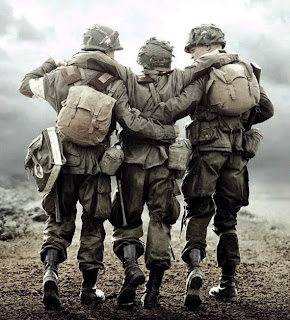 Some of that, of course, is borrowed pathos. World War II so fundamentally shaped twentieth century American life that any audience sitting down to watch this miniseries brings with it at least a cursory understanding of why this war was fought and the toll it took both at home and abroad. For instance, the viewer knows, even if the soldiers don’t yet, that while they were landing at Normandy the Germans were busy trying to exterminate an entire race of people. The viewer knows that the eventual loss of life due to this war was staggeringly high, reaching well into the tens of millions. And that the toll this conflict took on anyone who lived through it, whether they fought in the war or not, was felt for years to come, such that it shaped the character of two generations of the population of the entire world and was the defining moment of the last century. With that sort of backdrop always present somewhere in the back of the audience’s mind, the events of the Band of Brothers miniseries take on an emotional weight that they almost certainly would not otherwise have.
That added pathos, together with the fact that the events depicted on screen are as close to real as they could possibly be (a fact that is cleverly evoked by having the men upon whom these characters were based interviewed at the beginning of each installment), creates in the audience the sense not that they’re watching some filmmaker’s idea of what the war was like but rather that they’re watching the actual war. Because of that, the characters and events of the film become real in way that no other war film can even come close to. The virtuoso D-Day sequence that opens Saving Private Ryan, for instance, might get as close to the experience of war as cinema is capable; but the emotional impact of that admittedly powerful sequence pales in comparison to watching two beloved characters blown in half by artillery fire seven episodes into Band of Brothers.
The emotional impact of the deaths and catastrophic injuries in Band of Brothers owes its weight to a number of factors. Knowing that these men were real and that this really happened is a big part of it. Having been with them through training and D-Day and countless skirmishes and night patrols is part of it. And listening to the men who actually knew and were friends with the soldiers who died is part of it as well. Taken together, these elements add up to an emotional impact far beyond what's usually possible in a war movie. To even attempt to conceive of what that must have been like to live through is almost impossible. And yet these men managed to continue to fight, to pick up and move on despite such debilitating loss.
It’s commonplace to call the soldiers of World War II heroes. Tom Brokaw wrote a book calling them The Greatest Generation, an appellation that has since entered common usage as a way of describing anyone over the age of eighty. Predictably, of course, they all shirk that label, saying instead that though they served in the company of heroes, they themselves were not. To me, the real heroism on display here is not that these were mostly uneducated men— boys, really— who knew little of the world or what was in store for them but chose to go anyway. That’s courageous, of course, but can also be chalked up to a sense of honor or duty, or even just plain naïveté. What I find heroic about these men is that they kept on going. Seeing what they saw on D-Day, they still managed to fight on through France and into Holland, where they suffered unimaginable loss during the long winter in Bastogne. And still they kept on and continued into Germany and then Austria. It’s hard not to imagine giving up and packing it in after even one of those experiences. Hell, even one single day of what they saw would be enough to make anyone want to head for home. But they didn’t. Surrounded and all but engulfed by pain and fear, they kept on.
If there’s one thing that stands out at the end of Band of Brothers it’s the immeasurable sense of loss hanging over these men. More than just the lost friends and fellow soldiers, more than just the loss of innocence, there’s the very real sense that, by the end of 1945, these men had lost something ineffable about being human that they would never quite be able to recover. Though obviously none of us can know what it was like for these men, it certainly appears that much of their idealism died on the battlefields of Europe. Seeing what they saw, the pain and death, the horrible torture one group of people inflicted upon another and the way that a whole country stood by and watched it happen, they lost their faith in mankind. With that faith gone, all they had was each other.
At the close of the tenth and last episode of the miniseries, a voiceover describes the lives of each of the surviving members of Easy Company after they returned home. To a one they lived simple, modest lives, lives that today, in our celebrity obsessed, everyone is special and important culture, might be looked down upon as being normal, ordinary and, well, boring. But maybe those men learned something on the beaches of Normandy and the forests of Bastogne that only the experience of war can teach. When death closes in all around you and is ever present just over the next hill, all you really have to hang on to are the relationships you have with those closest to you. Maybe what you do isn’t nearly as important as how you do it and who you do it with. Maybe that’s the lesson these men took away from the war. It might have cost them their innocence, their youth, their idealism and their faith in their fellow man, but it certainly gave them a clear idea of what was important. It’s a lesson probably unknowable to those who were never there, but the fact that Band of Brothers drives that point home is what elevates it above other films of its kind. There might be nothing in the miniseries we haven’t seen before, but nothing before it has made that point so clearly and so forcefully.
World War II, of course, is no different. But what separates Band of Brothers from other depictions of WWII on film is not that it portrays the war in a way that’s all that different from what we’ve seen countless times before but rather that, because it’s based entirely on the recollections of men who were actually there and goes out of its way to be as historically accurate as possible, it breathes new life into some of the more hoary clichés of the World War II film. Even though we’ve seen the gung ho private hell bent on bringing a German Luger back to the States for his younger brother or the reluctant hero whose quiet strength is ideally suited to leading men into combat, Band of Brothers manages to evoke these clichés in a way that rings truer than most similar films, even ones lauded for their realism such as Saving Private Ryan.
 Some of that, of course, is borrowed pathos. World War II so fundamentally shaped twentieth century American life that any audience sitting down to watch this miniseries brings with it at least a cursory understanding of why this war was fought and the toll it took both at home and abroad. For instance, the viewer knows, even if the soldiers don’t yet, that while they were landing at Normandy the Germans were busy trying to exterminate an entire race of people. The viewer knows that the eventual loss of life due to this war was staggeringly high, reaching well into the tens of millions. And that the toll this conflict took on anyone who lived through it, whether they fought in the war or not, was felt for years to come, such that it shaped the character of two generations of the population of the entire world and was the defining moment of the last century. With that sort of backdrop always present somewhere in the back of the audience’s mind, the events of the Band of Brothers miniseries take on an emotional weight that they almost certainly would not otherwise have.
That added pathos, together with the fact that the events depicted on screen are as close to real as they could possibly be (a fact that is cleverly evoked by having the men upon whom these characters were based interviewed at the beginning of each installment), creates in the audience the sense not that they’re watching some filmmaker’s idea of what the war was like but rather that they’re watching the actual war. Because of that, the characters and events of the film become real in way that no other war film can even come close to. The virtuoso D-Day sequence that opens Saving Private Ryan, for instance, might get as close to the experience of war as cinema is capable; but the emotional impact of that admittedly powerful sequence pales in comparison to watching two beloved characters blown in half by artillery fire seven episodes into Band of Brothers.
The emotional impact of the deaths and catastrophic injuries in Band of Brothers owes its weight to a number of factors. Knowing that these men were real and that this really happened is a big part of it. Having been with them through training and D-Day and countless skirmishes and night patrols is part of it. And listening to the men who actually knew and were friends with the soldiers who died is part of it as well. Taken together, these elements add up to an emotional impact far beyond what's usually possible in a war movie. To even attempt to conceive of what that must have been like to live through is almost impossible. And yet these men managed to continue to fight, to pick up and move on despite such debilitating loss.
It’s commonplace to call the soldiers of World War II heroes. Tom Brokaw wrote a book calling them The Greatest Generation, an appellation that has since entered common usage as a way of describing anyone over the age of eighty. Predictably, of course, they all shirk that label, saying instead that though they served in the company of heroes, they themselves were not. To me, the real heroism on display here is not that these were mostly uneducated men— boys, really— who knew little of the world or what was in store for them but chose to go anyway. That’s courageous, of course, but can also be chalked up to a sense of honor or duty, or even just plain naïveté. What I find heroic about these men is that they kept on going. Seeing what they saw on D-Day, they still managed to fight on through France and into Holland, where they suffered unimaginable loss during the long winter in Bastogne. And still they kept on and continued into Germany and then Austria. It’s hard not to imagine giving up and packing it in after even one of those experiences. Hell, even one single day of what they saw would be enough to make anyone want to head for home. But they didn’t. Surrounded and all but engulfed by pain and fear, they kept on.
If there’s one thing that stands out at the end of Band of Brothers it’s the immeasurable sense of loss hanging over these men. More than just the lost friends and fellow soldiers, more than just the loss of innocence, there’s the very real sense that, by the end of 1945, these men had lost something ineffable about being human that they would never quite be able to recover. Though obviously none of us can know what it was like for these men, it certainly appears that much of their idealism died on the battlefields of Europe. Seeing what they saw, the pain and death, the horrible torture one group of people inflicted upon another and the way that a whole country stood by and watched it happen, they lost their faith in mankind. With that faith gone, all they had was each other.
At the close of the tenth and last episode of the miniseries, a voiceover describes the lives of each of the surviving members of Easy Company after they returned home. To a one they lived simple, modest lives, lives that today, in our celebrity obsessed, everyone is special and important culture, might be looked down upon as being normal, ordinary and, well, boring. But maybe those men learned something on the beaches of Normandy and the forests of Bastogne that only the experience of war can teach. When death closes in all around you and is ever present just over the next hill, all you really have to hang on to are the relationships you have with those closest to you. Maybe what you do isn’t nearly as important as how you do it and who you do it with. Maybe that’s the lesson these men took away from the war. It might have cost them their innocence, their youth, their idealism and their faith in their fellow man, but it certainly gave them a clear idea of what was important. It’s a lesson probably unknowable to those who were never there, but the fact that Band of Brothers drives that point home is what elevates it above other films of its kind. There might be nothing in the miniseries we haven’t seen before, but nothing before it has made that point so clearly and so forcefully.
Thursday, June 4, 2009
UP – pete docter – 8.3 / 10
The bar for a Pixar film is set pretty high-- perhaps unreasonably so-- but personally I’ve only really loved the Brad Bird entries in the Pixar catalog (The Incredibles and Ratatouille). Last year, I was particularly annoyed that the general consensus seemed to be that Wall-E was Pixar’s best film to date. Seeing as it had major problems in its last third, a completely predictable (not to mention poorly thought out) ending and a couple of action sequences that seemed more suited to something in a Dreamworks animation film, I couldn’t see how anyone could think it the best film Pixar had yet made.
Even though I only really enjoyed the first forty minutes or so of Wall-E, I was still heartened by the fact that Pixar didn’t seem to be resting on any particular formula or taking the easy way out and making more films about talking animals, toys, cars and other inanimate objects; something they could probably do for decades with great financial (and possibly even critical) success. Indeed, it almost seems as if they've purposefully decided to make films centered on topics and ideas that, on the surface, appear least likely to produce great films. Three years ago they made a film about a rat, possibly the most hated creature ever to get a starring role in a major film. They followed that with a story about the last inhabitant of a blighted earth, a robot without a voice. And now, with Up, they’ve made a film about a cantankerous old man biding his time on his porch as he waits to die.

And yet, somehow, Up turns out to be the funniest and possibly most moving Pixar film yet. And while it isn’t my personal favorite from the studio (that would be Ratatouille), it gets pretty close. Much of the emotional heft of the film owes to the incredible, wordless, ten-minute sequence that comes near the beginning of the film wherein we see young Carl and Ellie grow from young children into senior citizens, facing some serious (and very adult) problems along the way. Aside from the incredibly assured storytelling on display in this sequence, you also have to love the fact that the film doesn’t pander to the children in the audience. There’s no way, for instance, that a child of eight or nine would understand, from the quick shot we see here, that Carl and Ellie can’t have children. But rather than explain it with dialogue, the filmmakers (Pete Docter and co-director Bob Peterson) seem fine with the kids not getting it and seem to think it won’t impact their enjoyment of the film negatively. The level of confidence that choice displays is truly remarkable.
That moment is also, in a nutshell, the difference between a Pixar film and an animated film from one of its rivals (Dreamworks especially). Whereas in a film like Shrek or Kung Fu Panda, the stuff for adults is simply a random smattering of pop culture references, with Up the adults in the audience are experiencing the film in a whole different way than their kids. That difference in approach tells you everything you need to know about what sort of films Pixar is making (and, conversely, it also says a lot about what sort of films Dreamworks is making).
Whatever I might have thought of the ending of Wall-E, the first, mostly wordless half of the film works spectacularly well. It’s emotionally affecting, highly entertaining and remarkably assured. Aside from the aforementioned ten-minute wordless sequence at the start of Up, the best moment in the film is a similarly wordless sequence wherein Carl empties his house of all the worldly possessions acquired in his life with Ellie. It’s both a way of saying a last goodbye to his beloved wife and of finally choosing to begin the next phase of his life. In particular, the shot of their favorite chairs sitting side by side on the plateau just as they had sat for so many years in their living room is heartbreaking.
That the filmmakers at Pixar can achieve such poignancy without employing a single word of dialogue is extraordinary. And it’s become pretty clear after these last two movies (plus their last few short films (Lifted, Presto and Partly Cloudy) which have all been free of dialogue) that Pixar has a command of the visual medium that surpasses just about anything since sound first entered the picture in the late 1920s. That’s a tremendous achievement for any filmmaker but for a group who-- ostensibly at least-- make kids’ movies, it’s downright incredible. In fact, you could probably watch Up with the sound off and not miss out on any of the emotional impact of the film.
That’s not to say that the voice acting in Up is without merit. Indeed, the voices of the various dog characters are used to great comedic effect. In particular, Dug (voiced by co-director Bob Peterson who also voices Alpha) is given just the right mix of silliness and pathos that he stands out as one of the more memorable talking animals in a genre overrun with them. My personal favorite Dug moment comes right at the end when Carl and Russell (the stowaway on Carl’s floating house) are playing a game involving spotting different colored cars. Dug, color blind obviously, shouts out that he sees gray cars. It’s a moment that probably (though obviously I can’t say for sure) works for the kids in the audience just because Peterson’s deliver of the line is funny on its own. But it’s an added treat for the adults, one more way in which the filmmakers refuse to pander to their audience.
Up is not, however, without its problems. Perhaps owing to the fact that it’s more aggressively comedic than any film Pixar has yet produced, Up falters a little by telegraphing its jokes and repeating a few of them one time too many. Whereas with the dramatic elements the film is assured and nearly flawless, the comedic elements seem forced and occasionally labored. One such example is the bit where the dogs become distracted by the sight of a squirrel. Though it’s paid off pretty well in it’s final iteration, the joke becomes a little annoying after the second or third time it’s employed.
There’s also the clumsy way in which the film deals with its cartoonish, capital 'E' evil villain, especially since this is the first Pixar film that has resorted to such a stereotypical villain. There’s nothing redeemable about Charles Muntz and no sense of what might have made him the way he is (that the world didn’t believe his discoveries were real is not sufficient motivation for becoming a old Hollywood style, scenery chewing villain). He’s just a plot device to kick off the really nifty jungle chase sequence in the middle of the film and the elaborate airborne battle at the close of the film. And he’s dispatched in a rather bland and predictable way, almost as if he’s beside the point. And, really, I guess he is. The film isn’t about him. It’s Carl and Russell’s journey. Muntz is just there so that we can get some cool action. There’s nothing wrong with that, necessarily, but I’ve come to expect more from a Pixar film.
But comparing Up to other Pixar films is a little unfair. After all, The Incredibles, Ratatouille and the first half of Wall-E set the bar so high that a failure to clear it seems like something of a disappointment when the fact that Up even gets close to scaling those heights should be celebrated.
Besides the obvious jokes and stereotypically cartoony villain, perhaps what most keeps Up grounded where other Pixar films soared is the smallness of the story it has to tell. Up is the story of one man coming to terms with the death of his wife and finding his place in a world without her. And while that’s certainly a resonant story to tell (and one that's told with incredible grace and skill), it’s not exactly an earth-shatteringly important story. It’s a modest movie I guess is what I’m saying. There’s nothing wrong with that, of course. And the film tells its modest story extremely well. It’s really only in comparison to other Pixar films that Up falters. And while that’s incredibly unfair (after all, nobody judges Terminator Salvation on how it compares to The Dark Knight just because they were produced by the same studio), that’s just the way it is sometimes.
Even though I only really enjoyed the first forty minutes or so of Wall-E, I was still heartened by the fact that Pixar didn’t seem to be resting on any particular formula or taking the easy way out and making more films about talking animals, toys, cars and other inanimate objects; something they could probably do for decades with great financial (and possibly even critical) success. Indeed, it almost seems as if they've purposefully decided to make films centered on topics and ideas that, on the surface, appear least likely to produce great films. Three years ago they made a film about a rat, possibly the most hated creature ever to get a starring role in a major film. They followed that with a story about the last inhabitant of a blighted earth, a robot without a voice. And now, with Up, they’ve made a film about a cantankerous old man biding his time on his porch as he waits to die.

And yet, somehow, Up turns out to be the funniest and possibly most moving Pixar film yet. And while it isn’t my personal favorite from the studio (that would be Ratatouille), it gets pretty close. Much of the emotional heft of the film owes to the incredible, wordless, ten-minute sequence that comes near the beginning of the film wherein we see young Carl and Ellie grow from young children into senior citizens, facing some serious (and very adult) problems along the way. Aside from the incredibly assured storytelling on display in this sequence, you also have to love the fact that the film doesn’t pander to the children in the audience. There’s no way, for instance, that a child of eight or nine would understand, from the quick shot we see here, that Carl and Ellie can’t have children. But rather than explain it with dialogue, the filmmakers (Pete Docter and co-director Bob Peterson) seem fine with the kids not getting it and seem to think it won’t impact their enjoyment of the film negatively. The level of confidence that choice displays is truly remarkable.
That moment is also, in a nutshell, the difference between a Pixar film and an animated film from one of its rivals (Dreamworks especially). Whereas in a film like Shrek or Kung Fu Panda, the stuff for adults is simply a random smattering of pop culture references, with Up the adults in the audience are experiencing the film in a whole different way than their kids. That difference in approach tells you everything you need to know about what sort of films Pixar is making (and, conversely, it also says a lot about what sort of films Dreamworks is making).
Whatever I might have thought of the ending of Wall-E, the first, mostly wordless half of the film works spectacularly well. It’s emotionally affecting, highly entertaining and remarkably assured. Aside from the aforementioned ten-minute wordless sequence at the start of Up, the best moment in the film is a similarly wordless sequence wherein Carl empties his house of all the worldly possessions acquired in his life with Ellie. It’s both a way of saying a last goodbye to his beloved wife and of finally choosing to begin the next phase of his life. In particular, the shot of their favorite chairs sitting side by side on the plateau just as they had sat for so many years in their living room is heartbreaking.
That the filmmakers at Pixar can achieve such poignancy without employing a single word of dialogue is extraordinary. And it’s become pretty clear after these last two movies (plus their last few short films (Lifted, Presto and Partly Cloudy) which have all been free of dialogue) that Pixar has a command of the visual medium that surpasses just about anything since sound first entered the picture in the late 1920s. That’s a tremendous achievement for any filmmaker but for a group who-- ostensibly at least-- make kids’ movies, it’s downright incredible. In fact, you could probably watch Up with the sound off and not miss out on any of the emotional impact of the film.
That’s not to say that the voice acting in Up is without merit. Indeed, the voices of the various dog characters are used to great comedic effect. In particular, Dug (voiced by co-director Bob Peterson who also voices Alpha) is given just the right mix of silliness and pathos that he stands out as one of the more memorable talking animals in a genre overrun with them. My personal favorite Dug moment comes right at the end when Carl and Russell (the stowaway on Carl’s floating house) are playing a game involving spotting different colored cars. Dug, color blind obviously, shouts out that he sees gray cars. It’s a moment that probably (though obviously I can’t say for sure) works for the kids in the audience just because Peterson’s deliver of the line is funny on its own. But it’s an added treat for the adults, one more way in which the filmmakers refuse to pander to their audience.
Up is not, however, without its problems. Perhaps owing to the fact that it’s more aggressively comedic than any film Pixar has yet produced, Up falters a little by telegraphing its jokes and repeating a few of them one time too many. Whereas with the dramatic elements the film is assured and nearly flawless, the comedic elements seem forced and occasionally labored. One such example is the bit where the dogs become distracted by the sight of a squirrel. Though it’s paid off pretty well in it’s final iteration, the joke becomes a little annoying after the second or third time it’s employed.
There’s also the clumsy way in which the film deals with its cartoonish, capital 'E' evil villain, especially since this is the first Pixar film that has resorted to such a stereotypical villain. There’s nothing redeemable about Charles Muntz and no sense of what might have made him the way he is (that the world didn’t believe his discoveries were real is not sufficient motivation for becoming a old Hollywood style, scenery chewing villain). He’s just a plot device to kick off the really nifty jungle chase sequence in the middle of the film and the elaborate airborne battle at the close of the film. And he’s dispatched in a rather bland and predictable way, almost as if he’s beside the point. And, really, I guess he is. The film isn’t about him. It’s Carl and Russell’s journey. Muntz is just there so that we can get some cool action. There’s nothing wrong with that, necessarily, but I’ve come to expect more from a Pixar film.
But comparing Up to other Pixar films is a little unfair. After all, The Incredibles, Ratatouille and the first half of Wall-E set the bar so high that a failure to clear it seems like something of a disappointment when the fact that Up even gets close to scaling those heights should be celebrated.
Besides the obvious jokes and stereotypically cartoony villain, perhaps what most keeps Up grounded where other Pixar films soared is the smallness of the story it has to tell. Up is the story of one man coming to terms with the death of his wife and finding his place in a world without her. And while that’s certainly a resonant story to tell (and one that's told with incredible grace and skill), it’s not exactly an earth-shatteringly important story. It’s a modest movie I guess is what I’m saying. There’s nothing wrong with that, of course. And the film tells its modest story extremely well. It’s really only in comparison to other Pixar films that Up falters. And while that’s incredibly unfair (after all, nobody judges Terminator Salvation on how it compares to The Dark Knight just because they were produced by the same studio), that’s just the way it is sometimes.
Wednesday, June 3, 2009
DRAG ME TO HELL - sam raimi - 3.5 / 10
It’s reassuring, in a way, that even after achieving massive success in mainstream action movies (the Spider-Man franchise) Sam Raimi is still capable of delivering the same sort of movie he used to make on a shoestring budget with a couple friends at a cabin in the woods. The director’s latest, Drag Me to Hell, is tonally and thematically very similar to his horror comedies from twenty years ago (Evil Dead and Army of Darkness). That said, I still didn’t enjoy Drag Me to Hell all that much. I guess I should have expected that since I really didn’t care for Evil Dead or Army of Darkness all that much either. But the one new element Raimi adds to Drag Me to Hell is the one that really turned me off to the film, and that’s the cringe-inducing comedy of the Ricky Gervais / Danny McBride / Will Ferrell school. And since I generally hate that sort of humor, it’s no surprise that I was pretty much repulsed by Drag Me to Hell.


Tuesday, June 2, 2009
THE JERK - carl reiner - 4.6 / 10
Comedy is one of those things that, for whatever reason, often just doesn’t age well. No one watches Charlie Chaplin films today and thinks they’re hilarious. Critics like them and film students respect them but I find it impossible to believe that either of those groups really thinks they’re all that funny. And you don’t have to go back nearly that far to find something that was once beloved but no longer makes anyone laugh. The TV show M*A*S*H, today known mostly as the signal for a whole generation of twenty- and thirty-somethings that it’s time for bed (because reruns aired every night at 10:00 when we were kids), was thought to be pretty outrageously hilarious in its day. But to almost anyone under the age of thirty-five, the show falls completely flat. For whatever reason (socio-political, cultural or just because the way stories are told on television has evolved), the show didn’t age well.
 That’s not to say that no comedies age well. I still found Annie Hall hilarious the first time I saw it more than twenty-five years after it was first released. New and younger viewers discover the Monty Python films everyday and think them uproarious. But by and large comedy is measured in dog years. The pop culture references and in-jokes that litter even solid comedies like Role Models are going to be seem hopelessly dated in five or ten years. And though the film will still work for those of us who remember those jokes, to a younger generation they will be lost. And so our kids will look at us with amazement as we laugh our asses off at old South Park reruns (though I hold out hope they might still enjoy The Simpsons).
All that’s a long way of saying that despite its reputation as one of the best comedies of the past half century, The Jerk is pretty boring to a modern audience. This has less to do, I think, with the jokes in the film and more to do with the way in which the story is told. If it were made today, The Jerk would probably have employed a different structure and would have been a little less crudely produced. Those two things might add to the charm of the film for those who grew up with it, but for someone coming to the film now, it’s a fatal flaw.
The structure, in particular, is the film’s Achilles’ heel. It opens on Steve Martin’s Navin sleeping on the street outside a theater. The camera tracks over to him and he begins to tell his story, saying that he was once rich, powerful and famous but is now a bum. Then the story proper begins. But because the viewer knows Navin ends up penniless and sleeping on the street, there’s always a sense of waiting for the other shoe to drop. And because of that, a weird sort of tension is created in which the audience can’t fully enjoy what they’re seeing on the screen because they’re thinking about how this could lead to Navin’s downfall.
Whatever you might think of Forrest Gump (a film that seems to have borrowed quite heavily from the structure of The Jerk), the film only works because the framing story (the one where Forrest sits on the park bench and talks to strangers) takes place before the end of the main story. If Forrest had been telling his tale after having visited Jenny, found out she was dying and that her son was his, a lot of air would have been let out of the film. There would've been much less to hold the viewer’s interest and the film would certainly have been long forgotten by now (though I suppose you might think that would be a good thing).
The Jerk, of course, is primarily a comedy so aside from getting in the way of the humor, the clumsy structure really shouldn’t matter all that much. But because the comedic parts of the film have aged poorly and are no longer all that funny to a viewer who didn’t come of age during that period (or at least it’s not funny to this viewer anyway) all that’s left is the story. And what could have been a compelling tale is robbed of any emotional weight by the knowledge of how it’s going to end. Thus the film is pretty much a failure for a modern audience. It’s easy enough to see why audiences at the time thought it a classic, but comedy’s a very fickle thing. Here’s hoping that The Simpsons ages better.
 That’s not to say that no comedies age well. I still found Annie Hall hilarious the first time I saw it more than twenty-five years after it was first released. New and younger viewers discover the Monty Python films everyday and think them uproarious. But by and large comedy is measured in dog years. The pop culture references and in-jokes that litter even solid comedies like Role Models are going to be seem hopelessly dated in five or ten years. And though the film will still work for those of us who remember those jokes, to a younger generation they will be lost. And so our kids will look at us with amazement as we laugh our asses off at old South Park reruns (though I hold out hope they might still enjoy The Simpsons).
All that’s a long way of saying that despite its reputation as one of the best comedies of the past half century, The Jerk is pretty boring to a modern audience. This has less to do, I think, with the jokes in the film and more to do with the way in which the story is told. If it were made today, The Jerk would probably have employed a different structure and would have been a little less crudely produced. Those two things might add to the charm of the film for those who grew up with it, but for someone coming to the film now, it’s a fatal flaw.
The structure, in particular, is the film’s Achilles’ heel. It opens on Steve Martin’s Navin sleeping on the street outside a theater. The camera tracks over to him and he begins to tell his story, saying that he was once rich, powerful and famous but is now a bum. Then the story proper begins. But because the viewer knows Navin ends up penniless and sleeping on the street, there’s always a sense of waiting for the other shoe to drop. And because of that, a weird sort of tension is created in which the audience can’t fully enjoy what they’re seeing on the screen because they’re thinking about how this could lead to Navin’s downfall.
Whatever you might think of Forrest Gump (a film that seems to have borrowed quite heavily from the structure of The Jerk), the film only works because the framing story (the one where Forrest sits on the park bench and talks to strangers) takes place before the end of the main story. If Forrest had been telling his tale after having visited Jenny, found out she was dying and that her son was his, a lot of air would have been let out of the film. There would've been much less to hold the viewer’s interest and the film would certainly have been long forgotten by now (though I suppose you might think that would be a good thing).
The Jerk, of course, is primarily a comedy so aside from getting in the way of the humor, the clumsy structure really shouldn’t matter all that much. But because the comedic parts of the film have aged poorly and are no longer all that funny to a viewer who didn’t come of age during that period (or at least it’s not funny to this viewer anyway) all that’s left is the story. And what could have been a compelling tale is robbed of any emotional weight by the knowledge of how it’s going to end. Thus the film is pretty much a failure for a modern audience. It’s easy enough to see why audiences at the time thought it a classic, but comedy’s a very fickle thing. Here’s hoping that The Simpsons ages better.
Monday, May 25, 2009
ANGELS & DEMONS - ron howard - 2.2 / 10
Ron Howard has always been a competent filmmaker. And while he was never going to make a masterpiece, his films had an amiable quality that made them easy to watch and hard to hate. That was especially true of his earlier work like Splash, Gung Ho and The Paper. None of them were particularly good, exactly, but they were well made, well acted and pleasant enough. Not the kind of thing you’d rush out to see again or to tell your friends about, but not a bad way to spend a couple hours. There was never going to be anything controversial or provocative, nothing risqué or even all that challenging, but a Ron Howard film could always be counted on to be entertaining. In fact, that was sort of the trademark of a Ron Howard movie.
But that all changed when Howard hooked up with Akiva Goldsman in 2001. Goldsman, perhaps the least talented, most simplistic writer currently working in major studio movies, is the man responsible for destroying the old Batman franchise (having written Batman Forever and Batman & Robin), no mean feat considering Batman might be the world’s most popular and enduring fictional character. He’s never met a cliché he didn’t love and writes as if he has a screenwriting textbook next to his laptop at all times. The man has never written anything that wasn’t oversimplified, diagrammatic and just plain boring.

When Goldsman and Howard teamed up for A Beautiful Mind and were inexplicably rewarded with a fistful of Oscars, it solidified their creative partnership. Since then they’ve collaborated on The Da Vinci Code, Cinderella Man and now Angels & Demons, growing more formulaic and dull with each film. Where a pre-Goldsman Ron Howard movie could be counted on to be entertaining and pleasant, even occasionally affecting, a post-Goldsman Ron Howard movie can be counted on to be bombastic, boring and borderline insulting in its pandering to the lowest common denominator.
In the specific case of Angels & Demons, it means that every vital piece of information is repeated at least three times so that even the least attentive viewer can follow along (e.g. the fact that the bomb is set to go off at midnight is said at least four times by four different characters). It means that there are long, incredibly dull passages of exposition that make no sense in the context of the film but ensure that the less intelligent members of the audience know exactly what’s going on (e.g. Robert Langdon’s many long digressions about Vatican history to a bunch of Vatican employees who really shouldn’t need to be lectured by some Harvard professor). And it means that making sense falls a distant second behind looking and sounding cool.
It’s filmmaking by idiots for idiots is what I’m saying. And it’s downright insulting to anyone capable of following a plot more complicated than that of the average American Idol episode. And while that might lead to a box office bonanza (indeed, Howard’s collaborations with Goldsman have been his highest grossing movies), it also makes their films nearly impossible to sit through.
I could go on and on about the myriad issues I had with Angels & Demons, like why, for instance, when Langdon and a Vatican police officer are locked in a airless vault and suffocating to death it takes them minutes to figure out that maybe shooting the glass would be a good idea. Or, for that matter, how it’s even possible that two guys could use up all the oxygen in a massive room in just a couple minutes. Or why the power was shut down that long in the first place since a ten second power outage would have accomplished their goals just as easily. But once you start down that road you get sucked into a never-ending spiral of nonsense and idiocy; each instance of absurdity leads to another moment even more ridiculous and on and on. Nothing makes any sense and pointing out the exact ways in which it all fails to cohere would require more brainpower than was used to make the film in the first place so I won't bother.
Suffice it to say that Goldsman and Howard continue their unbroken streak of commercially successful, artistically bankrupt films. And know that if you pay good money to see Angels & Demons and you have more than a couple functioning brain cells, you’re going to be disappointed and extremely bored.
But that all changed when Howard hooked up with Akiva Goldsman in 2001. Goldsman, perhaps the least talented, most simplistic writer currently working in major studio movies, is the man responsible for destroying the old Batman franchise (having written Batman Forever and Batman & Robin), no mean feat considering Batman might be the world’s most popular and enduring fictional character. He’s never met a cliché he didn’t love and writes as if he has a screenwriting textbook next to his laptop at all times. The man has never written anything that wasn’t oversimplified, diagrammatic and just plain boring.

When Goldsman and Howard teamed up for A Beautiful Mind and were inexplicably rewarded with a fistful of Oscars, it solidified their creative partnership. Since then they’ve collaborated on The Da Vinci Code, Cinderella Man and now Angels & Demons, growing more formulaic and dull with each film. Where a pre-Goldsman Ron Howard movie could be counted on to be entertaining and pleasant, even occasionally affecting, a post-Goldsman Ron Howard movie can be counted on to be bombastic, boring and borderline insulting in its pandering to the lowest common denominator.
In the specific case of Angels & Demons, it means that every vital piece of information is repeated at least three times so that even the least attentive viewer can follow along (e.g. the fact that the bomb is set to go off at midnight is said at least four times by four different characters). It means that there are long, incredibly dull passages of exposition that make no sense in the context of the film but ensure that the less intelligent members of the audience know exactly what’s going on (e.g. Robert Langdon’s many long digressions about Vatican history to a bunch of Vatican employees who really shouldn’t need to be lectured by some Harvard professor). And it means that making sense falls a distant second behind looking and sounding cool.
It’s filmmaking by idiots for idiots is what I’m saying. And it’s downright insulting to anyone capable of following a plot more complicated than that of the average American Idol episode. And while that might lead to a box office bonanza (indeed, Howard’s collaborations with Goldsman have been his highest grossing movies), it also makes their films nearly impossible to sit through.
I could go on and on about the myriad issues I had with Angels & Demons, like why, for instance, when Langdon and a Vatican police officer are locked in a airless vault and suffocating to death it takes them minutes to figure out that maybe shooting the glass would be a good idea. Or, for that matter, how it’s even possible that two guys could use up all the oxygen in a massive room in just a couple minutes. Or why the power was shut down that long in the first place since a ten second power outage would have accomplished their goals just as easily. But once you start down that road you get sucked into a never-ending spiral of nonsense and idiocy; each instance of absurdity leads to another moment even more ridiculous and on and on. Nothing makes any sense and pointing out the exact ways in which it all fails to cohere would require more brainpower than was used to make the film in the first place so I won't bother.
Suffice it to say that Goldsman and Howard continue their unbroken streak of commercially successful, artistically bankrupt films. And know that if you pay good money to see Angels & Demons and you have more than a couple functioning brain cells, you’re going to be disappointed and extremely bored.
Friday, May 22, 2009
TERMINATOR SALVATION – mc g – 2.3 / 10
When you get right down to it, none of the Terminator films really make all that much sense. Why, for instance, if the machines could send three terminators back through time to kill Sarah and then John Connor, couldn’t they send a hundred? Why couldn’t they send a terminator every single day until they had a whole army of terminators? Why couldn’t they send a terminator further back in time to go after Sarah when she was still a little girl? For that matter, why couldn’t they send a terminator back to the 1800s to kill Sarah’s ancestors? Wouldn’t the technological advantage the terminator would have make them easy prey?


Wednesday, May 13, 2009
STAR TREK - j.j. abrams - 8.0 / 10
Describing a particular film as a rollercoaster thrill ride is about as cliché as it gets and usually the last refuge of the lazy critic, but that phrase is uniquely appropriate as a description of Star Trek in that the film is as fast moving, exciting, enjoyable, harmless and ultimately forgettable as any ride at Six Flags. To be sure, that’s no small accomplishment. I’m hard pressed to think of more than a handful of films that offer as much genuine enjoyment as this one. But like a rollercoaster ride that’s been enjoyed by thousands of theme park attendees without any real incident, the thrill of Star Trek is just in taking the ride, not in being asked to contemplate what any of it means.
And that’s a really good thing for the film because if you stop and think about what’s actually happening at any given moment, none of it makes any damn sense. For instance, is it really believable that Captain Pike (Bruce Greenwood, outstanding) is able to convince Jim Kirk (Chris Pine, appealingly arrogant) to enlist in Starfleet that easily after he’s spent his whole life running away from the institution that took his father? Does it make any sense that a stowaway on the Enterprise (Kirk) would be promoted to First Officer before having done anything to deserve it? Is there really no one on that massive ship more qualified? (The same could also be said for Uhura and Dr. McCoy who go from cadets to bridge officers in what has to be world record time.) Or, for that matter, what the hell is Winona Ryder doing in old age makeup playing Spock’s mom? Couldn’t they have found someone age appropriate to play the part?

Thankfully, however, it’s pretty hard to concentrate on these questions and inconsistencies while the film is unspooling. It’s only afterwards in thinking about it that they crop up. During the film, the terrific cast glosses over any holes by having so much damn fun flying a spaceship, teleporting into hostile environments, parachuting from outer space (another thing that I’m pretty sure is impossible) and knocking the crap out of each other. Their sense of wonder, adventure and excitement is so infectious that it’s impossible not to get caught up in it. There’s no guile, introspection or brooding. Everyone is just loving whatever it is they’re doing. From Chekov running down the halls to get to the teleportation room so he can rescue Kirk and Sulu to Scotty’s glee at seeing a fistfight on the bridge to Kirk’s amused grin pretty much all the time, it’s abundantly clear that everyone is on the adventure of their lives. And it’s pretty hard to hate on the film in the midst of that.
Similarly, this shared sense of glee between the audience and the characters is what made Iron Man work as well as it did (and earn as much money as it did). The film might be flawed (hell, it’s really flawed) but Tony Stark is having so much damn fun being Iron Man that the audience has fun too. With so many revered blockbusters of late (The Dark Knight, Superman Returns, etc.) making it seem like being a hero is a lot of work and inflicts some serious psychological damage, seeing the characters of Star Trek almost giddy at the prospect of saving the day is pretty remarkable and extremely satisfying. Just like a rollercoaster, there’s all the fun of actually doing something harrowing and death defying with none of the attendant danger or stress that would come with doing it for real.
That, of course, is also why the film falls short of real greatness (well, that and all the plot holes). There’s just no way that real people put in situations like these would behave the way these characters do. And because they wouldn’t, the film really doesn’t have all that much to say beyond simply entertaining its audience. But given how few would-be blockbusters accomplish even that, Star Trek is sort of remarkable.
If that seems like I’m damning the film with faint praise, perhaps that’s because I wasn’t quite as taken with it as I think I could have been had I known nothing about the Star Trek universe going in. There were a few too many nods to the original TV series and movies for my taste and they kept knocking me out of the film. Any time some tidbit of Trek lore was referenced (the Vulcan death grip, the guy in the red suit dying first, etc.), it momentarily broke the fourth wall and took me out of the film. And I’m not even that big a fan of the original series. I’ve only seen a handful of episodes of the show and only the first two (out of six) of the films. I imagine that if I’d seen them all this film might have been little more than a long string of inside jokes.
That being the case, I wonder if the film is actually less entertaining for hardcore Trekkies (or Trekkers or whatever they’re calling themselves these days). They might be pleased at having been kowtowed to, but having in-jokes constantly taking you out of the film is more annoying than anything else. I imagine they’ll also complain that even though the new film is a lot more visually impressive and emotionally thrilling than anything the original series and films were able to do, that misses the whole point of Star Trek. The point, at least as I understand it since I’m not much of a fan, is that the lack of pleasing aesthetics is the point. The show made its audience work to enjoy it. And though this turned off a lot of people, if you managed to stick with it, the reward was (supposedly) great.
I can’t really speak to that but I think rebooting Star Trek this way, as a fun, enjoyable ride, was the only way to make the series relevant again. The introspection and deeper meaning can came in the inevitable sequels. For now I’m content to marvel at the way in which J.J. Abrams and Co. (a group of people I honestly never thought would create anything of real merit) have reinvigorated an all but deceased franchise simply by making it fun. They made the world of Star Trek—a world that had, in the last decade or so, become all but synonymous with nerdy geekdom—a place that the average filmgoer who has never read a science fiction book in his life would want to visit. That alone is a remarkable feat. But that they did it with such unfettered joy makes Star Trek the blockbuster to beat this summer.
And that’s a really good thing for the film because if you stop and think about what’s actually happening at any given moment, none of it makes any damn sense. For instance, is it really believable that Captain Pike (Bruce Greenwood, outstanding) is able to convince Jim Kirk (Chris Pine, appealingly arrogant) to enlist in Starfleet that easily after he’s spent his whole life running away from the institution that took his father? Does it make any sense that a stowaway on the Enterprise (Kirk) would be promoted to First Officer before having done anything to deserve it? Is there really no one on that massive ship more qualified? (The same could also be said for Uhura and Dr. McCoy who go from cadets to bridge officers in what has to be world record time.) Or, for that matter, what the hell is Winona Ryder doing in old age makeup playing Spock’s mom? Couldn’t they have found someone age appropriate to play the part?

Thankfully, however, it’s pretty hard to concentrate on these questions and inconsistencies while the film is unspooling. It’s only afterwards in thinking about it that they crop up. During the film, the terrific cast glosses over any holes by having so much damn fun flying a spaceship, teleporting into hostile environments, parachuting from outer space (another thing that I’m pretty sure is impossible) and knocking the crap out of each other. Their sense of wonder, adventure and excitement is so infectious that it’s impossible not to get caught up in it. There’s no guile, introspection or brooding. Everyone is just loving whatever it is they’re doing. From Chekov running down the halls to get to the teleportation room so he can rescue Kirk and Sulu to Scotty’s glee at seeing a fistfight on the bridge to Kirk’s amused grin pretty much all the time, it’s abundantly clear that everyone is on the adventure of their lives. And it’s pretty hard to hate on the film in the midst of that.
Similarly, this shared sense of glee between the audience and the characters is what made Iron Man work as well as it did (and earn as much money as it did). The film might be flawed (hell, it’s really flawed) but Tony Stark is having so much damn fun being Iron Man that the audience has fun too. With so many revered blockbusters of late (The Dark Knight, Superman Returns, etc.) making it seem like being a hero is a lot of work and inflicts some serious psychological damage, seeing the characters of Star Trek almost giddy at the prospect of saving the day is pretty remarkable and extremely satisfying. Just like a rollercoaster, there’s all the fun of actually doing something harrowing and death defying with none of the attendant danger or stress that would come with doing it for real.
That, of course, is also why the film falls short of real greatness (well, that and all the plot holes). There’s just no way that real people put in situations like these would behave the way these characters do. And because they wouldn’t, the film really doesn’t have all that much to say beyond simply entertaining its audience. But given how few would-be blockbusters accomplish even that, Star Trek is sort of remarkable.
If that seems like I’m damning the film with faint praise, perhaps that’s because I wasn’t quite as taken with it as I think I could have been had I known nothing about the Star Trek universe going in. There were a few too many nods to the original TV series and movies for my taste and they kept knocking me out of the film. Any time some tidbit of Trek lore was referenced (the Vulcan death grip, the guy in the red suit dying first, etc.), it momentarily broke the fourth wall and took me out of the film. And I’m not even that big a fan of the original series. I’ve only seen a handful of episodes of the show and only the first two (out of six) of the films. I imagine that if I’d seen them all this film might have been little more than a long string of inside jokes.
That being the case, I wonder if the film is actually less entertaining for hardcore Trekkies (or Trekkers or whatever they’re calling themselves these days). They might be pleased at having been kowtowed to, but having in-jokes constantly taking you out of the film is more annoying than anything else. I imagine they’ll also complain that even though the new film is a lot more visually impressive and emotionally thrilling than anything the original series and films were able to do, that misses the whole point of Star Trek. The point, at least as I understand it since I’m not much of a fan, is that the lack of pleasing aesthetics is the point. The show made its audience work to enjoy it. And though this turned off a lot of people, if you managed to stick with it, the reward was (supposedly) great.
I can’t really speak to that but I think rebooting Star Trek this way, as a fun, enjoyable ride, was the only way to make the series relevant again. The introspection and deeper meaning can came in the inevitable sequels. For now I’m content to marvel at the way in which J.J. Abrams and Co. (a group of people I honestly never thought would create anything of real merit) have reinvigorated an all but deceased franchise simply by making it fun. They made the world of Star Trek—a world that had, in the last decade or so, become all but synonymous with nerdy geekdom—a place that the average filmgoer who has never read a science fiction book in his life would want to visit. That alone is a remarkable feat. But that they did it with such unfettered joy makes Star Trek the blockbuster to beat this summer.
Thursday, May 7, 2009
X-MEN ORIGINS: WOLVERINE – gavin hood – 2.4 / 10
Overstuffed with plot while simultaneously failing to explain some key elements of the character’s mythology, X-Men Origins: Wolverine never really figures out exactly what story it’s telling and because of that turns out to be mostly a muddled mess of a film. So much happens over the course of the film’s two-hour run time that it’s really somewhat amazing how little of it is memorable or interesting. Perhaps even more surprising is that amidst all the vehicular action sequences, hand-to-hand battles, gunfights and explosions, the film never takes the time to explain why these people have superpowers and how exactly their powers work. Anyone who’s seen the X-Men films would, I assume, understand that the world of Wolverine is filled with mutants who each have unique abilities (teleportation, flight, laser beam eyes, etc.) and that Logan’s ability is that he can heal himself. But if you didn’t know that going in, I think it’d be pretty damn confusing as to why he’s been alive for over a hundred years and bullets seem not to have any effect on him.
 But those concerns amount to little more than nitpicking when compared to the film’s main problem, namely that John ‘Wolverine’ Logan (Hugh Jackman, trying hard but ultimately forgettable) really has no purpose, no goal. There’s nothing the character really wants to achieve that justifies telling this story. He spends the first hour of the film wandering around from place to place with no real purpose (except maybe to be at peace, whatever that means). And for the second hour of the film, he just wants to kill Victor Creed (Liev Schreiber) who he believes murdered his paramour. Unfortunately, if you’ve seen any of the other X-Men films (which you sort of need to to understand this one), then you know that Victor survives the events of this film. Thus you know that Logan is going to be unsuccessful in achieving the only real goal he has, which sucks all the tension and narrative drive out of the film.
The problems with the film run even deeper than that, down to the very concept at the heart of its creation: i.e. the fact that this is a prequel that seeks to explain what happened in Logan’s past to turn him into the character we met in the X-Men films. But there’s a good reason why, when the character was first introduced, he was never given much of a backstory. This lack of a past was the most interesting thing about him. However good the idea of explaining that past might seem, allowing the viewers to fill in those gaps for themselves was always going to be more fulfilling. It’s the same problem that afflicts the Star Wars prequels. It might have sounded like a good idea to show how Anakin Skywalker became Darth Vader, but not only are the prequels a complete artistic failure, the image of the bratty child Vader had once been carries over into the other films, forever tainting what had previously been a pretty terrifying villain by bringing him down to human level.
There’s really just no way to explain what happened to Logan that would be nearly as interesting as what the viewers could come up with on their own. On top of that, this film has the added burden of having to end with Logan in more or less the same place he begins the X-Men films, that is without any memory of who he is or how he became the killing machine he is. In other words, at the end of Wolverine, Logan has to lose. And it was going to take people with far more talent than the ones assembled for this project to make a big summer blockbuster that ends badly for its hero protagonist but still satisfies the audience. That just wasn’t in the cards for this film.
 But those concerns amount to little more than nitpicking when compared to the film’s main problem, namely that John ‘Wolverine’ Logan (Hugh Jackman, trying hard but ultimately forgettable) really has no purpose, no goal. There’s nothing the character really wants to achieve that justifies telling this story. He spends the first hour of the film wandering around from place to place with no real purpose (except maybe to be at peace, whatever that means). And for the second hour of the film, he just wants to kill Victor Creed (Liev Schreiber) who he believes murdered his paramour. Unfortunately, if you’ve seen any of the other X-Men films (which you sort of need to to understand this one), then you know that Victor survives the events of this film. Thus you know that Logan is going to be unsuccessful in achieving the only real goal he has, which sucks all the tension and narrative drive out of the film.
The problems with the film run even deeper than that, down to the very concept at the heart of its creation: i.e. the fact that this is a prequel that seeks to explain what happened in Logan’s past to turn him into the character we met in the X-Men films. But there’s a good reason why, when the character was first introduced, he was never given much of a backstory. This lack of a past was the most interesting thing about him. However good the idea of explaining that past might seem, allowing the viewers to fill in those gaps for themselves was always going to be more fulfilling. It’s the same problem that afflicts the Star Wars prequels. It might have sounded like a good idea to show how Anakin Skywalker became Darth Vader, but not only are the prequels a complete artistic failure, the image of the bratty child Vader had once been carries over into the other films, forever tainting what had previously been a pretty terrifying villain by bringing him down to human level.
There’s really just no way to explain what happened to Logan that would be nearly as interesting as what the viewers could come up with on their own. On top of that, this film has the added burden of having to end with Logan in more or less the same place he begins the X-Men films, that is without any memory of who he is or how he became the killing machine he is. In other words, at the end of Wolverine, Logan has to lose. And it was going to take people with far more talent than the ones assembled for this project to make a big summer blockbuster that ends badly for its hero protagonist but still satisfies the audience. That just wasn’t in the cards for this film.
Friday, May 1, 2009
FIGHTING – dito montiel – 2.2 / 10
There are really only two types of boxing movies: ones about an underdog facing a bigger / tougher / more experienced champion in a fight no one expects him to win (all six Rocky films, Cinderella Man, etc.) and ones about whether or not the hero will throw the big fight for a fistful of cash (The Set-Up, Pulp Fiction, etc.). In a genre this limited and formulaic, the fact that Fighting aims to combine these two plots marks it as at least slightly different. Unfortunately, different does not mean better as Fighting just goes through the motions without any particular verve, passion or momentum. For a film about people beating the crap out of each other with their bare fists, it’s incredibly laid back and doesn’t seem to take anything all that seriously.


Monday, April 27, 2009
17 AGAIN – burr steers – 1.5 / 10
It'd be putting too fine a point on it to say that I had high hopes for Burr Steers following his 2002 directorial debut Igby Goes Down since that film, despite being pretty solid, didn't exactly herald the emergence of a new cinematic star (as something like Mean Streets or Hard Eight did). But it was full of promise and seemed to indicate that Steers was someone to watch. Since then he's done mostly TV work (that's not a dig, there's a lot of money in TV and he worked on some pretty good shows) and now he's finally returned to the big screen with the all around awful 17 Again.
The film opens with an extended sequence, much of it filmed in slow motion, of a shirtless Zac Efron dripping sweat as he shoots around on the basketball court. I guess Steers knows his audience because the opening day crowd of mostly teenage girls I saw the film with erupted into shrieks of pleasure at the sight of Efron’s abs; but it hardly indicates that anything worthwhile is going to transpire over the next hour and half. And, indeed, the shirtless scene is quickly followed by a sequence of events that defies believability. Mike (Zac Efron in his teenage years, Matthew Perry as an adult) is getting ready to play the biggest game of his life (championship on the line, college scouts in the crowd, etc.). And just before the opening whistle, Scarlett (Mike’s girlfriend) decides that this would be an appropriate time to tell him that she’s pregnant. After hearing the news, Mike promptly walks off the court, gives up his dream of a scholarship to start a family and resents the hell out of Scarlett for the next two decades because of it.

But you can’t really blame Mike for resenting Scarlett for ruining his dreams like that. Besides being incredibly inconsiderate (how hard would it have been to wait a hour to tell him, it’s not like the situation was going to change), there are numerous options the couple could have considered that would have made a lot more sense. Mike could have gone to college near Scarlett and helped to raise the child while still getting an education, for instance. Or, gasp, she could have gotten an abortion.
Likewise you can’t really blame Scarlett for being pissed at adult Mike because he’s spent the last seventeen years hating her for ruining his chances to play college basketball. These two people just don’t treat each other very well and really have no business being together. This is a pretty big problem for the film because their relationship is really the only thing adult Mike had going for him. Once a crazy janitor transforms him back into the studly seventeen year old he once was, the only reason he doesn’t stay there is because of Scarlett. However, since their relationship is so dysfunctional, it’s pretty hard for the audience to understand why Mike would make that decision.
In fact, Mike is having such an incredible time as a teenager there’s really no explicable reason why he would choose to give that up. With the help of a makeover and a hot new car courtesy of his internet millionaire best friend, Mike positively rules the school. All the girls are in love with him. Almost all of the guys want to be just like him and the couple that don’t Mike easily outwits and crushes. He can eat whatever he wants, do whatever he wants and go wherever he wants. He has complete freedom, unlimited funds and the face and body of Zac Efron. Why the hell would he ever want to go back to being Matt Perry?
Oh, right, Scarlett, the love of his life. The problem there is that since the audience never sees Mike and Scarlett being good to each other, they have no rooting interest in seeing them get back together. They’ve always treated each other horribly in the past and there’s no reason to think that won’t continue once Mike goes back to being an adult.
Whatever minimal interest the audience might have in seeing Mike and Scarlett get back together is further undercut once Mike (as a teenager) befriends his seventeen year old son and starts hanging out at his old house. Scarlett becomes attracted to the younger Mike to the point where it looks like they might actually act on this attraction. In fact, it’s intimated that if Mike would just admit to her who he really is, she would jump him right there. (And even when he returns to his schlubby adult self, Scarlett continues to pine for his seventeen year old body.) It sure seems like everyone would have been a lot better off if Mike had stayed a teenager forever.
Basically the film is saying that being a teenager is the pinnacle of human existence and everything is downhill from there. This is an incredibly strange and, I think, harmful message to be sending to the teenagers at whom this film is clearly aimed. The standard reading on body switching films such as this (Freaky Friday, Big, etc.) is that while life isn’t easy at any age, adulthood is much more rewarding than being a teenager. And, further, that if you were one of the unlucky ones for whom high school really was the best years of your life, that’s about the saddest thing in the world.
Personally, you couldn’t pay me enough to go back and relive high school. (Random aside: that’s another reason I hate Twilight. What kind of morons would actually want to keep moving from town to town so that they could go to high school all over again?) Obviously with my adult perspective and (relative) wisdom, I could rule the place. But what’s the point of being king among children? What would it benefit me to have a bunch of teenagers think I’m cool? Is having a few people look up to you worth all the drama and hormones and curfews and random locker searches that you’d have to endure? Hell no.
This is just one more example of the many ways that our culture celebrates mediocrity. Telling average teenagers that their banal existence is the pinnacle of human experience is a product of the same coddling impulse that gives everyone a prize just for showing up, that doesn’t allow dodge ball or picking teams in gym class, that tells everyone they’re special. Being a teenager sucks. It’s the stage of life you just have to get through in order to become a fully functioning member of society. It’s the time of life most likely to be embarrassing to your future adult self. Besides, teenagers already think they know everything. Is reinforcing that belief really a good idea?
The film opens with an extended sequence, much of it filmed in slow motion, of a shirtless Zac Efron dripping sweat as he shoots around on the basketball court. I guess Steers knows his audience because the opening day crowd of mostly teenage girls I saw the film with erupted into shrieks of pleasure at the sight of Efron’s abs; but it hardly indicates that anything worthwhile is going to transpire over the next hour and half. And, indeed, the shirtless scene is quickly followed by a sequence of events that defies believability. Mike (Zac Efron in his teenage years, Matthew Perry as an adult) is getting ready to play the biggest game of his life (championship on the line, college scouts in the crowd, etc.). And just before the opening whistle, Scarlett (Mike’s girlfriend) decides that this would be an appropriate time to tell him that she’s pregnant. After hearing the news, Mike promptly walks off the court, gives up his dream of a scholarship to start a family and resents the hell out of Scarlett for the next two decades because of it.

But you can’t really blame Mike for resenting Scarlett for ruining his dreams like that. Besides being incredibly inconsiderate (how hard would it have been to wait a hour to tell him, it’s not like the situation was going to change), there are numerous options the couple could have considered that would have made a lot more sense. Mike could have gone to college near Scarlett and helped to raise the child while still getting an education, for instance. Or, gasp, she could have gotten an abortion.
Likewise you can’t really blame Scarlett for being pissed at adult Mike because he’s spent the last seventeen years hating her for ruining his chances to play college basketball. These two people just don’t treat each other very well and really have no business being together. This is a pretty big problem for the film because their relationship is really the only thing adult Mike had going for him. Once a crazy janitor transforms him back into the studly seventeen year old he once was, the only reason he doesn’t stay there is because of Scarlett. However, since their relationship is so dysfunctional, it’s pretty hard for the audience to understand why Mike would make that decision.
In fact, Mike is having such an incredible time as a teenager there’s really no explicable reason why he would choose to give that up. With the help of a makeover and a hot new car courtesy of his internet millionaire best friend, Mike positively rules the school. All the girls are in love with him. Almost all of the guys want to be just like him and the couple that don’t Mike easily outwits and crushes. He can eat whatever he wants, do whatever he wants and go wherever he wants. He has complete freedom, unlimited funds and the face and body of Zac Efron. Why the hell would he ever want to go back to being Matt Perry?
Oh, right, Scarlett, the love of his life. The problem there is that since the audience never sees Mike and Scarlett being good to each other, they have no rooting interest in seeing them get back together. They’ve always treated each other horribly in the past and there’s no reason to think that won’t continue once Mike goes back to being an adult.
Whatever minimal interest the audience might have in seeing Mike and Scarlett get back together is further undercut once Mike (as a teenager) befriends his seventeen year old son and starts hanging out at his old house. Scarlett becomes attracted to the younger Mike to the point where it looks like they might actually act on this attraction. In fact, it’s intimated that if Mike would just admit to her who he really is, she would jump him right there. (And even when he returns to his schlubby adult self, Scarlett continues to pine for his seventeen year old body.) It sure seems like everyone would have been a lot better off if Mike had stayed a teenager forever.
Basically the film is saying that being a teenager is the pinnacle of human existence and everything is downhill from there. This is an incredibly strange and, I think, harmful message to be sending to the teenagers at whom this film is clearly aimed. The standard reading on body switching films such as this (Freaky Friday, Big, etc.) is that while life isn’t easy at any age, adulthood is much more rewarding than being a teenager. And, further, that if you were one of the unlucky ones for whom high school really was the best years of your life, that’s about the saddest thing in the world.
Personally, you couldn’t pay me enough to go back and relive high school. (Random aside: that’s another reason I hate Twilight. What kind of morons would actually want to keep moving from town to town so that they could go to high school all over again?) Obviously with my adult perspective and (relative) wisdom, I could rule the place. But what’s the point of being king among children? What would it benefit me to have a bunch of teenagers think I’m cool? Is having a few people look up to you worth all the drama and hormones and curfews and random locker searches that you’d have to endure? Hell no.
This is just one more example of the many ways that our culture celebrates mediocrity. Telling average teenagers that their banal existence is the pinnacle of human experience is a product of the same coddling impulse that gives everyone a prize just for showing up, that doesn’t allow dodge ball or picking teams in gym class, that tells everyone they’re special. Being a teenager sucks. It’s the stage of life you just have to get through in order to become a fully functioning member of society. It’s the time of life most likely to be embarrassing to your future adult self. Besides, teenagers already think they know everything. Is reinforcing that belief really a good idea?
Thursday, April 16, 2009
OBSERVE & REPORT – jody hill – 5.0 / 10
Having now watched the first season of Jody Hill’s HBO series Eastbound & Down and his second feature film Observe & Report, I’m at a loss as to how anyone can think Hill makes comedies. For the life of me I can’t figure out what anyone could possibly find funny in either the tv show or the film. That’s not to say that both aren’t occasionally entertaining or interesting but I just don’t see how anyone can laugh at the antics of such clearly disturbed human beings as Kenny Powers (Danny McBride’s washed up former pitcher in Eastbound & Down) and Ronnie Barnhardt (Seth Rogen’s mall cop in Observe & Report).
Both Kenny and Ronnie are severely unbalanced individuals who routinely treat everyone around them with utter disdain and disregard. And because of that, I find it very hard to laugh with or at them. If anything, I want to get these characters some psychiatric help. Kenny, for all his pomposity and vitriol, is, for the most part, just a harmless blowhard unless you really piss him off. Ronnie, on the other hand, is more than just an asshole, he’s mentally unbalanced and extremely dangerous (as the many people he severely wounds during the course of the film can attest). If Observe & Report had ended with Ronnie going on a mall wide shooting spree I wouldn’t have been the slightest bit surprised.

I guess that’s sort of the point, though. Compared to just about every character Adam Sandler and Will Ferrell have ever played, what Ronnie does in Observe & Report is pretty much par for the course. But the world Ronnie Barnhardt lives in and the people around him are relatively normal, unlike the world and characters of a Sandler or Ferrell film. Behavior that goes uncommented upon in those films really stands out in Observe & Report precisely because everyone around Ronnie is so recognizably normal. Thus the film becomes something of a dissection of what mainstream comedy has become and what and who a mainstream audience will laugh at.
That said, it still doesn’t explain why people would find the film funny. If the point of the film is to examine why audiences find disturbing and dangerous behavior funny, laughing at that behavior implicates you as part of the problem. Hill seems to be suggesting that if you laugh at any of the terrible stuff Ronnie does in Observe & Report (random beatings, date rape, attempted murder, etc.) then you’re missing some vital component of your emotional DNA.
But that makes very little sense to me. Why would someone make a film that’s only real function is to critique and insult its core audience? Is the whole thing an elaborate prank? (i.e. See how I can insult these idiots and still get them to laugh hysterically.) Or does Hill really think this stuff is funny? If it’s the former, then I guess Hill is something of a mad genius. Though why he’d spend so much time and effort to make a movie that his target audience will mostly misinterpret is beyond me. If it’s the latter, then Observe & Report is perhaps the most disturbing mainstream movie ever made.
And the film has no shortage of disturbing material in it. Take, for instance, the scene where Ronnie has vigorous sex with what appears to be a comatose Brandi (Anna Faris) (complete with vomit crusted on her pillow). After a few seconds—presumably to allow the audience to recover from the shock of what they’re seeing—Brandi comes to and yells at Ronnie to keep going before appearing to pass out again. The initial fifteen seconds of the scene, wherein it appears that Ronnie is raping Brandi (and a pretty good argument can be made that even though she wakes up briefly, what Ronnie is doing is still statutory rape) are so deeply horrifying that I can’t imagine how anyone could possibly laugh when Brandi wakes up and commands Ronnie to continue.
But some people in the audience I saw the film with did laugh. And I just don’t know what to make of that. Is Hill trying to see how far he can push the envelope before it becomes too disturbing for anyone to laugh? Or is he saying that there are no boundaries in comedy? Or is he after something much deeper? We can’t, for the most part, help when we laugh. So maybe Hill is using something incredibly disturbing as a punchline in order to get the viewer to question why they’re laughing in the first place.
I’d like to think that’s what he’s going for. But any argument to that effect is seriously undercut by the film’s ending. In it Ronnie finally catches up to the flasher who has been ‘terrorizing’ his mall and promptly shoots the man at point blank range. Then, with gallons of blood covering the floor, everyone begins to applaud. Ronnie then hauls the severely wounded man to his feet and drags him down to the police station where he is greeted with approval for his actions from the cops. By treating Ronnie ultimately as a hero for his violently disturbed behavior, Hill lets the audience completely off the hook. If the rest of the film really is an examination and critique of the man-child idiocy of most mainstream comedy (at least of the Stiller, Sandler, Ferrell variety), ending the film this way allows the audience to leave the theater without having to think much about what they were just laughing at. Since the characters within the film all end up approving of Ronnie’s behavior, the audience is invited to feel the same way about him. If the extremely unsettling things Ronnie did earlier in the film can be ignored by the other characters, then they can just as easily be ignored by the audience. And, again, I’m left wondering what the point of all this was.
An argument could be made that, just like in Taxi Driver (clearly a huge influence on this film), what the audience sees in the last ten minutes only happened that way in Ronnie’s mind. In fact, there is some textual evidence to support the theory that much of what the audience sees in the film didn’t really happen that way. (For instance, Ronnie is the only person still conscious after both the date rape scene and the scene where he severely wounds a group of drug dealers, and therefore he’s the only one who really knows what happened.) But if the ending (or even much of the film) is subjectively told from Ronnie’s perspective, it still has the same effect. The audience is still invited to ignore everything that came before it and view Ronnie as a hero.
I guess the ending could just have been an easy way for Hill to secure major studio backing for Observe & Report. If the film had ended the way it looked like it was going to (with some sort of mass murder), no one would have come near it. But the ending so undercuts everything it seemed like Hill had been trying to say with the first two thirds of the film that it leaves the distinct impression that maybe Hill wasn’t trying to say anything particularly insightful about what we find funny or who we like to laugh at. And if he wasn’t going for that, then he really was trying to get people to laugh at an extremely unbalanced individual beating up a group of teenage skateboarders, knocking out an Arab man just because his skin is brown, assaulting police officers, having sex with an unconscious woman and shooting an unarmed man. The implication that I should be laughing at any of this is probably the most disturbing thing I’ll see in a movie all year.
Both Kenny and Ronnie are severely unbalanced individuals who routinely treat everyone around them with utter disdain and disregard. And because of that, I find it very hard to laugh with or at them. If anything, I want to get these characters some psychiatric help. Kenny, for all his pomposity and vitriol, is, for the most part, just a harmless blowhard unless you really piss him off. Ronnie, on the other hand, is more than just an asshole, he’s mentally unbalanced and extremely dangerous (as the many people he severely wounds during the course of the film can attest). If Observe & Report had ended with Ronnie going on a mall wide shooting spree I wouldn’t have been the slightest bit surprised.

I guess that’s sort of the point, though. Compared to just about every character Adam Sandler and Will Ferrell have ever played, what Ronnie does in Observe & Report is pretty much par for the course. But the world Ronnie Barnhardt lives in and the people around him are relatively normal, unlike the world and characters of a Sandler or Ferrell film. Behavior that goes uncommented upon in those films really stands out in Observe & Report precisely because everyone around Ronnie is so recognizably normal. Thus the film becomes something of a dissection of what mainstream comedy has become and what and who a mainstream audience will laugh at.
That said, it still doesn’t explain why people would find the film funny. If the point of the film is to examine why audiences find disturbing and dangerous behavior funny, laughing at that behavior implicates you as part of the problem. Hill seems to be suggesting that if you laugh at any of the terrible stuff Ronnie does in Observe & Report (random beatings, date rape, attempted murder, etc.) then you’re missing some vital component of your emotional DNA.
But that makes very little sense to me. Why would someone make a film that’s only real function is to critique and insult its core audience? Is the whole thing an elaborate prank? (i.e. See how I can insult these idiots and still get them to laugh hysterically.) Or does Hill really think this stuff is funny? If it’s the former, then I guess Hill is something of a mad genius. Though why he’d spend so much time and effort to make a movie that his target audience will mostly misinterpret is beyond me. If it’s the latter, then Observe & Report is perhaps the most disturbing mainstream movie ever made.
And the film has no shortage of disturbing material in it. Take, for instance, the scene where Ronnie has vigorous sex with what appears to be a comatose Brandi (Anna Faris) (complete with vomit crusted on her pillow). After a few seconds—presumably to allow the audience to recover from the shock of what they’re seeing—Brandi comes to and yells at Ronnie to keep going before appearing to pass out again. The initial fifteen seconds of the scene, wherein it appears that Ronnie is raping Brandi (and a pretty good argument can be made that even though she wakes up briefly, what Ronnie is doing is still statutory rape) are so deeply horrifying that I can’t imagine how anyone could possibly laugh when Brandi wakes up and commands Ronnie to continue.
But some people in the audience I saw the film with did laugh. And I just don’t know what to make of that. Is Hill trying to see how far he can push the envelope before it becomes too disturbing for anyone to laugh? Or is he saying that there are no boundaries in comedy? Or is he after something much deeper? We can’t, for the most part, help when we laugh. So maybe Hill is using something incredibly disturbing as a punchline in order to get the viewer to question why they’re laughing in the first place.
I’d like to think that’s what he’s going for. But any argument to that effect is seriously undercut by the film’s ending. In it Ronnie finally catches up to the flasher who has been ‘terrorizing’ his mall and promptly shoots the man at point blank range. Then, with gallons of blood covering the floor, everyone begins to applaud. Ronnie then hauls the severely wounded man to his feet and drags him down to the police station where he is greeted with approval for his actions from the cops. By treating Ronnie ultimately as a hero for his violently disturbed behavior, Hill lets the audience completely off the hook. If the rest of the film really is an examination and critique of the man-child idiocy of most mainstream comedy (at least of the Stiller, Sandler, Ferrell variety), ending the film this way allows the audience to leave the theater without having to think much about what they were just laughing at. Since the characters within the film all end up approving of Ronnie’s behavior, the audience is invited to feel the same way about him. If the extremely unsettling things Ronnie did earlier in the film can be ignored by the other characters, then they can just as easily be ignored by the audience. And, again, I’m left wondering what the point of all this was.
An argument could be made that, just like in Taxi Driver (clearly a huge influence on this film), what the audience sees in the last ten minutes only happened that way in Ronnie’s mind. In fact, there is some textual evidence to support the theory that much of what the audience sees in the film didn’t really happen that way. (For instance, Ronnie is the only person still conscious after both the date rape scene and the scene where he severely wounds a group of drug dealers, and therefore he’s the only one who really knows what happened.) But if the ending (or even much of the film) is subjectively told from Ronnie’s perspective, it still has the same effect. The audience is still invited to ignore everything that came before it and view Ronnie as a hero.
I guess the ending could just have been an easy way for Hill to secure major studio backing for Observe & Report. If the film had ended the way it looked like it was going to (with some sort of mass murder), no one would have come near it. But the ending so undercuts everything it seemed like Hill had been trying to say with the first two thirds of the film that it leaves the distinct impression that maybe Hill wasn’t trying to say anything particularly insightful about what we find funny or who we like to laugh at. And if he wasn’t going for that, then he really was trying to get people to laugh at an extremely unbalanced individual beating up a group of teenage skateboarders, knocking out an Arab man just because his skin is brown, assaulting police officers, having sex with an unconscious woman and shooting an unarmed man. The implication that I should be laughing at any of this is probably the most disturbing thing I’ll see in a movie all year.
Friday, April 10, 2009
ADVENTURELAND – greg mottola – 9.4 / 10
Adventureland is a love story. But it’s a realistic love story, not whatever it is that Matthew McConaughey, Kate Hudson and Hugh Grant have been passing off as love stories in their romantic comedies all these years. Adventureland is a story about what it actually looks and feels like to fall in love for the first time, not, as we’re used to seeing at the movies, a romanticized story about what we wished it looked and felt like to fall in love. And because of that, I should offer this caveat: we all see love differently. It means something different to all of us. And because of that, your own response to this film will probably vary depending on how much (or how little) you agree with the filmmakers’ ideas about what falling in love is like. Since my own ideas about the subject line up pretty well with those expressed in the film, I found myself enthralled by it. Your mileage may vary.
The fact that I enjoyed Adventureland as much as I did is mildly surprising considering that, before even a single frame of the film had unspooled, it already had several strikes against it. First off, the film is clearly at least semi-autobiographical. There’s just no way Greg Mottola would bother telling this story unless something at least a little similar happened to him. When the filmmaker is that close to the story and when the story in question has been romanticized over twenty years of retellings (though I’m only guessing about that last part), there’s a pretty decent chance that the film will be completely self-serving and unsatisfying. Just think of how many awful ‘passion projects’ there’ve been over the years. From Gangs of New York to The Passion of the Christ, the phrase ‘passion project’ is usually just a euphemism for ‘piece of crap’.

Second, Mottola is coming off the wildly successful Superbad. When a director makes a movie that makes as much money as that one did, they’re pretty much handed the keys to the kingdom and told to go make whatever they want. For the most part, however, this turns out very very poorly. Compounding that, Miramax is releasing the film. This is significant just for the fact of it. When a director makes a hit movie for a studio, the studio does everything they can to keep him there (like giving him $150 million to make Watchmen for instance). So the fact that Columbia isn’t releasing Adventureland leads me to believe that they must have passed on the film. And if they passed on it, that pretty much guarantees the film won’t have broad appeal.
Third, Kristen Stewart is the object of the protagonist / filmmaker stand-in’s romantic attention. Before six months ago I actually quite liked Stewart, mostly because all I’d ever seen of her was her work on the screen. Once she started going out and doing interviews to promote Twilight, it became clear that in real life she is either a complete moron, a drug addict or simply unable to carry on a conversation if it hasn’t been scripted for her. That might be a little unfair but if you’ve seen her appearance on Letterman last year, you know I’m not exaggerating.
Yet somehow, despite everything the film seemed to have stacked against it, I really enjoyed it. Some of that enjoyment might be due to the film hitting a couple of my weak spots. I’m as much a sucker for a good coming of age story as a hopeless romantic is for a good rom com. I’m also a sucker for a film with a great soundtrack. And Adventureland deploys The Cure, The Velvet Underground, David Bowie and Yo La Tengo to great effect. And, perhaps most tellingly, James Brennan (Jesse Eisenberg), the ‘hero’ of the film, looks and sounds about the same as I felt when I was about nineteen years old. (In reality I probably looked and sounded a whole lot different but his character is pretty much exactly how I imagined I appeared to the outside world.) Given all of that, it’d be awfully hard for me to resist the film’s charms.
But what’s most admirable about the film is that it unfailingly chooses to be honest and subtle when, given the somewhat ridiculous setting (a cut rate theme park in the late 1980s), it could very easily have gone for the big laugh or the big romantic gesture. Instead, the film is restrained in a way that is both assured and assuring. The viewer knows early on that although some outrageous things might happen in the film, none of them are going to stretch the bounds of believability. And though James might get himself into some embarrassing situations, these will come from a place of emotional honesty. There’s nothing I hate more than cringe-inducing comedy when it’s completely gratuitous (someone serenading his girlfriend in front of her whole apartment building, for instance) or just trying to get the audience to squirm. But when it comes from an emotionally honest place and feels like something an actual human being might do, what could have been embarrassing becomes instead endearing.
Also, Mottola handles the adults in the film in a really appealing way. In a film like this, centered as it is on the lives of young adults, the parents are most often portrayed as little more than cartoon characters. Typically they're either completely oblivious to what their kids are doing or else they’re preaching at them and sounding completely clueless. Either way, the parents in most movies about teenagers have no real influence on the kids, almost as if their very existence is a nuisance. The parents in Adventureland, on the other hand, have a real impact on their kids’ lives, and not necessarily for the better. Though they're trying their best to impart some kind of wisdom to their offspring, the adults in the film are still trying to figure out their own lives and so have precious little insight to impart to their children. Because of that, the kids have no choice but reject their parents and set out on their own. The underlying message of these relationships is that there is no substitute for personal experience. There is nothing any adult can tell a teenager that will really help them figure out what to do with their lives. They have to make their own mistakes and fumble their way through just as their parents have.
That relationship, so hard to get right on film (mostly because the person writing it, whether teenager or parent, usually can’t avoid taking sides), is nothing compared with the difficulty of convincingly depicting two believable characters falling in love. Most of great love stories end in one of two ways: either the couple spends the whole story dancing around each other, finally getting together at the very end (e.g. Pride and Prejudice) or they’re together for a very short time (i.e. before any real issues can set in) and then broken up forever, usually by the death of one or both of them (e.g. Romeo and Juliet, Titanic, etc.). It’s extremely difficult to portray a romantic relationship on screen that is both realistic and still dramatically satisfying. And to do it with a couple that’s barely entered their twenties is almost unheard of. That’s what elevates Adventureland from just a good coming of age story amongst many into something special.
It helps that Kristen Stewart’s Em is pretty much the idealized woman for every guy who ever was (or thought himself to be) a lonely, awkward, nerdy young man who couldn’t figure out who to be or what to do with his life. Her character, especially in her first few scenes, is a sort of idealized version of ‘the one that got away’, that girl that every smart, introverted, artsy boy was secretly in love with but could never get to notice him. Em is smart, fearless and down to earth but also just a tiny bit damaged and in need of ‘saving’. And though at first that characterization is a little cliché, by the end of the film it’s become clear that there’s a lot more to Em than it first appeared and that the only way she’ll ever be ‘saved’ is if she saves herself. Interestingly, that’s usually the message most films like this send about their hero. The girl is usually the prize he earns for figuring out who he really is. In Adventureland, however, there is the very real sense that both Jesse and Em are going to be better together than they would ever be apart.
To get a sense of how remarkable an achievement Adventureland is, think about some of the more beloved movies of the past that attempt to do something similar (i.e. tell a story about a young couple falling in love). Every one that you can name (Say Anything, Sixteen Candles, Cruel Intentions, The Notebook, etc.), are all completely unrealistic. The emotions that the characters express might convincingly mimic real emotion but the situations are ludicrous, the dialogue is filled with long speeches (usually in some sort of public setting) about how one half of the couple feels about the other and the story itself is unfailingly wrapped up in a neat little bow. Even the ancillary characters in those movies usually get some kind of closure to whatever they were dealing with. None of that strikes me as in any way resembling my experience of reality. Those movies mythologize and romanticize young love in a way that almost completely divorces it from reality.
Adventureland, on the other hand, completely demythologizes and deromanticizes its characters' lives, bringing them down to a human level. There’s just no comparison between the films mentioned above and Adventureland where the characters very rarely say the right thing and often say nothing at all, romantic gestures are small and usually go unnoticed, and pronouncements of undying love are uttered through third parties while extremely stoned. That’s a lot closer to how I remember it being when I was twenty, and Adventureland is that much more powerful (to me at least) because of it.
It’s hard to convincingly portray love on screen for so many reasons, not the least of which being that it doesn’t look exactly the same to any two viewers. What one person sees as a completely realistic depiction of love may look to another like utter nonsense. Thus I can only speak for myself when I say this, but to me Adventureland contains probably the truest rendering of what it feels like to be young and in love with the world supposedly at your feet but seeming instead like it’s spinning completely out of control. It evokes a time and a place and a stage of life with such pitch perfect emotional clarity and honesty that at times I was a little embarrassed by how much it affected me. And any film that can peer that deeply into a viewer’s soul is special indeed.
The fact that I enjoyed Adventureland as much as I did is mildly surprising considering that, before even a single frame of the film had unspooled, it already had several strikes against it. First off, the film is clearly at least semi-autobiographical. There’s just no way Greg Mottola would bother telling this story unless something at least a little similar happened to him. When the filmmaker is that close to the story and when the story in question has been romanticized over twenty years of retellings (though I’m only guessing about that last part), there’s a pretty decent chance that the film will be completely self-serving and unsatisfying. Just think of how many awful ‘passion projects’ there’ve been over the years. From Gangs of New York to The Passion of the Christ, the phrase ‘passion project’ is usually just a euphemism for ‘piece of crap’.

Second, Mottola is coming off the wildly successful Superbad. When a director makes a movie that makes as much money as that one did, they’re pretty much handed the keys to the kingdom and told to go make whatever they want. For the most part, however, this turns out very very poorly. Compounding that, Miramax is releasing the film. This is significant just for the fact of it. When a director makes a hit movie for a studio, the studio does everything they can to keep him there (like giving him $150 million to make Watchmen for instance). So the fact that Columbia isn’t releasing Adventureland leads me to believe that they must have passed on the film. And if they passed on it, that pretty much guarantees the film won’t have broad appeal.
Third, Kristen Stewart is the object of the protagonist / filmmaker stand-in’s romantic attention. Before six months ago I actually quite liked Stewart, mostly because all I’d ever seen of her was her work on the screen. Once she started going out and doing interviews to promote Twilight, it became clear that in real life she is either a complete moron, a drug addict or simply unable to carry on a conversation if it hasn’t been scripted for her. That might be a little unfair but if you’ve seen her appearance on Letterman last year, you know I’m not exaggerating.
Yet somehow, despite everything the film seemed to have stacked against it, I really enjoyed it. Some of that enjoyment might be due to the film hitting a couple of my weak spots. I’m as much a sucker for a good coming of age story as a hopeless romantic is for a good rom com. I’m also a sucker for a film with a great soundtrack. And Adventureland deploys The Cure, The Velvet Underground, David Bowie and Yo La Tengo to great effect. And, perhaps most tellingly, James Brennan (Jesse Eisenberg), the ‘hero’ of the film, looks and sounds about the same as I felt when I was about nineteen years old. (In reality I probably looked and sounded a whole lot different but his character is pretty much exactly how I imagined I appeared to the outside world.) Given all of that, it’d be awfully hard for me to resist the film’s charms.
But what’s most admirable about the film is that it unfailingly chooses to be honest and subtle when, given the somewhat ridiculous setting (a cut rate theme park in the late 1980s), it could very easily have gone for the big laugh or the big romantic gesture. Instead, the film is restrained in a way that is both assured and assuring. The viewer knows early on that although some outrageous things might happen in the film, none of them are going to stretch the bounds of believability. And though James might get himself into some embarrassing situations, these will come from a place of emotional honesty. There’s nothing I hate more than cringe-inducing comedy when it’s completely gratuitous (someone serenading his girlfriend in front of her whole apartment building, for instance) or just trying to get the audience to squirm. But when it comes from an emotionally honest place and feels like something an actual human being might do, what could have been embarrassing becomes instead endearing.
Also, Mottola handles the adults in the film in a really appealing way. In a film like this, centered as it is on the lives of young adults, the parents are most often portrayed as little more than cartoon characters. Typically they're either completely oblivious to what their kids are doing or else they’re preaching at them and sounding completely clueless. Either way, the parents in most movies about teenagers have no real influence on the kids, almost as if their very existence is a nuisance. The parents in Adventureland, on the other hand, have a real impact on their kids’ lives, and not necessarily for the better. Though they're trying their best to impart some kind of wisdom to their offspring, the adults in the film are still trying to figure out their own lives and so have precious little insight to impart to their children. Because of that, the kids have no choice but reject their parents and set out on their own. The underlying message of these relationships is that there is no substitute for personal experience. There is nothing any adult can tell a teenager that will really help them figure out what to do with their lives. They have to make their own mistakes and fumble their way through just as their parents have.
That relationship, so hard to get right on film (mostly because the person writing it, whether teenager or parent, usually can’t avoid taking sides), is nothing compared with the difficulty of convincingly depicting two believable characters falling in love. Most of great love stories end in one of two ways: either the couple spends the whole story dancing around each other, finally getting together at the very end (e.g. Pride and Prejudice) or they’re together for a very short time (i.e. before any real issues can set in) and then broken up forever, usually by the death of one or both of them (e.g. Romeo and Juliet, Titanic, etc.). It’s extremely difficult to portray a romantic relationship on screen that is both realistic and still dramatically satisfying. And to do it with a couple that’s barely entered their twenties is almost unheard of. That’s what elevates Adventureland from just a good coming of age story amongst many into something special.
It helps that Kristen Stewart’s Em is pretty much the idealized woman for every guy who ever was (or thought himself to be) a lonely, awkward, nerdy young man who couldn’t figure out who to be or what to do with his life. Her character, especially in her first few scenes, is a sort of idealized version of ‘the one that got away’, that girl that every smart, introverted, artsy boy was secretly in love with but could never get to notice him. Em is smart, fearless and down to earth but also just a tiny bit damaged and in need of ‘saving’. And though at first that characterization is a little cliché, by the end of the film it’s become clear that there’s a lot more to Em than it first appeared and that the only way she’ll ever be ‘saved’ is if she saves herself. Interestingly, that’s usually the message most films like this send about their hero. The girl is usually the prize he earns for figuring out who he really is. In Adventureland, however, there is the very real sense that both Jesse and Em are going to be better together than they would ever be apart.
To get a sense of how remarkable an achievement Adventureland is, think about some of the more beloved movies of the past that attempt to do something similar (i.e. tell a story about a young couple falling in love). Every one that you can name (Say Anything, Sixteen Candles, Cruel Intentions, The Notebook, etc.), are all completely unrealistic. The emotions that the characters express might convincingly mimic real emotion but the situations are ludicrous, the dialogue is filled with long speeches (usually in some sort of public setting) about how one half of the couple feels about the other and the story itself is unfailingly wrapped up in a neat little bow. Even the ancillary characters in those movies usually get some kind of closure to whatever they were dealing with. None of that strikes me as in any way resembling my experience of reality. Those movies mythologize and romanticize young love in a way that almost completely divorces it from reality.
Adventureland, on the other hand, completely demythologizes and deromanticizes its characters' lives, bringing them down to a human level. There’s just no comparison between the films mentioned above and Adventureland where the characters very rarely say the right thing and often say nothing at all, romantic gestures are small and usually go unnoticed, and pronouncements of undying love are uttered through third parties while extremely stoned. That’s a lot closer to how I remember it being when I was twenty, and Adventureland is that much more powerful (to me at least) because of it.
It’s hard to convincingly portray love on screen for so many reasons, not the least of which being that it doesn’t look exactly the same to any two viewers. What one person sees as a completely realistic depiction of love may look to another like utter nonsense. Thus I can only speak for myself when I say this, but to me Adventureland contains probably the truest rendering of what it feels like to be young and in love with the world supposedly at your feet but seeming instead like it’s spinning completely out of control. It evokes a time and a place and a stage of life with such pitch perfect emotional clarity and honesty that at times I was a little embarrassed by how much it affected me. And any film that can peer that deeply into a viewer’s soul is special indeed.
Subscribe to:
Posts (Atom)